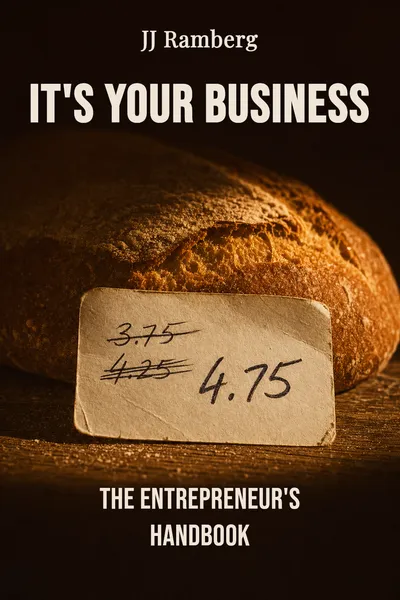
It's Your Business
The entrepreneur's handbook
Description
For six years, JJ Ramberg hosted a show on MSNBC called Your Business — the only program on American cable dedicated entirely to small companies. Every week, she sat across from people who had built something from nothing: a bakery, a software firm, a family manufacturer, a one-person consultancy that had somehow grown into forty. She asked them the same kinds of questions each time. How did you find your first customers? What nearly sank you? What would you do differently? By the time she sat down to write, she had absorbed hundreds of these conversations, and a pattern had started to show through them.
That pattern became It's Your Business, published in 2012 and an immediate Wall Street Journal bestseller. The book is not a memoir and not a theory of entrepreneurship. It reads more like a field guide assembled by someone who has spent years listening to operators talk shop — the person at the table who has heard every version of the story and can tell you which moves tend to work and which ones quietly ruin people. Ramberg organizes it around the decisions a founder actually faces, in roughly the order they arrive.
What made it land with entrepreneurs was less any single trick than the posture behind it. Ramberg does not treat running a small business as a scaled-down version of running a large one. She treats it as its own thing, with its own logic, its own traps, and its own quiet advantages that the corporate playbook tends to miss entirely.
The question we’re asking : What does a founder actually need to know, and where does the standard business advice steer small operators wrong?What we’ll see : How a cable-TV host turned hundreds of founder conversations into a practical guide to money, growth, and the particular craft of running something small.
Table of contents
01Chapter 1 — The show that became a handbook
Ramberg came to small business the long way. Before television she had worked at the search company GoTo.com in its early days, and she had co-founded a website, GoodSearch, that donated a share of its revenue to charities the user chose. She knew what it felt like to make payroll from the inside, which is part of why the show worked. When she interviewed a founder, she was not a journalist parachuting into unfamiliar territory. She had sweated the same numbers.
Your Business ran on MSNBC from 2006 onward, and its format was simple: real owners, real problems, no gloss. A caterer whose biggest client had just walked. A retailer trying to decide whether to open a second location. A pair of siblings who could not agree on who ran what. Over hundreds of segments, the same handful of mistakes kept reappearing, dressed in different industries. People underpriced their work. They hired friends. They confused being busy with being profitable. They grew for the sake of growing.

02Chapter 2 — Money is a system, not a mood
If the book has a spine, it is money — and specifically the gap between profit and cash. Ramberg returns again and again to a truth that catches new founders off guard: a company can be profitable on paper and still die because it runs out of cash. Revenue that arrives sixty days after the work is done does not pay the rent that is due tomorrow. She spends real time on the mechanics of getting paid — invoicing quickly, asking for deposits, chasing receivables without apology — because these dull habits are what keep the lights on.
Pricing gets the same treatment. One of the most common patterns from the show was the founder who priced too low, out of fear or modesty, and then could not understand why more work meant more exhaustion and no more money. Ramberg's counsel is direct: understand your true costs, including your own time, and price to the value you deliver rather than to what you think you can get away with. Underpricing is not humility. It is a slow way of subsidizing your customers with your own solvency.
03Chapter 3 — Growth without losing the thread
Growth is where Ramberg's advice turns against the grain. The default assumption is that bigger is always better, that any business worth having is one trying to become a larger business. She pushes back on this. Growth, in the book, is a choice with real costs, and the right size for a company is whatever lets it serve its customers well and pay its people — including the founder — a decent living. Chasing scale for its own sake is one of the surer ways to break something that was working.
When growth is the right call, she insists it be deliberate. That means hiring ahead of desperation rather than in a panic, since the frantic hire made to plug a hole is usually the wrong one. It means building processes so the business does not live entirely in the founder's head, because a company that cannot run without you is not an asset, it is a job you can never leave. And it means being honest about which parts of the work you should let go of, even when handing them off feels like losing control.
04Chapter 4 — What a small business actually is
Step back from the tactics and the book is making a quiet argument about category. A small business is not a large corporation that has not grown up yet. It is a different animal, and most of the advice aimed at founders goes wrong precisely because it borrows the corporate frame — the obsession with scale, the language of disruption, the assumption that the endgame is always to get bought or go public. Ramberg's whole approach rests on the idea that the small operator plays a different game, with different winning conditions.
Those conditions have their own advantages, which she is careful to name. A small business can know its customers by name, turn on a dime, and change course in an afternoon without a committee. It can stand for something specific rather than everything vaguely. These are not consolation prizes for staying small; they are structural strengths that large companies spend fortunes trying to fake. The founder who understands this stops apologizing for not being bigger and starts using the thing that only smallness allows.
05Conclusion
The book closes where the show began: with the founder at the table, the one trying to figure out the next move. Ramberg's answer, gathered from hundreds of those conversations, is not a formula but a stance. Know your numbers cold. Price like your solvency depends on it, because it does. Grow when growth serves the thing you built, and not otherwise. Treat the small size of your company as a tool rather than a stage to outgrow. The advice is deliberately unspectacular, which is exactly what makes it usable on a Tuesday morning when a client has gone quiet and the payroll is due.
Related books