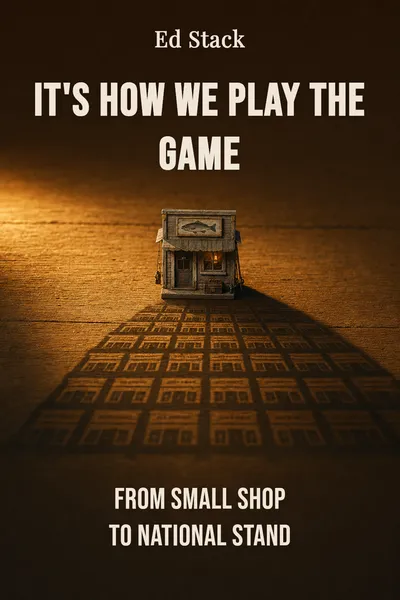
It's How We Play the Game
From small shop to national stand
Description
In February 2018, a nineteen-year-old walked into a high school in Parkland, Florida, with a legally purchased rifle and killed seventeen people. In the days that followed, Ed Stack — chairman and chief executive of Dick's Sporting Goods, a chain his father had started as a single bait-and-tackle shop in Binghamton, New York — pulled the company's records and found that the shooter had bought a shotgun from one of his stores months earlier. Not the murder weapon. But a gun, from him. He decided the company would stop selling assault-style rifles altogether, and destroy the inventory it already had rather than return it to the manufacturers.
That decision cost Dick's, by Stack's own accounting, roughly a quarter of a billion dollars in sales and a good deal of goodwill in the very customer base that had built the business. It also arrived at the end of a story that had almost nothing to do with politics and almost everything to do with a man, his father, and a company they spent sixty years growing from one store into a national chain of more than eight hundred. The memoir Stack wrote about it, It's How We Play the Game, is the account of both — how the shop got big, and what he was willing to risk once it was.
The temptation with a book like this is to read it backward, as if the whole thing were a long runway to one dramatic stand. Stack resists that. He spends most of the pages on the unglamorous middle: the debt, the family fights, the near-bankruptcy, the slow craft of retail. The firearms chapter lands harder precisely because everything before it is about survival and growth, not about conscience.
The question we’re asking : How does a company built for six decades on growth and family loyalty end up spending a fortune to walk away from a product line that made it money?What we’ll see : A single bait shop turning into a national chain, the debt and family strain that nearly ended it along the way, and the moment a retailer decided some sales weren't worth keeping.
Table of contents
01Chapter 1 — The bait shop and the father who built it
Dick Stack opened his store in Binghamton in 1948, at the urging of his grandmother, who handed him three hundred dollars from a cookie tin when the sporting-goods supplier he worked for told him his idea for a fishing-tackle shop was worthless. He named it Dick's. It sold bait, rods, and lures to a working-class upstate town, and over the years it expanded into general sporting goods without ever becoming large. It was a store, not a company, and Dick ran it the way a man runs something he built with his hands — closely, stubbornly, and with a temper.
Ed grew up inside it. He started working the floor as a boy, and the book is unsentimental about what that was like. His father could be generous and he could be cruel, sometimes in the same afternoon, and the store was the stage for both. Ed recounts being fired by his father more than once, being humiliated in front of staff, and also being trusted with responsibility earlier than most sons would be. The relationship is the spine of the memoir, and Stack refuses to tidy it into a simple tribute.

02Chapter 2 — Buying the company, and nearly losing it
Ed bought the business from his father in stages through the 1980s, a transaction loaded with the emotional freight of everything that had come before. It was not a clean handoff. Dick did not fully want to let go, and Ed did not fully want to be told how to run what he had bought. The purchase left the company carrying debt, and Ed's plan for that debt was the opposite of his father's instinct: instead of paying it down and staying small, he intended to borrow more and grow fast.
The strategy was to move Dick's out of Binghamton and into new markets as a bigger-format sporting-goods store, the kind that could compete on selection and price. It worked well enough that Stack kept pressing, opening stores across the Northeast, until the expansion outran the company's ability to pay for it. By the early 1990s Dick's was overextended, undercapitalized, and close enough to failure that Stack describes lying awake doing arithmetic that never came out right. He had bet the company his father spent a lifetime building, and the bet was going wrong.
03Chapter 3 — The scale that changed the arithmetic
By the 2010s Dick's was no longer a regional chain that had gotten lucky. It was a national retailer with hundreds of stores, competing against the big-box players and, increasingly, against Amazon and the slow erosion of physical retail. Stack spends real time on the mechanics of that competition, because the mechanics are the story: how a sporting-goods chain survives when a customer can check a price on a phone in the aisle, how you fight for margin against manufacturers who also sell direct, how you decide which categories are worth keeping.
Guns were one of those categories, and the book is honest about why. Firearms and ammunition drew a particular customer — the hunter, the outdoorsman — who came for the gun and left with boots, a jacket, a cooler, a fishing rod. The gun was often the lower-margin item; the trip it generated was the profit. Stack understood the arithmetic completely, which is part of what makes the later decision cost something. He was not a man who disliked guns or didn't understand their place in his business. He had sold them his whole career.
04Chapter 4 — What a retailer decided it was willing to lose
The comfortable corporate assumption is that doing the right thing and doing the profitable thing eventually converge — that principle is good business if you take the long view. A great deal of modern corporate messaging depends on this being true, because it lets companies claim their values at no real cost. What makes Stack's account bracing is that he does not pretend it was true here. He believed the firearms decision was right, and he believed it would cost the company money, and both beliefs turned out to be correct. There was no long view in which the numbers came out ahead.
That is the harder version of standing on principle, and it is the one Stack actually describes. Dick's pulled assault-style rifles from its shelves, raised the minimum purchase age to twenty-one, stopped selling high-capacity magazines, and — the detail that drew the most attention — destroyed roughly five million dollars of existing rifle inventory rather than send it back into the market. Stack knew he would lose hunting customers, and he did. He knew some manufacturers would retaliate, and some did. He made the decision anyway, and the book is clear that he made it as an owner, not as a manager optimizing an outcome.
05Conclusion
The book ends where the shooting left it — with a company changed, a customer base partly gone, and a chief executive who had traded a chunk of his business for the ability to look at himself. Stack does not claim vindication. Sales in the affected categories fell, some stores felt it for years, and he never argues the market rewarded him for what he did. He argues only that he could live with it, which for a man who spent his childhood trying to earn a difficult father's approval is its own kind of resolution.
Related books