

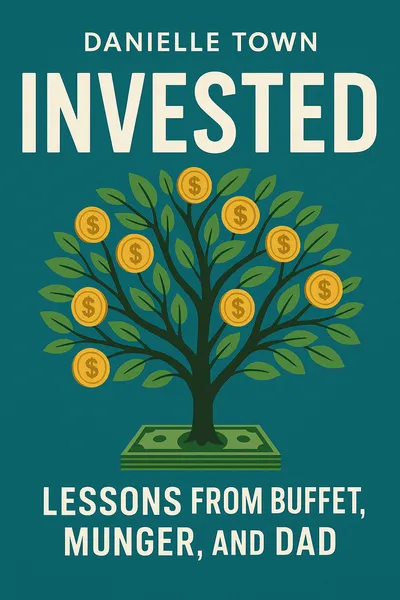
Invested
Lessons from buffett, munger, and dad
Description
To achieve financial freedom, it's crucial to become an educated investor, understanding and supporting the missions of the companies you invest in. This involves learning value investing principles as practiced by renowned investors like Warren Buffett and Charlie Munger. Dedicate a year to grasp these concepts, progressing monthly, and allocate regular time to enhance your investment skills.
As you gain experience, tailor your investment approach to your preferences, creating a lifelong, unassailable skill. Let this journey transform your view of finances from mere utility to a source of joy and liberty, as my own investment practice has brought me profound satisfaction and the freedom to live life on my terms. May your investment endeavors exceed your greatest expectations. - Danielle Town
Table of contents
01Embrace courage
As an aspiring investor, defining your investment goals is crucial. Many aim for financial independence, which varies from person to person. It could mean having enough to afford a dream job, work part-time, support a family, start a nonprofit, move to a safer area, travel, or have a safety net for emergencies. Essentially, it's about living your ideal life. The ultimate goal is financial comfort by retirement, or better yet, enough to pursue passions without financial worries, as Danielle Town suggests.

02Know your metrics
To calculate the savings needed for a comfortable retirement, consider four key factors. Lifestyle expenses are crucial; what you spend now will cost more in the future due to inflation. The power of compound interest cannot be overstated; starting early allows your savings to grow significantly over time. Investing as much as possible into your retirement is essential, as expenses often rise to match income without disciplined spending. The rate of return on investments is also critical; while most people have a fixed rate, learning to invest like Buffett and Munger could increase returns and allow for an earlier retirement.
03Spend consciously
At the start of your investment journey, creating a dedicated space for your "Investing Program" office is essential. If a physical space isn't available, a box containing all your investment-related materials can suffice. This box might include investment books like "Rule #1," "Payback Time," and "The Education of a Value Investor," motivational photos, objects symbolizing your values and goals, and even a scented candle to enhance the atmosphere each time you open it.
Recognizing the vast number of corporations and publicly listed companies available for investment is crucial. Thus, adopting a philosophy or strategy to narrow down your choices is necessary. Danielle Town, for example, chose to invest in companies that align with her values and support individuals like Andrew Carnegie, Steve Jobs, and Oprah Winfrey, who were motivated by excellence and innovation rather than mere greed.
04Initiate research
The Efficient Market Hypothesis posits that stock prices reflect all available information, making them equal to their intrinsic value. However, value investing, as championed by Warren Buffett and others, operates on the principle that markets are not always efficient and that stocks can be undervalued.
To begin with value investing, Buffett suggests focusing on industries within your "Circle of Competence" and finding companies that impress you. Research is key, involving a thorough review of SEC filings like Form 10-Ks and 10-Qs, analyst calls, and reputable business publications. Buffett's annual letters to Berkshire shareholders also offer valuable insights into value investing principles.
05Defenses & leadership
Warren Buffett and Charlie Munger are renowned for their investment philosophy, which emphasizes the importance of investing in businesses that are understandable and have a sustainable competitive advantage, or "moat." They also prioritize competent management. Munger's checklist for evaluating investments includes understanding the business, assessing management quality, and determining if the company has a moat.
There are six types of moats a company might have: a strong brand like Coca-Cola or Harley-Davidson; high customer switching costs; network effects, as seen with Facebook; a toll bridge situation where the company dominates its industry; intellectual property or trade secrets; and being the lowest-cost producer. Before investing, it's crucial to evaluate the strength and durability of a company's moat.
06Define your expertise
Your family's beliefs about finances, wealth, and money can significantly influence your own perceptions. Some may view wealth negatively, while others adopt an abundance mindset. To challenge your biases about wealth, it's important to first understand and acknowledge how your family perceives wealth. Show gratitude for these traditions and the experiences that shaped them.
Then, shift your mindset towards abundance, envisioning yourself as a successful investor and establishing new traditions for moving forward. Believing in wealth as a positive influence can make you a more successful investor, as you'll be more inclined to invest effort in becoming informed.
07Hunt for deals
Charlie Munger's fourth principle for investing emphasizes the importance of buying shares at a price that includes a safety margin and is reasonable. To determine if the price is right, three methods are used. The Ten Cap approach involves assessing whether the investment will yield at least a 10 percent annual return by calculating the owner's earnings and multiplying by ten. A higher cap rate suggests a better return and increases the business's value, requiring a solid grasp of the company's true owner earnings.
The Payback Time method estimates the duration needed to recoup the investment cost. For private companies, a payback period of up to eight years is deemed reasonable, while public companies can extend to sixteen years. This method considers the projected growth of the company's free cash flow and incorporates the Windage Growth Rate to adjust for actual growth rate variations.
08Safety margins
Valuing a company using multiple methods can provide a comprehensive understanding of its worth and help establish a margin of safety in the purchase price. The Ten Cap and Payback Time valuations already incorporate this margin, while the free cash flow valuation can include it through discounted cash flow analysis. To calculate the Ten Cap price, one can use Warren Buffett's Owner Earnings formula, and for the Payback Time, subtract the initial year's free cash flow and the compounded free cash flow of subsequent years from the total purchase price. Free cash flow consists of net cash from operating activities, property purchases, equipment, and other capital expenditures.
For the Margin of Safety price, project the company's Earnings Per Share in ten years by multiplying the current earnings per share by the growth rate ten times. Then, determine the future market value as a multiple of per share earnings and divide by four to get today's market value, which gives the current sticker price of shares. Halving the sticker price yields the Margin of Safety buy price for today. These methods may produce different results as they assess different factors. The Payback Time is considered highly accurate due to its reliance on free cash flow and growth potential. Buying a public company at less than ten times the owner's earnings is often a good deal, independent of future growth. The Margin of Safety calculation is a conservative valuation approach.
09Narrative importance
When considering an investment in a company, it's essential to construct a compelling narrative that outlines why the company is a good investment opportunity. This narrative should be based on thorough research and analysis, focusing on aspects such as the market context, trends, and the company's unique insights or advantages. However, to avoid falling prey to confirmation bias, it's equally important to challenge this narrative by inverting it and attempting to prove the opposite. This inversion process, inspired by Charlie Munger's approach to problem-solving, involves critically examining the reasons for investment and seeking evidence that could contradict them. If the reasons withstand this scrutiny, the investment becomes more compelling.
10Building portfolios
The concept of an "antifragile portfolio" is designed to thrive during market downturns by focusing on companies with strong competitive advantages, or "moats." These companies can leverage their position during economic fluctuations, such as inflation or deflation, to maintain or even enhance their market standing.
For instance, they might raise prices to navigate inflation or maintain customer loyalty during deflation without reducing prices. Additionally, companies with significant moats and high profit margins can use economic turmoil to their advantage by acquiring weaker competitors or employing aggressive market strategies, thereby emerging from recessions stronger, with increased market share and cash flow, positively impacting their stock prices.
11Selling strategies
Warren Buffett's investment philosophy emphasizes holding onto high-quality companies indefinitely, unless fundamental aspects of the business change. This change could be due to a loss of competitive advantage, disruptive innovations, a shift in management that reduces confidence, or a significant corporate event like a merger or acquisition.
Buffett's approach is rooted in the belief that as long as the core reasons for investing in a company remain intact, there is no need to sell. However, he also acknowledges the importance of being adaptable to technological advancements and market dynamics, which can alter a company's competitive landscape. For instance, Buffett famously considered whether technological changes would impact the demand for traditional products like chewing gum, illustrating that not all businesses are equally affected by technological shifts. To manage market volatility and reduce investment risk,
12Reflect and celebrate
The investment landscape is vast and complex, but with time and dedication, you can become proficient in identifying and researching potential investment opportunities. Warren Buffett, one of the wealthiest self-made individuals, started with only $100 and has donated more to charity than anyone else.
Despite his financial success, Buffett values teaching others about proper investing and becoming better individuals as his most important legacy. Phil Town regards Buffett and Charlie Munger as revolutionary teachers whose strategies, such as Rule #1 investing, can lead to wealth if followed diligently. This approach has allowed many to build generational wealth, and for that, there is a deep sense of gratitude towards these investment giants.