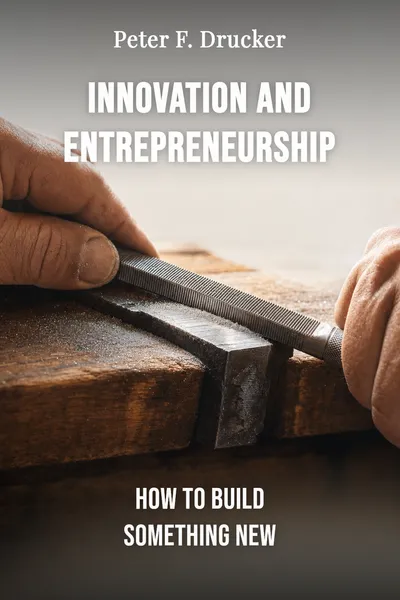
Innovation and Entrepreneurship
How to build something new
Description
In 1985, Peter Drucker — by then the most widely read management thinker in the world, at seventy-five, with decades of consulting behind him — published a book that set out to do something no one had quite done before. He wanted to treat innovation and entrepreneurship not as a mystery, not as a gift some people are born with, but as a practice. A discipline. Something with rules, sources, and methods that could be studied and, more to the point, learned. He had watched the American economy shift under his feet: while the Fortune 500 shed jobs through the 1970s and early 1980s, the country somehow kept generating millions of new ones. The engine, he argued, was entrepreneurship — and almost nobody understood how it actually worked.
The prevailing story at the time was romantic. The entrepreneur was a lone visionary, a gambler with a spark of inspiration, someone who saw what others couldn't and bet the house on it. Drucker found this both flattering and useless. Flattering because it turned business into destiny; useless because you can't teach destiny. If innovation depended on genius striking like lightning, then a company, a hospital, or a government agency could only wait and hope. Drucker refused that. Successful innovators, he insisted, were rarely the wild risk-takers of legend. They were people who went looking, in specific places, for specific kinds of change — and then did the patient work of turning what they found into something useful.
That reframing is the whole book. It reads less like a manifesto than like a field manual written by someone who had spent a lifetime watching organizations succeed and fail up close. And it arrived at a moment when the question felt urgent: where do new industries actually come from, and can the people who build them do it on purpose?
The question we’re asking : Is building something new a matter of talent and luck, or a discipline with sources and rules that can be practiced deliberately?What we’ll see : How Drucker stripped the romance out of innovation and rebuilt it as ordinary, teachable work — and what that reframing asks of the institutions around it.
Table of contents
01 Chapter 1 — Innovation is work, not a flash of genius
Drucker opens by clearing away the mythology. Entrepreneurship, he says, is not a personality type. It is a behavior. The corner deli that opens a fourth identical location is a business owner, not an entrepreneur; McDonald's, which took the hamburger stand and rebuilt it around standardized quality and systematic training, was entrepreneurial to the core. What separates them isn't temperament or appetite for risk. It's whether they create a new market or a new source of value out of existing resources. On this definition, a giant like General Electric can be entrepreneurial and a small startup can be utterly conventional.
He borrows a word from the French economist Jean-Baptiste Say, who around 1800 described the entrepreneur as someone who shifts resources from an area of lower yield to one of higher yield. Innovation is simply the tool that makes the shift possible. And a tool, crucially, can be handled well or badly, learned or ignored. Drucker's most quietly radical move is to insist that innovation is a discipline in the same way that medicine or engineering is a discipline — with a body of knowledge, a set of methods, and a track record of practitioners who reliably outperform the amateurs.

02 Chapter 2 — The seven places to look for opportunity
If innovation is purposeful, then it must have somewhere to start. Drucker's answer is his most practical contribution: seven sources of opportunity that a person can actually go and examine. The first four sit inside a business or industry and are visible to anyone paying attention. The unexpected comes first — the surprise success or the surprise failure that nobody planned for. He tells of Macy's treating booming appliance sales as an embarrassment rather than an opening, while a competitor built a fortune on the same signal. The unexpected is the richest source precisely because pride and habit make firms look away from it.
The second source is incongruity: a gap between what is and what everyone assumes ought to be. Ocean freight was long thought to be expensive because of the cost of the voyage; the real cost, it turned out, was the ship sitting idle in port. The container ship attacked that incongruity and transformed global trade. Third comes process need — the missing link in a task everyone already performs, like the reflective road marking that made night driving safer. Fourth are changes in industry and market structure, the moments when an established order cracks and nimble newcomers pour through.
03 Chapter 3 — Rules for a discipline that can be learned
Having named where to look, Drucker turns to how to act — and here the field-manual tone is strongest. Purposeful innovation begins with analysis, not inspiration. It means going out and looking at the sources, asking what a genuine opportunity would have to satisfy. But it also means going out and looking with your own eyes and ears, because innovation is conceptual and perceptual at once. The successful innovator studies the numbers and then watches how people actually behave, listens to what they say, notices what they reach for. The idea and the human reality have to be checked against each other.
The advice that follows is almost anti-heroic. Effective innovation is small. It aims to do one specific thing, and it stays simple enough that when something goes wrong — and something always goes wrong — the fault can be found and fixed. Grand schemes that try to revolutionize everything at once are, in Drucker's experience, the ones that fail. The most successful new products often begin looking modest, even trivial: not the industry that will change civilization, but a better zipper, a cheaper razor, a service that fills a gap nobody else bothered with. Ambition belongs in the outcome, not in the opening move.
04 Chapter 4 — What entrepreneurship asks of a society
Step back from the checklists and Drucker's larger claim comes into view: if innovation is a discipline rather than a gift, then a society's capacity to renew itself is a choice, not a matter of luck. He was writing during what he called the emergence of an entrepreneurial economy in the United States — a period when new and mid-sized firms, not the industrial giants, were generating the bulk of new jobs. That, to him, was not an accident of American character. It was the visible result of entrepreneurship being practiced widely, and it could be cultivated anywhere the practice took hold, or squandered anywhere it didn't.
This is why he refused to confine the argument to business. Hospitals, universities, government agencies, and charities need innovation as badly as any company, and often find it harder, because their budgets reward doing more of what they already do rather than doing something new. Drucker treats the public-service institution as a genuine and difficult case, not an afterthought. A society that innovates only in its garages and startups, while its schools and its bureaucracies calcify, has only solved half the problem — and probably the easier half.
05 Conclusion
The book ends where it began: with the insistence that the mystery was never really there. What looked from a distance like inspiration turns out, up close, to be a set of habits — knowing where to look, checking the idea against the world, starting small, and staying at it long after the excitement fades. Drucker had spent a career watching organizations, and what he distilled was less a theory than a craftsman's account of how the new actually gets made. The entrepreneur of legend, waiting for lightning, barely appears in his pages; the entrepreneur who shows up is patient, observant, and often a little bored by their own methods.
Related books