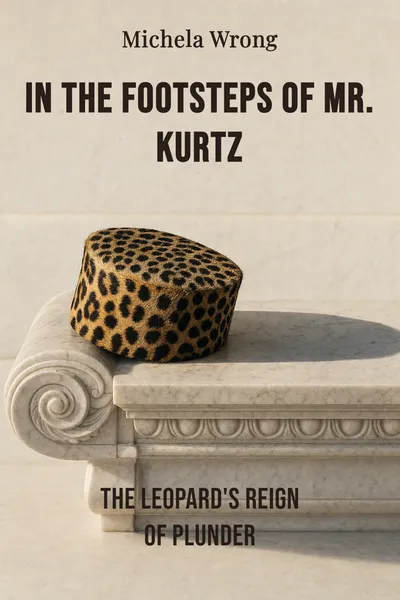
In the Footsteps of Mr. Kurtz
The Leopard's Reign of Plunder
Description
In May 1997, as rebel columns closed in on Kinshasa, the airport at Gbadolite was jammed with crates. Mobutu Sese Seko, president of a country he had renamed Zaire, was leaving the jungle palace he had built in his native village — a marble complex with a runway long enough for the Concorde he chartered for shopping trips to Paris. The pink champagne he favored was still on ice. Within days he was gone, dying in exile in Morocco that September, and the state he had ruled for thirty-two years collapsed so completely that it seemed never to have existed as anything but a projection of one man.
Michela Wrong, who reported from Zaire in its final years for Reuters and the Financial Times, went looking for what remained. Her title borrows from Joseph Conrad: Mr. Kurtz, the ivory agent of Heart of Darkness who set himself up as a god deep in the Congo and lost his mind there. The parallel is not decoration. Mobutu built a personal cult, drained the country's copper and diamonds into foreign accounts, and presided over a jungle court while his people slid into poverty — a modern Kurtz, ruling from the same river.
What Wrong reconstructs is less a biography than an autopsy of a system. A man does not loot a nation the size of Western Europe alone; he needs bankers, diplomats, mining executives, and Cold War patrons who found him useful. The Leopard was cunning, charming, and brutal by turns. He was also, for decades, exactly the kind of ally the West wanted.
The question we’re asking : How did one man turn an entire country into his private estate, and who let him do it for thirty-two years?What we’ll see : How the Leopard seized power, made himself indispensable, and hollowed out a nation from a palace in the jungle.
Table of contents
01 Chapter 1 — The man who made himself a country
Joseph-Désiré Mobutu came from nothing that would have predicted a throne. Born in 1930 in Lisala, expelled from his mission school, he did seven years in the colonial army and then turned to journalism in Léopoldville. When the Belgian Congo lurched toward independence in 1960, he was a young aide close to Patrice Lumumba, the fiery nationalist who became the country's first prime minister. The independence was a shambles — the Belgians left almost overnight, the army mutinied, the mineral-rich province of Katanga seceded, and the new state began tearing itself apart within weeks.
Mobutu, then a colonel, staged his first coup in September 1960, months into independence. Lumumba was arrested and, in January 1961, handed to his Katangan enemies and executed, with the complicity of Belgian officers and the quiet approval of Washington, which saw the charismatic Lumumba as a Soviet risk. Mobutu bided his time. In November 1965 he seized power outright and did not relinquish it for the rest of his life. He was thirty-five.

02 Chapter 2 — The art of being needed
Mobutu's genius was never administration. It was reading what powerful people wanted and making himself the answer. During the Cold War, Zaire sat in the middle of Africa, sharing a border with Angola, where a Marxist government backed by Cuban troops fought a long civil war. That geography turned Mobutu into a frontline anticommunist, and the reward was decades of American, French, and Belgian backing that survived every report of atrocity and embezzlement.
The support was not abstract. The CIA ran operations through Kinshasa; American presidents received him at the White House; the Belgians and French sent paratroopers to save him when rebellions in Katanga — renamed Shaba — threatened the mining heartland in 1977 and 1978. Western creditors kept lending even as it became clear the money vanished. The International Monetary Fund installed a German banker, Erwin Blumenthal, at the central bank in the late 1970s; he left after a year, warning that there was no prospect of the loans ever being repaid because the president simply took what he wanted. The lending continued anyway.
03 Chapter 3 — The palace and the emptiness around it
The clearest picture of what Mobutu built is Gbadolite. In the far north, in the village where he was raised, he raised a court out of the forest: three palaces, air conditioning, marble, a nuclear-proof bunker, and that famous runway. He flew in hairdressers and cases of wine, entertained visiting dignitaries, and dispensed patronage to the surrounding region so lavishly that locals never turned against him. It became known, without irony, as the Versailles of the jungle.
The wealth financing it was real and enormous. Zaire held some of the world's richest deposits of copper, cobalt, industrial diamonds, and gold. Gécamines, the state mining company in Katanga, was for years the engine of the whole economy. But the revenue did not build roads, schools, or hospitals. It flowed outward — into Swiss accounts, Belgian townhouses, French châteaux, a fleet of properties across Europe. Estimates of Mobutu's personal fortune ran into the billions of dollars, figures inflated in the telling but grounded in a plain fact: at moments he was reportedly worth roughly as much as his country's entire external debt.
04 Chapter 4 — What a stolen state leaves behind
The word Wrong keeps circling is kleptocracy — rule by theft. It is worth taking seriously as a category rather than an insult. In an ordinary corrupt state, officials steal despite the system; the graft is a leak in machinery meant to do something else. Mobutu's Zaire was the reverse. The theft was not a malfunction of the state. It was the state's entire purpose, and every institution — the mining company, the central bank, the army, the party — existed to move wealth upward toward one man and his circle. A functioning bureaucracy would have been a threat, because a functioning bureaucracy generates accountability. Dysfunction was not failure. It was design.
That reframing carries an uncomfortable corollary, and this is the heart of Wrong's argument: a kleptocracy on this scale cannot exist in isolation. The stolen copper had to be sold to someone; the diamonds needed dealers; the billions needed banks willing to hold them and no questions asked. The loans that were never repaid came from Western institutions that knew, from Blumenthal's own report onward, exactly where the money went. Mobutu was not an African aberration standing apart from a respectable world order. He was plugged into it, useful to it, and sustained by it for as long as the Cold War made his anticommunism worth the price.
05 Conclusion
The crates at Gbadolite in 1997 were the last scene of a story that had always been about one man mistaking himself for a nation. When Mobutu boarded his plane, there was almost nothing behind him to keep functioning — no institutions he had not corroded, no economy he had not looted, no successor he had not neutralized. He had spent thirty-two years ensuring that Zaire could not survive without him, and in that narrow, ruinous sense he succeeded. The country that had borne his name did not outlast his flight by long, dissolving into the wars that still shape Central Africa.
Related books