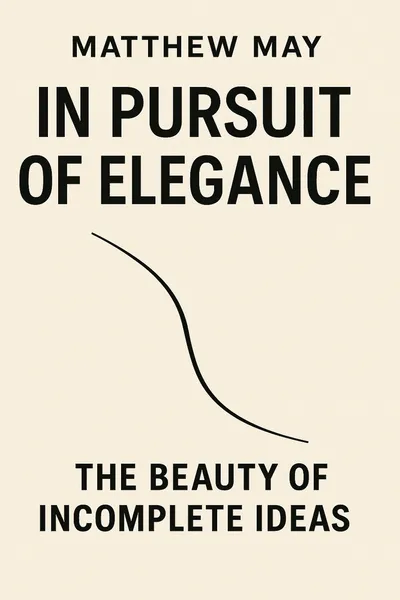
In pursuit of elegance
The beauty of incomplete ideas
Description
Elegance is rare and noteworthy when found in events, products or services. Elegance cuts through noise to deliver a profound experience that changes minds and markets. What isn't there is as important as what is with elegance. Elegance has four key elements: symmetry, seduction, subtraction and sustainability.
The blend of logic and creativity in balancing these elements enables elegance. The full power of elegance comes from maximizing impact with minimum input. Absence can be as or more powerful than presence with elegance.
Table of contents
01 Overview - the significance and worth of refinement
Elegance is a concept that resonates deeply across various aspects of life and business, embodying the principle of achieving maximum impact with minimal input. It is the art of doing more with less, where simplicity and power converge to create something truly remarkable. Elegance is not commonplace; it is a rare and highly sought-after quality that can make a significant difference when applied thoughtfully.
Consider the visual impact of a diagram with perpendicular lines that suggest the presence of a letter without actually drawing it. The letter exists in the negative space, and its absence is more compelling than if it were explicitly shown. This invisible letter seems to come to life once it is perceived, illustrating how elegance often stems from what is not there rather than what is. This principle of subtraction over addition is not new; it echoes the ancient wisdom of Lao Tzu, who recognized the value of emptiness when he said, "It is the empty space that makes a wheel useful."
Jim Collins, a renowned business author, understood the power of subtraction when he inherited money and faced limited time. He chose to focus on what he could eliminate from his life, which led him to resign from his job, fiercely protect his time, and delve into researching what distinguishes great companies from good ones. This approach of embracing less to achieve more culminated in his writing of the business classic "Good to Great." Similarly, Lexus exemplifies elegance in its pursuit of perfection, adhering to the Toyota Production System's philosophy of continuous improvement and waste reduction. The brand's commitment to eliminating imperfections is a testament to the idea that elegance is often about what is removed, not added.

02 Element #1 - proportion
Symmetry, a concept deeply rooted in the balance of proportions, manifests itself not only in the natural world through the mirrored forms of bilateral symmetry seen in animals but also transcends into various domains including science, business, and societal structures. This principle of symmetry, far beyond its physical representation, plays a pivotal role in crafting elegant solutions across these fields, offering a framework that champions individual judgment and freedom. This, in turn, catalyzes increased engagement and heightened awareness among individuals and communities alike.
Taking the example of driving, the quality of a vehicle's brakes significantly influences driving behavior. With high-performance brakes, drivers are inclined to drive at higher speeds and apply brakes later, confident in their vehicle's ability to stop promptly. Conversely, with inferior braking systems, drivers adopt a more cautious approach, driving slower and braking earlier. This analogy extends to a hypothetical scenario where if all vehicles were equipped with substandard brakes, roads might witness enhanced safety due to universally cautious driving behaviors. This principle of symmetry, thus, finds relevance in organizational and societal systems, advocating for balanced approaches that encourage self-regulation and responsibility.
03 Element #2 - allure
Inherent to human nature is a deep-seated curiosity, a relentless pursuit of patterns and meanings that often becomes more intense when faced with the unexpected. This was precisely the case when Steve Jobs, the visionary behind Apple, unveiled the iPhone in 2007, a device that notably omitted a physical keypad. Critics were quick to voice their skepticism, pointing out not just the missing keyboard but also the device's exclusive partnership with AT&T and potential limitations due to network speeds. Despite these criticisms, Apple maintained a stance of unwavering confidence, choosing not to engage in a traditional advertising frenzy. Instead, Jobs emphasized the innovative on-screen keyboard as a pivotal feature, promising a versatile and streamlined user experience.
The iPhone's steep price tag did not deter interest; it managed to captivate over 20 million Americans, achieving a level of widespread awareness that most conventional advertising campaigns could only dream of. Apple's marketing approach cleverly played on the human tendency to be intrigued by the unknown, providing just enough information to pique curiosity without giving everything away. This strategy, reminiscent of the age-old tactic of playing hard to get, effectively created a sense of suspense and engagement, similar to the gripping allure of a thriller or mystery novel that leaves readers hanging on the edge of their seats.
04 Element #3 - reduction
The concept of elegance in solutions and ideas is often rooted in the art of simplicity and focus. This approach involves stripping away the non-essential elements to reveal the core value of a concept or product. It's a principle that may seem counterintuitive in a world that often equates more with better, but it's about understanding the importance of what to remove rather than what to add. This idea has been embraced by artists and writers throughout history. Michelangelo, for instance, described his process of sculpting David as one of removing everything that was not David. Writers like Antoine de Saint-Exupéry and Italo Calvino also sought perfection and potency in their work by focusing on subtraction, aiming to achieve the most impact with the fewest words.
In the realm of business, this philosophy is exemplified by In-N-Out Burger, which has captivated customers with its limited menu. The simplicity of the menu creates intrigue and allows for a level of customization through a "secret menu," which customers have come to love. This approach helps the company avoid the pitfalls of feature creep while maintaining its unique appeal. In the world of sports, cyclist Lance Armstrong, under the guidance of coach Chris Carmichael, adopted a "less is more" training regimen. By concentrating on his strengths and allowing for ample recovery time, Armstrong achieved multiple victories in the Tour de France.
05 Element #4 - maintainability
Sophisticated ideas are characterized by their remarkable simplicity and potent impact, as well as their ability to be sustained over time, not just for short-term promotional efforts. These ideas avoid the necessity for continuous compromises because they are designed to deliver the greatest impact with the least amount of effort. True elegance is defined by its lasting nature and timelessness, as opposed to good intentions that cannot be sustained. The most challenging aspect of elegance is its sustainability. To be considered truly sustainable, a concept must fulfill two criteria: it must be resourceful in the face of increasing demands and diminishing time, and it must avoid creating additional problems. Matthew May notes that achieving this kind of elegance is often difficult, which is why many solutions with good intentions end up with negative side effects or unintended consequences.
Elegance is not about complexity; even simple solutions can be highly effective. For instance, during the peak of VCR popularity, a video rental store faced the issue of customers not rewinding tapes. Various complex solutions were proposed, but the store found an elegant solution by renting out tapes that were not rewound, requiring everyone to rewind before watching. This approach was cost-effective, fair, and sustainable, and it avoided the need for strict enforcement, leading to increased customer satisfaction.
Related books