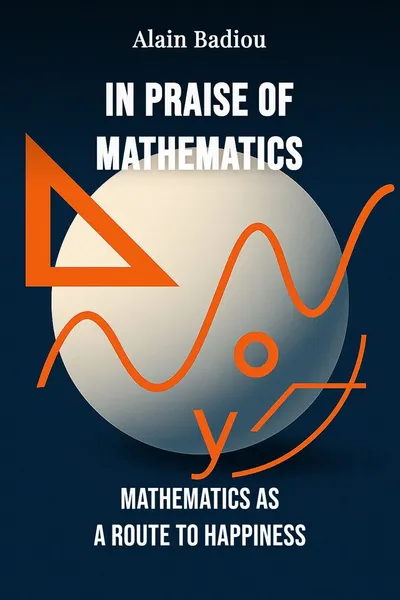
In Praise of Mathematics
Mathematics as a route to happiness
Description
In 2015, the philosopher Alain Badiou sat down with the journalist Gilles Haéri for a book-length conversation with an odd premise: to defend mathematics. Not to teach it, not to popularize it, but to argue that the discipline most people remember as a source of classroom dread is in fact a route to something like happiness. The result, published in French as Éloge des mathématiques and in English as In Praise of Mathematics, is short, spoken, and deliberately provocative. Badiou was in his late seventies, one of the most combative living thinkers, and he chose to spend a slim book insisting that we have all been sold a lie about what numbers are for.
The lie, as he tells it, has two faces. The first is that mathematics is cold — a machinery of proofs and grades, useful for engineers and torturous for everyone else. The second is newer and more insidious: that mathematics matters only because it powers the economy, the algorithms, the finance that runs our lives. Badiou wants to reject both. For him mathematics is neither an ordeal nor a tool. It is one of the oldest and most beautiful adventures of human thought, bound up with philosophy since the Greeks, and severed from it only recently and to everyone's loss.
That is a large claim to hang on a subject most of us fled the moment school let us. But Badiou is not really talking about homework. He is talking about what it means to think clearly, to reach a truth that holds regardless of opinion, and to feel the particular pleasure that comes when something finally clicks into place. The wager of the book is that this pleasure is not reserved for specialists.
The question we’re asking : Can a subject most of us learned to dread actually be defended as a source of happiness?What we’ll see : How Badiou rebuilds the ancient bond between mathematics and philosophy, and where beauty enters the argument.
Table of contents
01Chapter 1 — A conversation to rescue a hated subject
Badiou builds the book as a dialogue, and he does it on purpose. Rather than lecture from a podium, he lets Haéri push back, ask the naive question, voice the reader's skepticism. The form matters because the content is a rescue operation, and a rescue is easier to trust when you can hear the doubts being answered out loud. The subject to be rescued is mathematics itself, and the first thing Badiou has to clear away is the memory almost everyone carries: the exam, the red ink, the sense of being sorted into those who get it and those who don't.
He is blunt about how mathematics is presented. Taught as a series of techniques to be mastered under pressure, it becomes a filter, a machine for ranking children, stripped of any sense of why it exists or what it once meant. Nobody, Badiou notes, teaches the great mathematical ideas the way we teach the great poems or the great paintings — as achievements of the human spirit worth loving. We teach the procedures and hide the adventure. Small wonder people come out hating it.

02Chapter 2 — Why philosophy cannot do without mathematics
The heart of Badiou's case is that philosophy and mathematics were never meant to live apart. From Plato through Descartes, Leibniz, Spinoza and on to the twentieth century, the great philosophers were also, in one way or another, mathematicians — or at least thinkers who took mathematics as the model of what a secure truth looks like. Badiou reads this not as coincidence but as necessity. Philosophy asks what is real, what is true, what can be known; mathematics is the one human practice that reaches conclusions no opinion can shake.
This is where his own philosophy shows through. For Badiou, mathematics is not merely about number and shape — it is, at bottom, the science of being itself, of what it means for anything to exist at all. That is a startling proposition, and the book states it without much softening: when we do mathematics, we are not manipulating symbols invented for convenience, we are touching the structure of what there is. Set theory, the study of collections and infinities, becomes for him something close to ontology, the study of being.
03Chapter 3 — The four truths, and why beauty belongs among them
Badiou situates mathematics inside a larger scheme that runs through his whole body of work: the claim that human beings are capable of truths in four domains, and only four. There is science, of which mathematics is the purest form. There is art. There is politics, understood as the pursuit of genuine equality. And there is love, the truth built by two people out of their difference. These are what he calls the conditions of philosophy — the places where truths are actually produced, which philosophy then thinks about but does not itself generate.
The scheme does something clever for his argument. It refuses to isolate mathematics as a cold outlier among warmer human concerns. Mathematics sits alongside love and art as one of the great arenas where a person can be seized by something larger, can commit to a truth and be changed by it. In each domain, Badiou holds, a truth begins as an event — a break, a discovery — and demands fidelity from whoever encounters it. The mathematician faithful to an unsolved problem is, in this picture, not so different from a lover faithful to a love or a militant faithful to a cause.
04Chapter 4 — What a formula and a fugue have in common
Step back from the specific claims and the larger wager comes into view. Badiou is not, finally, arguing about curricula or ontology for their own sake. He is arguing about happiness, and about who gets to have the demanding kind. His whole book pushes against a quiet resignation of our age — the sense that thinking hard is a chore, that the good life is made of comfort and consumption, and that the joys of the intellect are a specialist's affair, cordoned off behind expertise.
The insistence that mathematical beauty is genuine beauty is his way of refusing that resignation. If the satisfaction of a clean proof belongs to the same family as the satisfaction of a fugue by Bach or a well-made poem, then it is not a technician's private reward. It is available, in principle, to anyone willing to follow the thought to its end. The barrier is not native talent, Badiou implies, but a culture that never bothered to show us the beauty in the first place, offering only the drills.
05Conclusion
The book began with a memory almost everyone shares — the dread of the mathematics class — and ends by turning that memory inside out. What we learned to fear was never mathematics itself, Badiou argues, but a mutilated version of it: procedures without purpose, ranking without beauty, an instrument handed over to the machinery of the economy and cut loose from the question of truth. Reunite it with philosophy, put it back beside art and love and politics as one of the ways human beings reach the true, and the dread has nowhere left to stand.
Related books