
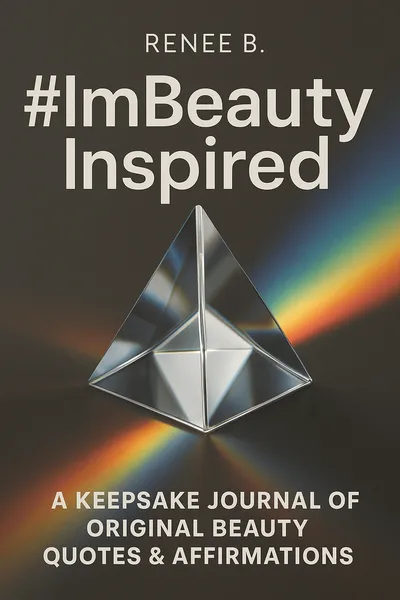
#ImBeautyInspired
A Keepsake Journal of Original Beauty Quotes & Affirmations
Description
Renee B. contributes to the contemporary wellness literature through a practical approach to beauty consciousness, situating her work within the broader cultural movement toward self-empowerment through aesthetic appreciation. This keepsake journal represents an intervention in the beauty discourse, proposing affirmational practice as a vehicle for personal transformation. The work emerges within a cultural context where beauty standards undergo constant negotiation and where individual agency in aesthetic self-definition gains increasing prominence.
The central research question examines how structured affirmational practice can transform individual relationships with beauty and self-perception. The defended thesis positions beauty consciousness, cultivated through daily affirmational engagement, as a pathway to enhanced self-worth and authentic self-expression. The main stake involves democratizing beauty empowerment through accessible, personalized affirmational practice.
Renee B.'s contribution to beauty empowerment literature lies in her systematic approach to consciousness transformation through structured affirmational practice. The work successfully bridges therapeutic psychology and aesthetic philosophy, offering practical methodology for beauty relationship development. Her emphasis on original content and daily practice distinguishes the work from passive consumption models, promoting active engagement with beauty consciousness. The journal format proves particularly effective for the author's pedagogical objectives, creating sustainable framework for long-term practice rather than momentary inspiration. The work's coherence emerges through consistent emphasis on agency, authenticity, and accessibility in beauty engagement, positioning these values as foundational to transformative practice.
Table of contents
01 Affirmational Architecture and Consciousness Formation
The work establishes affirmational practice as a structured methodology for consciousness transformation, drawing implicitly from cognitive-behavioral frameworks and positive psychology paradigms. Renee B. constructs beauty not as external validation but as internal recognition, positioning affirmations as architectural elements in selfhood construction. The theoretical foundation suggests that repeated engagement with positive beauty statements creates neural pathways supporting enhanced self-perception.

02 Democratization of Beauty Discourse
The work's social implications extend beyond individual transformation toward broader democratization of beauty discourse. By providing original quotes and affirmations, Renee B. challenges monopolistic beauty narratives typically controlled by commercial interests. This democratizing gesture positions every individual as both consumer and creator of beauty meaning, disrupting traditional authority structures in aesthetic judgment.
03 Temporal Restructuring and Daily Practice
The keepsake journal format introduces temporal restructuring into beauty consciousness, transforming sporadic aesthetic appreciation into sustained daily practice. This temporal dimension reflects contemporary acceleration culture's need for structured mindfulness interventions. Renee B. recognizes that beauty consciousness requires cultivation rather than spontaneous emergence, positioning her work within mindfulness and meditation traditions.
04 Identity Formation and Aesthetic Authenticity
The ethical implications of the work center on authentic self-expression versus social conformity in beauty practice. Renee B.'s emphasis on original quotes suggests resistance to mass-produced beauty messaging, promoting individualized aesthetic philosophy development. This approach raises questions about authentic selfhood in an increasingly mediated beauty culture, where personal expression often mirrors social media aesthetics.
05 Critical Assessment and Future Directions
The work's limitations include insufficient engagement with structural beauty inequalities and potential reinforcement of individualistic solutions to systemic problems. The emphasis on personal transformation through affirmational practice may inadvertently blame individuals for beauty-related suffering while minimizing social and economic factors affecting aesthetic access. Additionally, the work lacks theoretical sophistication in addressing beauty's cultural construction and power dynamics.
Related books