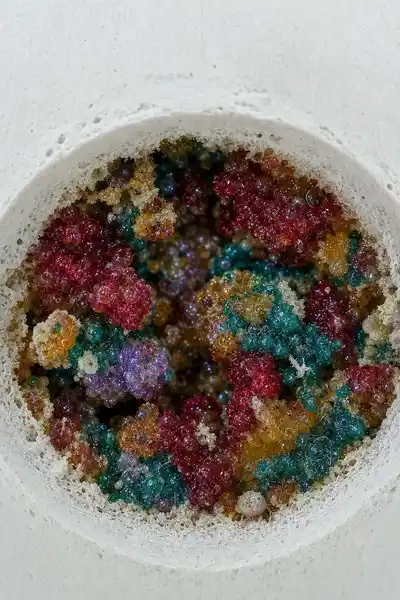
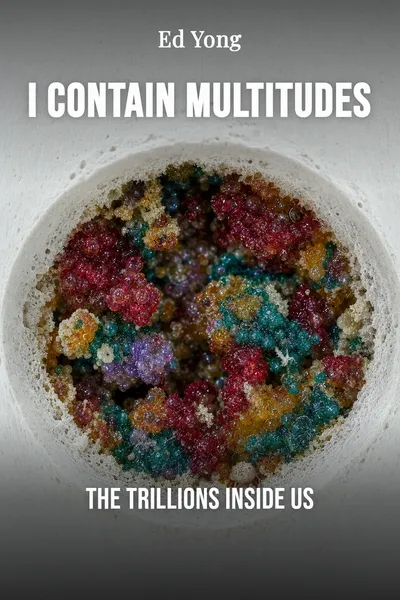
I Contain Multitudes
The trillions inside us
Description
There is a bacterium called Wolbachia that lives inside the cells of insects, and it is very good at getting itself passed on. It can turn males into females, kill male embryos, and let females reproduce without mates — all so that more of its host's daughters, and therefore more copies of itself, make it into the next generation. Ed Yong opens I Contain Multitudes with creatures like this not because they are freaks, but because they are ordinary. Every animal Yong looks at, from the deep-sea tubeworm to the person reading his book, turns out to be less a single thing than a crowd. The title he borrowed from Walt Whitman is not a metaphor. It is a description.
Yong, a science journalist, wrote the book in 2016 as a tour of a field that had quietly exploded. For most of the history of microbiology, bacteria were the enemy — things to be cultured, identified, and killed. Then cheaper genetic sequencing let scientists read the microbes living in a gut or on a leaf without having to grow them first, and the census that came back was staggering. Trillions of them, thousands of species, doing work we had credited entirely to ourselves. The immune system, digestion, the development of organs, even mood: none of it, it turned out, runs on human cells alone.
What Yong does with this is refuse the easy versions of the story. The microbiome is not a wellness product, and microbes are neither our friends nor our foes. They are partners in a negotiation that never ends, and the terms are constantly renegotiated inside every body on the planet. Reading him, the tidy picture of a human being as a self-contained individual starts to come apart in an interesting way.
The question we’re asking : If we are each home to trillions of microbes doing work we thought was ours, what exactly is the thing we call a body?What we’ll see : How the census of our inner life was taken, what those partnerships actually do, what happens when they go wrong, and how all of it reshapes the idea of the individual.
Table of contents
01 Chapter 1 — The self that was never one
The number gets quoted so often it has lost its shock, so it is worth slowing down. A human body carries roughly as many bacterial cells as human ones — the old claim of ten-to-one has since been revised downward, but even the conservative estimate leaves us roughly half microbe by count. These organisms cluster in the gut, coat the skin, line the mouth, and settle into every surface that meets the outside world. Yong's point is not the tally itself. It is that we never noticed, because we could not see them, and because the tools we built to study bacteria were built to hunt pathogens.
That blind spot has a history. When Antonie van Leeuwenhoek first turned his handmade lenses on the scrapings from his own teeth in the 1670s, he saw "animalcules" swimming in what he called his mouth, and he was delighted rather than alarmed. But the germ theory that followed two centuries later, through Pasteur and Koch, cast microbes as invaders. A good bacterium was a dead one. That framing was medically useful and, Yong argues, badly incomplete. It trained generations to see the microbial world as a threat to be sterilized rather than a system to be understood.

02 Chapter 2 — The microbe that learned to make peace
The most surprising thread in the book is how much of our own biology microbes quietly run. Yong walks through the gut first, where bacteria break down fibers our own enzymes cannot touch, releasing compounds that feed the cells lining the intestine and tune the immune system. Animals raised germ-free in sterile labs — mice with no microbes at all — turn out strange: their guts are malformed, their immune systems underdeveloped, their behavior altered. The microbes are not passengers. They are part of how the body assembles itself.
Yong's favorite example of a well-managed partnership is the bobtail squid and a glowing bacterium called Vibrio fischeri. The squid houses the bacteria in a special organ; the bacteria produce light that hides the squid's silhouette from predators below. Each night the squid vents most of them out and lets the survivors regrow by day. It is a relationship with rules, maintained by both sides, and it shows how precisely a host and its microbes can be built to fit together — the squid even has genes that only make sense in the presence of its lodgers.
03 Chapter 3 — When the partnership breaks
If microbes help build and run us, then disturbing them should cause trouble, and Yong spends a substantial part of the book on the growing evidence that it does. Some of the strongest cases come from the gut. Transfer the microbes from an obese mouse into a germ-free one, and the recipient tends to gain more weight than it would with microbes from a lean donor — a striking hint that the community itself, not just diet or genes, shapes how a body stores energy. The finding is early and contested, but it broke open a line of thinking.
The pattern extends into places we would not have guessed. Yong reviews work linking depleted or lopsided microbial communities to allergies, to inflammatory bowel disease, to immune disorders — the idea being that immune systems which never learned the ordinary give-and-take of a diverse microbial world overreact to harmless things. He treats the so-called hygiene hypothesis carefully, noting it is often crudely stated: the problem is less about dirt than about the loss of the right microbial exposures at the right moments, especially in early life.
04 Chapter 4 — A different way of drawing the line around a body
Step back from the squid and the mice and the gut, and the real work of I Contain Multitudes is conceptual. It goes after the idea of the individual — the notion that a body is a single, self-contained organism with a hard edge between inside and outside. Once you take the microbes seriously, that edge blurs. The gut, technically, is a tube open to the world at both ends, lined with life that is neither fully us nor fully foreign. Where does the organism stop and the environment begin? Yong's answer is that the question may be badly posed.
Biologists have a term he leans on: the holobiont, the host and all its microbes considered as one ecological unit. It is not a mystical idea. It is a practical reframing that says a plant, an insect, a person is better understood as a community than as a soloist. Evolution, in this view, does not only act on the animal's own genes; it acts on the partnership, on how well host and microbe manage to cooperate. Some of the innovations that let animals digest new foods or occupy new habitats came not from their own DNA but from the microbes they took on board.
05 Conclusion
We began with Wolbachia, the bacterium that rewrites the reproductive lives of the insects it inhabits, and it turns out to be a fitting emblem for the whole book. It is not a villain and not a helper. It is a tenant with interests of its own, folded so deeply into its host that the two can no longer be cleanly separated. Yong's achievement is to show that this is the rule, not the exception — that every animal is a negotiation, and that the negotiation is where a surprising amount of life's work gets done.
Related books