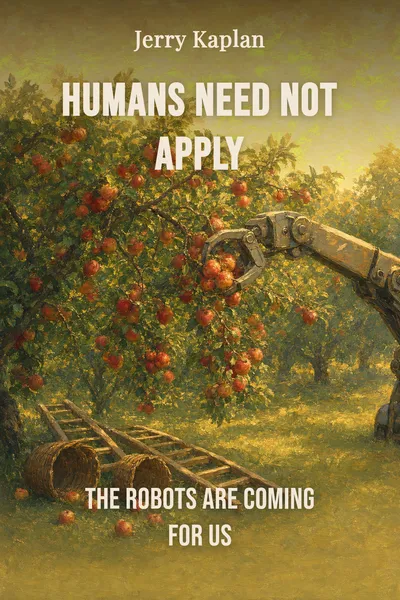
Humans Need Not Apply
The robots are coming for us
Description
In 2015, a computer scientist and entrepreneur named Jerry Kaplan published a book with a title borrowed from the old want-ad shorthand for jobs closed to a certain kind of applicant: Humans Need Not Apply. Kaplan was not a pessimist writing from the sidelines. He had spent decades inside Silicon Valley, co-founding companies, teaching at Stanford, and living through several waves of technology that were each supposed to change everything and mostly didn't. That track record is what gives the book its particular flavor. When someone who has watched the hype cycle from the inside says this time the shift is real and structural, it lands differently than the usual futurist noise.
His argument is narrower and sharper than the headlines about killer robots suggest. Kaplan splits artificial intelligence into two practical categories he calls forged laborers — machines that act in the world, the robots and self-driving cars — and synthetic intellects, the pattern-finding systems that read scans, price assets, and sort résumés. Neither needs to think like a person to displace one. What matters is that together they can now do a widening share of the tasks that used to require a human being with a paycheck. And unlike earlier automation, this wave reaches into white-collar work that felt safe.
The genuinely uncomfortable part of Kaplan's book is not that machines take jobs. Economies have always shed old jobs and grown new ones. It is what happens to the money. When productivity climbs but the gains flow to whoever owns the machines, the old bargain — work hard, share in the growth — quietly stops holding. Kaplan is less interested in whether the robots are coming than in who ends up richer when they arrive.
The question we’re asking : If artificial intelligence can now do the work, what happens to the people and the wealth that work used to support?What we’ll see : A Silicon Valley insider's tour of how two kinds of machine reshape labor, pull wealth upward, and hand us choices we haven't started making.
Table of contents
01Chapter 1 — Two machines that never sleep
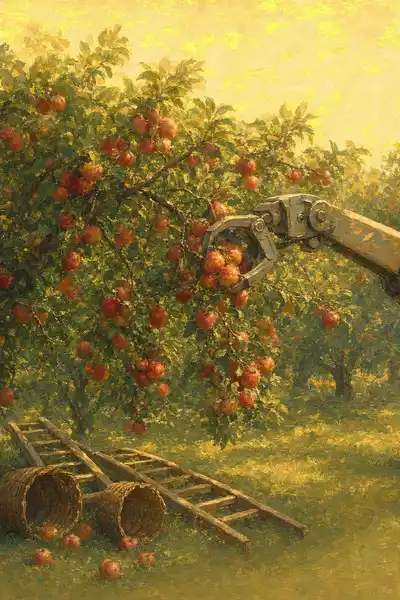
Kaplan's first move is to strip away the science-fiction fog. Forget the android with a personality and a grudge. The systems already changing the economy come in two humbler shapes. The first he calls forged laborers: machines that sense and act in the physical world. Warehouse robots that pull orders, self-driving trucks, harvesting arms that pick fruit without bruising it. They are not clever in any human sense. They are cheap, tireless, and getting better fast, and they occupy the exact niche that manual and semi-skilled labor used to fill.
The second kind is stranger and, for many readers, more threatening. Kaplan calls them synthetic intellects — software that finds patterns in mountains of data and makes decisions from them. A system that reads mammograms as well as a radiologist. A program that drafts contracts, screens loan applications, or reviews legal documents by the thousand. These do not walk around; they sit on servers. But they chew through precisely the cognitive tasks that a college degree was supposed to protect. The lawyer sorting discovery documents and the doctor scanning X-rays are, from the machine's point of view, doing pattern recognition.

02Chapter 2 — Wealth that piles up at the top
Having laid out the machines, Kaplan pivots to the part that keeps him up at night: distribution. The productivity that automation unleashes is real. More gets made, for less, faster. In theory that is pure gain — a richer society all around. The trouble is that the gains do not spread themselves. They flow to whoever owns the forged laborers and synthetic intellects, and ownership of that kind of capital is already concentrated.
Kaplan frames this as a break in an old arrangement most of us never examined. For much of the twentieth century, rising productivity and rising wages moved together, roughly. When companies got more efficient, workers captured a decent share through higher pay. That coupling is what made the middle class feel like the natural product of a growing economy. What Kaplan sees in the automation wave is the two curves pulling apart. Output rises; the wages of ordinary workers stall or slip. The reward for owning the machine detaches from the reward for operating it, and fewer and fewer people are on the owning side.
03Chapter 3 — When ownership goes to the algorithm
The most inventive stretch of the book is where Kaplan stops diagnosing and starts proposing. If the core problem is that machines generate wealth for a narrow class of owners, then the obvious lever is ownership itself. His instinct is not to slow the machines down or tax them into submission, but to widen the circle of people who hold a stake in them. Spread the shares, and you spread the gains.
One idea he develops is what he calls a job mortgage — a way to finance a person's transition into new work the way we finance a house. Rather than leaving displaced workers to sink or retrain on their own dime, a market instrument could let someone borrow against their future earnings in a growing field, with investors sharing both the risk and the upside. Retraining stops being a private gamble and becomes something the financial system underwrites, because there is money to be made in getting people successfully into the jobs that still pay.
04Chapter 4 — The economy we still get to design
Step back from the specific forecasts and a larger claim comes into focus, one that separates Kaplan from most writing about automation. The dominant register in this conversation is fatalist. The robots are coming, the story goes, the way a storm is coming — a force of nature to brace against, adapt to, or flee. Kaplan's whole book is a quiet argument against that framing. The machines are technology, yes, but the economy they operate inside is an institution, and institutions are made of choices.
This is why the distribution problem sits at the heart of the book rather than the technology. The capacity of a synthetic intellect to read a scan is a fact of engineering. Whether that capacity enriches a few investors or a broad public is a fact of law, ownership, taxation, and the financial instruments we choose to build. The first is genuinely out of our hands; the second is entirely within them. Kaplan's insider vantage point matters here precisely because he refuses to hide behind the aura of inevitability that Silicon Valley so often wears when explaining why nothing can be done.
05Conclusion
The title Kaplan borrowed carries a threat: a notice that certain applicants need not bother. His book takes that threat seriously without surrendering to it. The forged laborers and synthetic intellects really are coming for a widening range of work, blue-collar and white-collar alike, faster than the comforting historical pattern would predict. On that much he is bracing and clear-eyed. But the sentence he keeps circling back to is not about the machines. It is about the money they make and the shrinking number of hands it lands in.
Related books