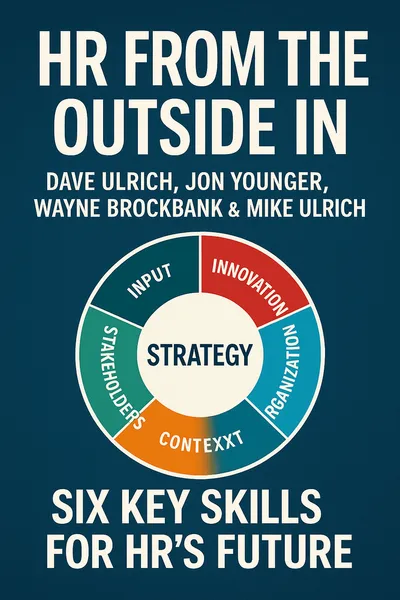
Hr from the outside in
Six key skills for hr's future
Description
After a 25-year study by HR associations, it is clear that HR will evolve from an inside-out to an outside-in perspective. Instead of focusing on internal processes, HR will prioritize business performance drivers like strategy, stakeholder expectations, and the business environment.
There are six key future HR domains. A good HR professional will need to be a strategic positioner, credible activist, capability builder, change champion, innovator and integrator, and technology proponent.
Outside-in HR is premised on HR being the business itself, not just connecting strategy and HR. HR must create and deliver real business value.
Table of contents
01 Section 1: strategic business partner
HR professionals must understand the global business context to be successful and translate underlying trends into concrete business implications. This understanding goes beyond knowing the intricacies of their own industry; it requires a grasp of the competitive dynamics of the market to develop an insightful vision for their company's future. High-performing HR professionals think and act from the outside in, a concept that has evolved over the past 25 years from knowing finances to adapting strategy to serving stakeholders to responding to external conditions.
To serve as a strategic positioner, one must genuinely understand the business. Strategic positioning involves anticipating and matching external implications. To become a strategic positioner, HR professionals must overcome any discomfort with finance and math to learn business concepts, which allows them to move beyond their specialty and add value by participating in all management conversations. HR professionals acting as strategic positioners position their organization within its context, referring to products, services, and reputation. Positioning means recognizing, anticipating, and leveraging trends. It requires flexibility to find and seize opportunities, fitting and shaping future opportunities more than transforming the organization.

02 Section 2: trusted advisor
Human resources professionals play a crucial role in advocating for organizational change, and their credibility is key to their effectiveness. According to David Ulrich, Wayne Brockbank, Jon Younger, and Mike Ulrich, credibility for HR professionals is achieved by focusing on business-relevant issues, fulfilling promises, meeting obligations, communicating effectively, building trustful relationships with colleagues, and demonstrating a willingness to take risks for the business's benefit. Historically, HR's credibility was based on personal relationships with line managers during the 1980s and 1990s, and by the 2000s, it shifted towards demonstrating competence and contributing to business results. In recent years, credibility has evolved to require HR to proactively contribute to business priorities, understanding both external threats and internal challenges.
There are four key factors that enable credible activism for HR professionals. First, delivering results with integrity involves setting clear organizational performance goals, adjusting them as needed, meeting commitments with timely and detailed solutions, and upholding the organization's values and ethical standards. Second, influencing and relating to others is about building broad relationships, helping line managers understand human capital implications, communicating effectively, disagreeing respectfully, and taking appropriate organizational risks. Third, building trust is crucial and involves demonstrating a commitment to continuous improvement, setting specific goals, providing support, monitoring progress, and offering mentorship. HR professionals should become skilled in coaching, learning, and employee development tools to effectively build trust. Lastly, strengthening HR perceptions requires understanding innovations and issues across organizations, participating in professional organizations, teaching and incentivizing learning, building external networks, and engaging with the HR community.
03 Section 3: talent cultivator
Human resource professionals play a critical role in helping organizations build capabilities over time. They assist managers in creating meaning for employees and ensuring the organization's capabilities align with and reflect deeper staff values.
As per the McKinsey Quarterly, companies can gain a competitive edge by developing foundational capabilities. Firms need to be more deliberate in comprehending which capabilities truly influence business performance.
A key HR responsibility is aiding in developing the organization's capabilities. If HR can accurately define, diagnose, and deliver the right key capabilities that underpin success, they can create an organizational asset that outlasts individual leaders and endures over time. Organizational capabilities come in various forms, but seven are likely the most important:
- Strategy execution - Managing innovation and change - Attracting, retaining and motivating talent - Leveraging a productive culture - Managing profitability and delivering value - Developing future leaders - Good governance
Building key capabilities has been an HR priority since the 1990s. Defining and providing the appropriate capabilities on demand involves having the right resources, an excellent culture, and efficient processes in place.
As per David Ulrich, Wayne Brockbank, Jon Younger, and Mike Ulrich, HR professionals help create the right organization by making it more efficient via reengineering work, clarifying roles and responsibilities through organization design choices, aligning and integrating systems through organization audits, or defining and delivering the right capabilities through cultural audits.
04 Section 4: change driver
High-performing HR professionals play a crucial role in developing their organization's capacity for change. They understand the importance of building a strong case for change based on market realities and implement processes to facilitate these changes effectively. Overcoming resistance is a key part of the process, which involves engaging key stakeholders and ensuring that the organization has the appropriate processes, resources, and capacity to learn from both successes and failures.
The pace of change is accelerating, driven largely by advancements in technology. This has led to increased customization, faster information flow, and evolving customer and employee expectations, necessitating organizational transformation. Knowledge is becoming obsolete more quickly as new information is continuously made available online. This is evidenced by the fact that of the original Fortune 500 companies listed in 1955, only a fraction remain independently today. Over a single decade, from 2000 to 2010, about half of the large, stable companies disappeared, illustrating that change is a constant in both personal and professional lives. HR professionals must help companies to face, accept, and embrace the pressures for change rather than avoid them.
05 Section 5: innovator
Savvy hr professionals are at the forefront of aligning hr practices and resources with the desired business outcomes, innovating and integrating in ways that bolster organizational capabilities. This alignment is crucial for hr to reach a tipping point where its impact on overall business results is widely recognized. Traditionally, hr's role has been to ensure the availability of the right talent and leadership to propel organizations forward. This involves attracting, training, and retaining talented employees, identifying leaders, and placing them in roles that enhance their skills, and ensuring teams have competent employees to deliver the strategy-required capabilities.
The journey of becoming an hr resource innovator and integrator involves five core factors. The first is workforce planning and analytics, which is about optimizing human capital by identifying current skills, defining critical strategic roles, assessing strengths and weaknesses, and planning for future capabilities. This also includes managing any transition processes effectively. The second factor is building a talent pipeline, a traditional yet evolving hr role that focuses on developing future technical, organizational, and interpersonal skills by identifying required competencies, setting standards, assessing talent, and investing in talent improvement through various strategies.
06 Section 6: technology champion
HR has a long history of adopting new technologies to improve efficiency, and currently, two applications stand out: social networking to boost connectivity and aggregating data into actionable insights for key decisions. These can increase productivity and provide real value. As M.S. Krishnan, Joseph Handleman, and Wayne Brockbank stated, "Most organizations still use IT for efficiency, but technology can also differentiate by applying talent and knowledge assets inside and out. Savvy companies now use tech as a platform to connect internal talent and collaborate externally with stakeholders. They deliver training modules and track usage. They reveal expertise and performance, and connect employees globally on these platforms."
Becoming a technology champion involves three factors. First, enhance HR through technology. HR tends to lag other departments in adopting the newest tech, but doesn't have to. Payroll, reviews, and benefits tracking can be automated, but that's just the beginning. Digitizing employee data, roles, and workflows unlocks opportunities. Cisco's system motivates healthy body mass index. American Express enables shift swaps without manager approval. Others maintain live skills databases capturing each employee's proficiency at various tasks, available when assembling project teams. Performance reviews can also be screen-based for quick, open updates. More HR applications will emerge and spread.
Related books