
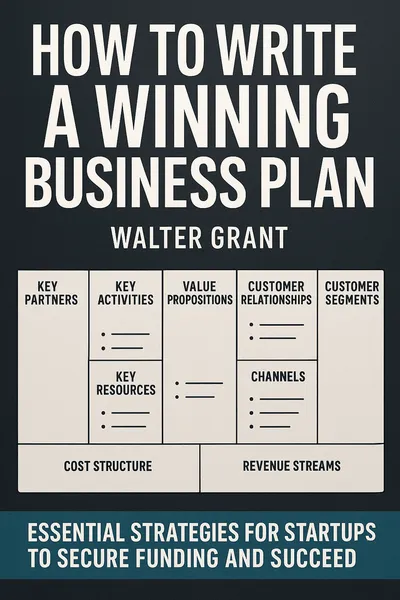
How to write a winning business plan
Essential strategies for startups to secure funding and succeed
Description
The value proposition details the product/service offering and target customer. The profit formula shows how you will make money. Key metrics like customer acquisition cost and lifetime value indicate business viability.
Using a visual business model canvas enables concise presentation of all plan aspects and analysis of idea iterations. This brings order to daily routine.
Table of contents
01 Necessity of operating business plan
A business plan sets out your business model – how you will create value for yourself while delivering products and services your customers value. Your business plan is your roadmap on how to do that. A good business plan should be used daily. In addition to giving confidence to investors, studies also show that companies which have taken the time to write a business plan on average grow 30% faster than those which do not. The exercise of writing a business plan is good for you, because it makes you think through your business model and get specific.
When you put together a business plan, several good things happen: You articulate and get down on paper where you want your business to head, or what you want to achieve by when. You can make a judgment call on the feasibility of your journey, and identify what will be the shortest path to your goal. You look at potential stumbling blocks, and identify what alternate routes might become available to you. You clarify what resources will be needed – financial, human, physical, or industry know-how. You have an opportunity to figure out the cheapest and most efficient methods to get your business up and running. You clarify in advance what the keys to success will be – understanding what customers want, packaging your product or service the right way, converting your offering into revenue, etc.
Overall, the benefits of putting together a written business plan are quite compelling. The exercise of writing a business plan forces you to get specific about how you will produce and capture value. It's a roadmap for the journey ahead. A business plan is thus a platform that all stakeholders involved in the business venture can refer to for guidance regarding common objectives and strategies fashioned to attain these objectives. With this cautious approach, chances of failure are minimized. Each business venture undertaken is a calculated move that has been analyzed from various angles and has a high probability of success. The challenge with a business plan is if you come up with a 100-page document, very few people will ever read it, understand it, or use it. A much better approach is to put together a 1-page version of your business plan, that people can use and refer to every day. If you do that, as new ideas are bounced around each day, you can figure out which ideas to research more, and which will not fit your business model.

02 Expenditures
Operating costs are a crucial consideration for any business. A well-developed business plan must accurately identify the main drivers of costs, and demonstrate how those costs relate to potential revenue streams. The leading cause of business failure is a mismatch between costs and revenues - either not fully understanding the true costs involved, or failing to properly link those costs to the various products, services and revenue channels. When costs are not mapped to specific revenue streams, it becomes impossible to determine the profitability of individual offerings. By thoroughly analyzing costs, projecting revenues, and linking the two at a granular level, a business can appropriately price offerings, eliminate unprofitable segments, and make decisions that lead to sustainability and growth. Taking the time upfront to deeply understand the cost structure and connect costs to the associated revenue opportunities provides a critical foundation for the financial viability of a business.
Collaborators
Companies focus on areas where they have competitive edges, relying on partners for other activities. Depending on the business, partners may include suppliers providing materials; infrastructure and service providers offering transport, waste management, etc; competitors helping create marketplaces; distributors assisting with sales and delivery; government agencies providing permits; alliances for joint ventures; and customers and stakeholders. Your plan should detail the ecosystem your business operates in or plans to, showing you've considered everything and can pivot if needed. Keep in-house what provides competitive advantage; outsource non-key activities to tap into others' efficiencies. Detail which partners will provide non-key activities—this may need regular reassessment. Outsourcing done right increases success chances by generating more value. If attempting everything in-house to save money, lost time and poor quality often result. Marketing, digital platforms and accounting are commonly outsourced.
03 Assets
Google's key activities include developing its proprietary search algorithm, indexing the data available on the web, ongoing research and development, and marketing and selling the company's products. Google's key resources that support these activities are its proprietary search algorithm called pagerank, googlebot which is its automated web crawler that indexes webpages, its talented employees especially engineers and product managers, its various platforms like search, maps, youtube etc that provide valuable data, patents and intellectual property to protect its proprietary technology, and its extensive computing infrastructure that supports its web crawling and search capabilities. Together, these algorithm, data, people and infrastructure act as competitive advantages that have made google the dominant search engine. Maintaining these resources through continual innovation and expansion into new products and markets is critical for google to retain its leadership position.
Income channels
Revenue streams provide the operating income for a business and guide decisions regarding financing and overall profitability. An informed business plan forecasts revenues, costs, and resulting profitability. Analyzing revenue streams assists in selecting suitable pricing approaches, which can be volume-based, fixed, reached through bargaining, set by auctions, determined by market forces, or a combination. Unappealing revenues indicate a need to redesign the product by adding features, seeking new customer segments, or revamping the value proposition. Understanding revenue streams facilitates these improvements.
Revenues mainly come in two types:
Transaction-based revenues derive from one-time purchases or payments for products, services, etc. These tightly link to customer demand and may be seasonal. For example, landscaping companies earn most revenue during warmer months. Recurring revenues come from ongoing, repeated payments like subscriptions, licensing fees, contracts, etc. These prove easier to accurately forecast, lending a higher degree of certainty for business plans. For instance, a software company can reliably predict subscription revenue from existing clients.
04 Offering Worth
Starting a business is like building a house with LEGO blocks. You start by laying the foundation, which is your business plan. This forms the solid base upon which you build, step by step.
If your core business fundamentals are strong, like a sturdy building foundation, your enterprise has a higher chance of thriving among the 10% of successful companies. This strong base comes from a well-developed strategy. Launching a successful venture requires passion, commitment, a combination of technical knowledge and business acumen, a willingness to observe, listen, and learn, and the ability to adapt to market forces.
Related books