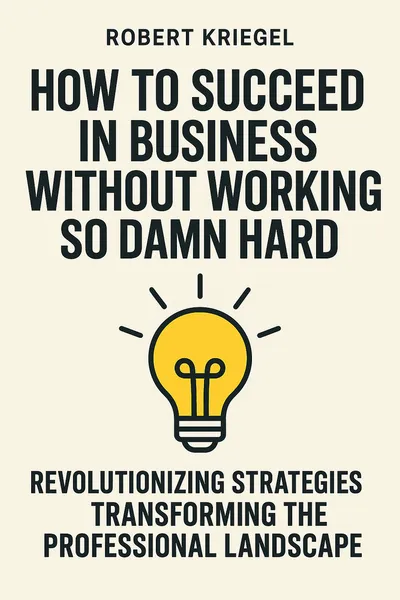
How to succeed in business without working so damn hard
Revolutionizing strategies: transforming the professional landscape
Description
To succeed, work smarter, not just harder. Instead of long hours, passionately focus on breakthrough ideas. Rethink your approach to tilt the playing field. Pioneer new paths instead of following the herd.
Challenge assumptions and reinvent your business philosophy. Create change instead of playing catch-up. Develop dramatic new solutions without the burnout. Success comes from innovation, not just perspiration.
Table of contents
01 Rethink rules, reshape business models
Accelerating worsens matters
Rushing to get things done often backfires. When people focus solely on speed, the quality of work suffers. More mistakes happen, requiring fixes that take up time. Little errors crop up from poor communication. With everyone in a hurry, there’s no room for innovation or creativity. A wiser approach is to start small, perfect your business model, then expand. Trying to outgrow competitors too quickly leads to disastrous decisions from lack of time. As author gary hamel notes, investing faster than learning overdrives opportunities, resulting in expensive failures. Michael bloomberg cautions against growth euphoria. When growing rapidly, it’s tempting to accelerate further. But that’s when trouble strikes. Resist and slow down instead. Controlled, thoughtful growth centered on quality prevents waste, sparks creativity, and leads to sustainable success. The fastest route forward is rarely the best path. Great achievements require patience, not haste. By resisting rash decisions today, the foundations form for meeting larger goals tomorrow.
Slowing boosts productivity
We can accomplish more by delivering our efforts with passion and creativity rather than straining ourselves to the maximum capacity. Like olympic athletes who perform better at 90 percent effort than 110 percent, we should aim to work hard but smoothly rather than frantically. Pushing ourselves too hard leads to fatigue, mistakes, moodiness, declining quality, and lack of endurance when we really need it. The key is to work diligently but unhurriedly, focusing on doing excellent work rather than meeting unrealistic deadlines. Most people would benefit from slowing down a little, enabling them to produce higher quality output with less stress. Working at a measured pace allows us to enjoy the process while still being productive. The goal is working sustainably and contentedly, not burning ourselves out in a frenzied rush.
Leverage strengths, not weaknesses
Rather than spreading yourself thin trying to be well-rounded, identify your greatest talent and pour your energy into perfecting it. Lean into what energizes you. Building on strengths is enjoyable and plays to your natural abilities, catalyzing success and fulfillment. Celebrate how focusing on a specialty makes your business unique. Let partners handle everything else capably through outsourcing relationships. Management legend peter drucker advised building around strengths not weaknesses. Former charles schwab executive ellen dilsaver notes that lacking fatal flaws, excelling in innate strengths brings results and propels careers. Professional dynamter chairman bruce hubby says identifying and empowering strengths, not correcting weaknesses, motivates peak performance. Channeling strengths multiplies confidence, productivity and achievement. When you maximize what you uniquely do best, you unlock the greatest potential for satisfaction and contribution.
Schedule daily thinking time
You make an excellent point that when we are caught up in the busyness of daily tasks and demands, it can be very difficult to make space for new, innovative ideas to emerge. Carving out dedicated "time-outs" where we step back and allow our minds to wander freely is so important. I especially like your suggestion to leave communication devices behind during these breaks. Constant connectivity can lead to distraction and fragmented thinking - taking a tech break allows us to dive deeper into imagination and ideation.
Getting physical exercise is another great way to activate creative thinking, as you mentioned. Activities like walking, running, or working out seem to stimulate connections in the brain. Allowing the conscious mind to focus on movement lets the subconscious play with ideas more freely.
The quotes you included sum it up perfectly - making regular time for reflection and mind-wandering is key. As bianchi notes, without taking breaks we risk burning out, lowering morale, and blunting innovation. I love the shaw quote as well - by deliberately thinking and daydreaming, we fuel the problem-solving and ideas that can lead to breakthroughs.
In the end, work will always be there waiting for us. But creativity won't happen on its own - we need to intentionally step off the treadmill and let our minds wander if we want to unlock our best thinking. The companies that encourage this type of space for employees are the ones most likely to thrive with fresh ideas. Does this perspective resonate with your own views on encouraging workplace creativity? I'm happy to discuss further.

02 Reinvent games, don't just compete
Look outside your industry for ideas
The key to business success is not playing by your competitors' rules or trying to beat them at their own game. Instead, focus on innovating and creating your own unique rules and offerings. Find ways to differentiate yourself and tilt the playing field in your favor. Reinvent your business model, area of focus, offerings, partnerships - whatever it takes to establish yourself as the only one who does what you do. Create new markets instead of competing in existing ones. Become an expert in your field by teaching others. The goal is to establish a competitive advantage via creativity and differentiation, not head-to-head competition. Companies that successfully rewrite the rules of their industries are the ones that will still be here in a decade. Don't assume your competitors know what they're doing - chart your own innovative course. The fundamental idea is to change the rules of the game so you hold the high ground on a non-level playing field.
Immerse yourself in the action
The path to business achievement does not involve mimicking your opponents or trying to outperform them at their own tactic. Instead, concentrate on trailblazing and fabricating your own distinctive guidelines and proposals. Uncover techniques to differentiate yourself and tilt the scene to support you. Redesign your business model, zone of focus, contributions, associations - whatever it takes to build up yourself as the only one who accomplishes what you do. Make new markets rather than contending in existing ones. Become a specialist in your field by teaching others. The objective is to build up a competitive advantage through innovation and separation, not direct rivalry. Organizations that effectively reorder the guidelines of their enterprises are the ones that will even now be here in 10 years. Don't expect your rivals comprehend what they're doing - outline your own creative course. The fundamental thought is to change the tenets of the game so you hold the high ground on an uneven playing field.
The past holds the future's resources
Looking to the past can unveil ideas worth reviving in the present. Business history offers a treasure trove of concepts, products and services that were once successful. With some updating to account for modern capabilities, these aged ideas could thrive again, perhaps with a new twist tailored to current market conditions. Useful inspiration can emerge from diverse sources - classic films, historical publications, elder perspectives, corporate chronicles of still-extant and defunct companies, and even approaches in foreign lands. As the quotations suggest, the future belongs to those who honor the lessons of the past while seeking innovation. Sometimes a fresh approach is simply a forgotten or underappreciated idea presented in a new light. Rather than constantly chasing the new, it pays to regularly reexamine the old. The longest view backwards may reveal the clearest path ahead.
Listen to the young's ideas
Most organizations issue top-down instructions. However, creative ideas often bubble up from the bottom. The only way to uncover these is by "listening down" - listening to junior staff input. This makes sense since new hires likely talk to customers. Similarly, production workers probably have the best ideas for improvements. Create opportunities to hear their voice - maybe with "reverse mentoring" where young people teach executives their knowledge. The learning possible this way will be impressive. As steve miller of royal dutch shell said, no leader can have all the answers. Solutions on meeting challenges must come from those closest to the action. And as rakesh gangwal of us airways stated, he loves when frontline staff have ideas because those generally work. Listening to entry-level employees provides creative insights and morale boosts. Their customer interactions yield fresh perspectives on better meeting customer needs.
Stimulate creativity with odd partnerships
When assembling a team, include people with different perspectives. Excessive conformity stifles the creative friction within the best teams. Groups generate more pioneering ideas when members contribute varying viewpoints and scrutinize concepts passionately. Thus, optimal teams resemble "odd couples" with seemingly incompatible personalities. To build a creative team: incorporate diverse mindsets. Allow healthy disagreement without personal attacks—critique ideas, not people. Ensure everyone receives respect and can pitch suggestions. Insist on openness to left-field proposals. Discourage ego and the notion of winners/losers—just strong or weak ideas. Prepare members to withstand some creative abrasion, enabling the best ideas to emerge.
Related books