How to Spend $50 Billion to Make the World a Better Place
Fifty billion, maximum impact
Description
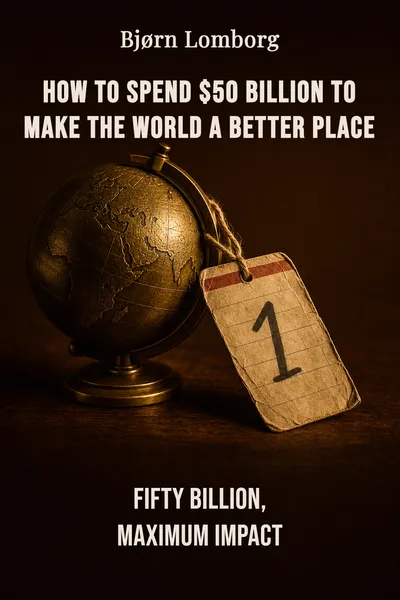
In May 2004, eight economists — five of them Nobel laureates — sat down in Copenhagen with a strange assignment. Imagine a benefactor hands the world an extra fifty billion dollars, to be spent over four years on making things better. Not on everything. On some things. The economists were asked to look at the planet's largest problems, weigh the proposed solutions against their costs, and rank them from best to worst use of the money. The project was called the Copenhagen Consensus, and Bjørn Lomborg, the Danish academic who organized it, later turned its debates into a book with a title that reads like a dare: How to Spend $50 Billion to Make the World a Better Place.
The premise sounds almost tasteless at first. Ranking human suffering? Putting a price on clean water against a price on fighting AIDS, and declaring a winner? But the discomfort is exactly the point. Money spent on one problem is money not spent on another. Every government, every charity, every aid agency already makes these trade-offs — they just make them quietly, by inertia, by lobbying, by which cause happened to trend that year. Lomborg's wager was that doing it openly, with the numbers on the table, would be more honest and more useful than pretending the choice doesn't exist.
The book gathers ten of the world's most serious challenges — climate change, disease, conflict, hunger, dirty water, corruption, trade barriers and more — each introduced by a leading expert who lays out the scale and the options. Then it lets the economists argue. What emerges is less a tidy answer than a way of thinking that many people find unsettling long after they've closed the cover.
The question we’re asking : If we had a fixed pot of money for the whole planet, how would we decide what to fix first — and can that decision be made honestly?What we’ll see : How a room full of economists tried to rank the world's biggest problems, why their answers surprised almost everyone, and what the exercise reveals about the way we already choose.
Table of contents
01 Chapter 1 — A panel, a chalkboard, and a hard question
The setup is deliberately artificial. There is no actual philanthropist with fifty billion dollars waiting to be told where to send it. The number is a device — large enough to matter, small enough to force a choice. If the pot were infinite, there would be nothing to argue about; you'd fund everything. The whole exercise depends on scarcity, because scarcity is the condition every real decision-maker actually lives in. Aid budgets are finite. Attention is finite. The question isn't whether to prioritize but whether to do it with eyes open.
Lomborg's framing borrows straight from economics, and specifically from the idea of cost-benefit analysis: for every proposed solution, estimate what it costs and what good it does, then compare. A dollar that buys ten dollars of human welfare beats a dollar that buys two. Stated that baldly it sounds cold, but the alternative — spending without ever asking what you get back — is the thing that lets billions vanish into projects that help almost no one. The panel wasn't asked which problems mattered most in the abstract. They were asked where the money would do the most measurable good.

02 Chapter 2 — The list nobody wanted to make
When the panel published its ranking, the result landed like a small provocation. At the very top, rated the best possible use of the money, sat the fight against HIV/AIDS. The economists estimated that a serious prevention program across the worst-affected regions could avert millions of infections at a cost that was tiny compared with the suffering and lost lives prevented. The math was brutal in its clarity: relatively little money, enormous return. It ranked first not because AIDS is the world's worst disease in some cosmic sense, but because the intervention worked and was cheap per life saved.
Close behind came a cluster of interventions that shared the same quality — unglamorous, well understood, and absurdly good value. Providing micronutrients, chiefly iron and vitamin A supplements, to malnourished populations ranked among the very best buys, because a few cents of vitamins can prevent blindness, stunting and death. Liberalizing global trade — dismantling the subsidies and tariffs that rich countries use to shut poor farmers out of their markets — ranked high too, since it costs the donor almost nothing yet could lift hundreds of millions out of poverty. And controlling malaria, largely through bed nets and treatment, rounded out the top tier.
03 Chapter 3 — When the cheap fix beats the famous one
At the bottom of the 2004 ranking sat the responses to climate change — including the Kyoto Protocol and various carbon-tax proposals. The panel didn't dispute that the climate was warming or that humans were driving it. Their objection was narrower and, in Lomborg's telling, more useful: the specific policies on offer cost a great deal now and delivered benefits that were modest, uncertain, and mostly far in the future. Spend the same money on iron supplements or bed nets and you save identifiable lives this decade. That comparison is what pushed climate measures to the bottom — not as a problem, but as a place to put the next fifty billion.
This is the moment the book earns most of its enemies and most of its admirers, often for the same reason. To many readers it felt like a licence to ignore the century's defining crisis. To others it was a bracing dose of honesty about trade-offs that campaigners preferred to leave unspoken. Lomborg's own position, developed across his work, is not denial but sequencing: address the cheap, immediate wins first, and treat expensive long-horizon problems with research and patience rather than costly gestures that buy little.
04 Chapter 4 — Priorities are a moral act, not an accounting trick
It's tempting to read the Copenhagen Consensus as an economics stunt — clever men with spreadsheets reducing human misery to a rate of return. But the deeper claim underneath Lomborg's project is a moral one, and it's harder to dismiss than the arithmetic. The claim is that refusing to prioritize is itself a choice, and usually a worse one. When aid flows to whichever cause is loudest or most photogenic, people who could have been helped cheaply are left unhelped. The vitamin A that never reached a child is a decision, even if nobody consciously made it.
This reframes what the fifty-billion exercise is actually for. It isn't really about a hypothetical donor. It's a mirror held up to how the world already spends — through governments, foundations, and the vast machinery of international aid — and a demand that those choices be defended rather than drifted into. The book's insistence on numbers is not coldness. It's the opposite: a refusal to let good intentions substitute for good outcomes, because the person waiting for a bed net doesn't benefit from our compassion, only from the net.
05 Conclusion
The Copenhagen Consensus never handed anyone fifty billion dollars, and the 2004 ranking it produced has been argued over ever since — the climate placement especially, which struck many readers as too neat by half. But the ledger was never the real product. What Lomborg built was a machine for making trade-offs visible: eight economists, ten problems, and a rule that you had to say why one dollar went here and not there. The answers surprised people because the cheapest, least glamorous interventions kept winning, and the causes that dominate our attention often didn't.
Related books