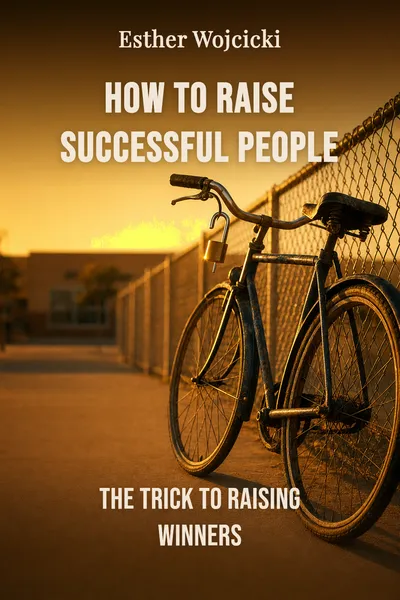
How to Raise Successful People
The TRICK to raising winners
Description
In the early 1980s, a Palo Alto high-school teacher named Esther Wojcicki took over a small, struggling journalism class at Palo Alto High School and handed the students something most adults instinctively withhold: control. They would decide what to investigate, run the budget, miss their own deadlines, and live with the consequences. Over the next three decades that class grew into one of the largest scholastic media programs in the country, with hundreds of teenagers producing a newspaper, magazines, and broadcasts largely without an adult standing over them. Colleagues called her Woj. The students called the room theirs.
The same woman raised three daughters at home using the same instinct. Susan became the chief executive of YouTube. Janet became a physician and professor of pediatrics. Anne co-founded the genetics company 23andMe. The press eventually gave Wojcicki a nickname that is half tribute and half marketing — the Godmother of Silicon Valley — and asked the obvious question. How does one household, and one classroom, produce that many capable adults without the hovering, the tutoring arms race, and the relentless supervision that defines so much modern parenting?
Her answer, set out in How to Raise Successful People, is almost stubbornly plain. She rejects the premise that children are projects to be optimized. What she offers instead is a five-part framework she calls TRICK, built on the conviction that the surest way to make a child capable is to stop managing them quite so much. It sounds easy. In practice it asks parents to give up the one thing they hold tightest.
The question we’re asking : Can a child become genuinely capable only when the adults around them step back — and what does it cost the adults to do it?What we’ll see : How a teacher and mother turned a five-letter method into a quiet argument against the way we now raise children.
Table of contents
01 Chapter 1 — A journalism teacher who raised a generation
Wojcicki's authority on the subject is not theoretical, and that matters to how the book reads. She spent more than thirty-six years teaching, and her classroom became the testing ground for everything she later wrote about home. The journalism program she built at Palo Alto High School started with about twenty students and grew, over the years, into a sprawling operation of several hundred — one of the largest of its kind in the United States. What made it unusual was not the size but the handover. The teenagers, not the teacher, owned the work.
Her own childhood pointed her the other way first. She grew up in a strict, anxious, immigrant household where money was scarce and a younger brother died after what she came to see as avoidable medical hesitation. The experience left her suspicious of the kind of fearful control that passes for protection. When she became a parent and a teacher, she set out deliberately to do the opposite of what had been done to her — not by being permissive, but by trusting children with real responsibility and real stakes.

02 Chapter 2 — TRICK, and why it starts with letting go
The framework is an acronym, and Wojcicki uses it without apology: Trust, Respect, Independence, Collaboration, and Kindness. TRICK. The order is not random. Trust comes first because, in her reading, almost everything else depends on it, and because it is the value parents find hardest to extend. We trust our children in theory and supervise them in practice, and the gap between the two is where a great deal of modern anxiety lives.
Trust, for her, is concrete rather than sentimental. It means letting a child walk to the store, handle a tool, make a plan, and occasionally fail at all three. The point of the failure is the learning, which is why she is so insistent that parents not intervene to prevent it. A child who is never allowed to get something wrong never discovers they can recover, and the recovery is the actual lesson. She frames hovering not as care but as a quiet message that the adult does not believe the child can manage — a message children absorb and eventually believe.
03 Chapter 3 — The respect a child is owed before they earn it
The two bookends of TRICK — Respect and Kindness — are where Wojcicki is at her most pointed, because they cut against deep parental reflexes. Respect, in her account, is not something a child accumulates through good behavior and is granted as a reward. It is owed from the start. That includes respecting a child's emerging autonomy, their interests, and crucially their right to a future they choose rather than one assigned to them. She is openly skeptical of parents who steer children toward prestigious careers, treating a child's life as an extension of adult ambition.
This is the quiet center of the book's argument, and it is easy to miss because it sounds gentle. Respecting a child's own goals means tolerating choices that look, to an anxious parent, like detours or mistakes. It means resisting the temptation to engineer a résumé. Wojcicki's own daughters did not follow a single prescribed path; they were allowed to wander toward what interested them, and she treats that latitude as a cause of their later capability rather than a risk to it.
04 Chapter 4 — What a parenting method is really an argument about
Strip the acronym away and How to Raise Successful People is an argument about authority — about who controls a childhood, and whose fear is actually being managed when an adult intervenes. Wojcicki's recurring claim is that the hovering, scheduling, and rescuing that define a certain style of affluent parenting are not really for the child at all. They soothe the parent. The supervision is a way of managing adult anxiety, and the child absorbs the cost in confidence they never get to build.
Seen this way, TRICK is less a technique than a redistribution of power inside the home. Trust, independence, collaboration — each one transfers a little authority from the adult to the child, deliberately and earlier than instinct prefers. The wager underneath is that competence is not something poured into a child from above but something that grows only in the space an adult agrees to vacate. Withhold that space in the name of safety and you withhold the very experience that produces capable adults.
05 Conclusion
The teacher who handed her newspaper to its teenagers and the mother who let her daughters wander toward their own interests were running the same experiment, and her book is the report from inside it. Trust, Respect, Independence, Collaboration, Kindness — TRICK reads at first like a tidy formula for producing impressive adults, the kind of children who end up running companies and practicing medicine. Read more closely, it is something less flattering and more useful: an account of how much capability a child loses when the adults around them cannot bear to step back.
Related books