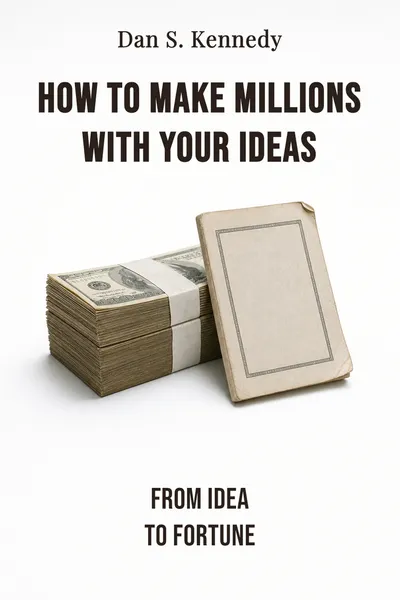
How to Make Millions with Your Ideas
From idea to fortune
Description
Dan Kennedy opens his 1996 book with a promise most business writers are too cautious to make out loud: that ordinary people, with ordinary ideas, working out of spare bedrooms and garages, have turned those ideas into genuine fortunes — and that the path they took can be reverse-engineered. He fills the pages with them. A man who sold a booklet on how to remove stains. A woman who built a mail-order empire around a single kitchen gadget. A struggling chiropractor who repackaged his patient-newsletter into a business worth more than his practice. Kennedy's point is not that these people were geniuses. It's that they weren't.
Kennedy knew this world from the inside. He'd made his name as a direct-response copywriter and consultant, the guy small-business owners called when the ads weren't pulling and the mailing list had gone cold. He'd watched brilliant products die quietly and mediocre ones mint money, and he'd formed a blunt conviction about why. The difference, almost never, was the quality of the idea. It was everything that happened after the idea — the packaging, the pricing, the selling, the relentless multiplying of a thing that already worked.
That conviction runs against how most of us think about getting rich. We wait for the flash of inspiration, the billion-dollar concept nobody's had yet. Kennedy spends his book arguing that we've got the whole equation backwards, and that the fortune was never hiding in the idea at all.
The question we’re asking : If ideas are supposedly the hard part, why do so many good ones die broke while ordinary ones make millions?What we’ll see : How Kennedy dismantles the myth of the golden idea and rebuilds fortune as a repeatable, unglamorous craft anyone can learn.
Table of contents
01 Chapter 1 — The wealth is in the system, not the spark
Kennedy's first move is to demote the idea. Most people, he argues, are paralyzed at the starting line because they believe wealth requires an original stroke of genius — something never done before, protected by a patent, defended against the world. So they sit on their hunches, waiting to be sure, and the moment passes. Meanwhile the people actually getting rich are working with ideas that are borrowed, obvious, or lifted wholesale from another industry. Originality, in his telling, is close to worthless. Execution is close to everything.
He backs this with a steady parade of examples, and the examples are deliberately unimpressive. Somebody notices that dry cleaners could send reminder postcards, and builds a business selling that system to dry cleaners. Somebody takes a diet tip that already works and wraps it in a compelling booklet and a compelling ad. None of these people invented anything. What they did was spot a working idea and build a machine around it — a way to reach buyers, take their money, and deliver the goods at a profit.

02 Chapter 2 — Three roads to the same fortune
If the idea is only raw material, the obvious question is what to do with it. Kennedy lays out a handful of routes, and they map onto three broad situations a reader might be in. The first is the person with nothing but a hunch and no business yet. The second is the owner of a plodding, bill-paying business who wants far more from it. The third is the person who already has a modest success and wants to blow it up into something big. The same underlying logic serves all three; only the starting point changes.
For the person starting from zero, Kennedy leans hard on the information business — booklets, courses, newsletters, how-to material sold by mail. He loves it because the margins are enormous, the inventory costs almost nothing, and the same knowledge can be sold over and over. You solve one problem well, you write it down, and you sell the writing to everyone with that problem. His stain-removal and diet examples live here. The product is essentially the answer to a question people are already asking and already paying to fix.
03 Chapter 3 — The multiplier machine
The center of gravity in Kennedy's world is marketing, and specifically the kind he built his career on: direct response. Not the fuzzy brand-awareness advertising big companies buy, where nobody can say what a dollar produced. Direct response is the ad that asks for an order right now and tells you exactly how many orders it got. Every mailing, every coupon, every offer is a measurable test. You keep what pulls, you kill what doesn't, and you scale the winners. For a person trying to turn an idea into money, this is the difference between guessing and knowing.
The word he keeps returning to is multiply. A single sale is a transaction. A fortune is built by taking that transaction and finding every possible way to repeat it. Sell the same customer a second product. Sell the same product to a new market. License the method to someone in a different city or a different industry. Turn a one-time buyer into a subscriber. Kennedy is almost obsessive about the back end — the sales that happen after the first one — because that's where the real money hides. The first sale often just covers the cost of finding the customer; the profit lives in everything after.
04 Chapter 4 — What Kennedy is really selling
Step back from the booklets and the mailing lists, and the book is making a quiet argument about who gets to be rich. The romantic story of wealth belongs to the inventor and the visionary — people set apart by talent, credentialed by a great idea. Kennedy is trying to take that story away. If ideas are cheap and abundant, then the barrier to fortune isn't intelligence or originality; it's the willingness to do the unglamorous work of packaging and selling. That's a democratic claim, and a slightly deflating one. It says the door was never locked. Most people just never tried the handle.
There's a cost to that worldview, and Kennedy mostly embraces it rather than hiding it. If selling is the whole game, then the person who wins is not necessarily the one with the best product but the one most willing to promote — to advertise loudly, to charge boldly, to keep asking for the order after others would feel embarrassed to. His world rewards persistence and a thick skin over refinement and taste. He's honest that this is not for everyone, and that a lot of talented people fail precisely because they find the selling beneath them.
05 Conclusion
The people Kennedy paraded at the start — the stain-remover, the gadget-seller, the chiropractor with the newsletter — return at the end looking different. On first read they seem like lucky amateurs who stumbled into money. By the last chapter they read as proof of a method: each one found a working idea, built a way to sell it, and then multiplied that selling until it became a fortune.
Related books