
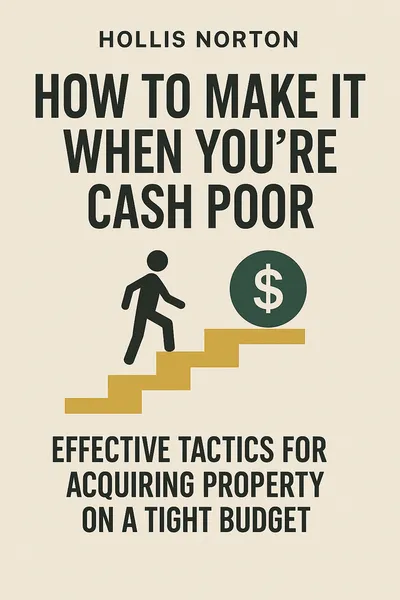
How to make it when youre cash poor
Effective tactics for acquiring property on a tight budget
Description
anyone can achieve financial independence in 5 years or less by investing in real estate. It requires hard work, creativity, and the ability to think differently, but the rewards are worth it. To get started, write down financial goals, commit time each week, involve your spouse, make offers regularly, visualize success, take seminars, read relevant books/magazines, and join real estate associations.
The only obstacle is yourself, so treat problems as opportunities and take action.
Table of contents
01 Awaiting action
Becoming financially independent through real estate investing within 5 years requires effort, not laziness. You must study, work hard, and dedicate free time. However, the technique does not involve magic or mystery. It simply requires borrowing money to buy properties that will appreciate in value over time while covering debt obligations. To build wealth differently than the herd, you must blaze new trails with resourcefulness and creativity instead of mindless plodding. Although rewarding, it demands clear thinking and decisive action. Once you understand wealth creation, you never lose the ability.

02 Bovine consumption guide
When starting out in real estate investing, begin at a level you feel comfortable with and build from there over time. Much like you wouldn't eat an entire cow at once but would happily consume it in steaks over a period, approach deals progressively. You can do very well purchasing houses alone without immediately venturing into more complex investments.
03 Real estate essentials
Real estate remains the best vehicle to turn a small investment into significant wealth relatively safely over time. While riskier ventures may generate outsized returns sporadically, real estate tends to appreciate steadily regardless of market cycles. The most accessible approach is purchasing good rental properties and holding them long-term, letting rental income build your financial independence.
04 Finding your property
Real estate investments can be made in raw land, single family homes, apartments, shopping centers or commercial buildings. Raw land may seem appealing but generates no income and requires outlays for rates and services, while not appreciating evenly nationwide. Only purchase land you can develop or that is an undisputed bargain.
05 Locating your investment
Most people know that investing in real estate is a safe and sure way to make money. Yet, fear caused by a lack of knowledge prevents most people from trying it themselves. Flexible sellers are almost always people going through a transition requiring relocation or other change, which could be caused by divorce, job issues, retirement, family changes, death in the family, etc. The key is to create a win-win situation where these motivated sellers get their property sorted out and you get the chance to make some money by providing a service.
06 Speaking with sellers
When negotiating with potential sellers, view every discussion as an opportunity to create a mutually beneficial agreement. Go into negotiations confidently—if they accept your offer, great. If not, stay positive and try again. Remember that you can provide solutions to their problems. While enthusiasm is good, make sure you fully understand their motivations and flexibility before making an offer. Initially make contact by phone, then meet in person to negotiate effectively.
07 Property value assessment
The most reliable way to estimate market value is to consult real estate brokers and review their records of recent sold prices in the neighborhoods you're considering. Some brokers may be reluctant to share this data, so don't hesitate to inquire with other brokers if needed. Another option is to request a property's tax records from the seller, which outline actual expenses. While some sellers will refuse, motivated sellers may provide these records, which can help determine accurate expenses since owners aim to maximize deductions.
08 Limited cash purchase options
When looking to purchase a property, seeking out motivated sellers who don't urgently need a large down payment can provide more flexibility. Consider proposing a lease with option to buy, installment payments on the down payment, financing from family/friends, assuming the existing mortgage, using other assets for collateral, raising the offer price in exchange for better terms, utilizing equity from other properties, buying foreclosed or government-owned discounted properties, adding closing costs to the mortgage amount, split funding the down payment over time, taking on partners to help fund the down payment, borrowing from credit unions, using tenant deposits or first month's rent for the down payment, writing a promissory note with flexible terms for the down payment amount, or charging some down payment costs on credit cards if limits allow. With a motivated, flexible seller, creative down payment options may help secure financing and ownership.
09 Cooperating with lenders
When applying for a mortgage, you'll likely get asked if there's secondary financing or what the source of your down payment is. Bankers dislike little equity. Have the seller take an unsecured personal note, especially if you know them. Transfer mortgages using other property as collateral. Buy via contract for deed not involving the bank. Have the seller refinance, take over payments, and pay the percentage the bank didn't finance.
10 No credit background
Motivated sellers provide opportunities for everyone to purchase real estate, regardless of credit history, background, or past successes and failures. The concept is to borrow from the sellers rather than banks. Good credit will prove beneficial long-term, however.
Purchasing without credit is not always the best approach for any purchase but it is realistically possible. For those with poor or no credit, here is one way to build good credit: Select the top three property investment-focused banks locally. Open savings accounts at each, depositing as much as affordable. Request $1000 loans from each bank using the savings as collateral for 6+ month terms.
11 Structuring non-problematic offers
Using debt to purchase real estate allows you to leverage your investment and multiply returns. However, you must structure the purchase to avoid negative cash flow where rents fail to cover mortgage payments. This is usually not a pricing issue but rather a lack of financing knowledge. Do not assume a low interest rate offer will automatically be rejected - start low and give the seller a chance to accept. Agents focus on sales, not creative financing. Know more than they do.
12 Trapped under balloons?
The first line of defense for an approaching balloon mortgage deadline is to have a clause in the original contract allowing the buyer to extend the mortgage for up to 18 months if prevailing interest rates seem too high for a feasible refinance. Even without this clause, ask the seller for an extension well before they might worry you're in trouble. Offer something appealing like easing their tax burden by spreading the payment over time, a higher interest rate in return for extending, or slightly higher payments plus a renewal fee.
13 Understanding returns
To determine your rate of return on a rental property investment, you need to calculate four factors and divide their sum by the amount of capital you actually invested. First, determine your net cash flow from rent income after paying expenses and debt servicing. Next, calculate the money you save on taxes due to depreciation write-offs. Third, quantify the equity build-up, which is your increasing percentage of freehold ownership in the property over time. Finally, factor in the appreciation, which is how much the property's value has increased since your purchase.
14 Early retirement planning
A lease with an option to buy benefits the owner, tenants, and buyer. The owner receives reliable rental income from tenants motivated to maintain the property because they have a path to future ownership. The tenants access better housing than they may otherwise afford while positioning themselves to purchase the home as their income grows over time.
The buyer conducting the lease-option transaction earns income exceeding costs during the rental period, a signing bonus upon sale, and potential appreciation gains. Real estate agents who earn a percentage commission dislike lease-options because their payment is deferred to the eventual sale rather than upon move-in. To generate $50,000 annual income from this strategy, seek out motivated sellers with suitable properties, offer lease-options at favorable terms, then market the properties for sale via interest-only contracts at a small premium over the option price.
15 Instant income sources
Use spare cash to build wealth through real estate. Buy discounted mortgages, then exchange the mortgages with sellers for freehold property. Refinance to buy more. Find sellers willing to accept large down payments and charge no interest as you pay off the balance over several years.
Then rent or refinance. Save interest with a shorter mortgage term - paying off a $100K 30-year mortgage in 15 years saves over $170K interest. Putting property in a trust keeps the old loan when transferring ownership - change the trust beneficiary, the trustee stays the same. With mortgages, sell notes at a discount for cash, though discounts near 50% are not ideal. Sell payments instead, discounting total cash flow.
16 Getting seller discounts
Approach sellers who have had their property on the market for a while without success. Offer to buy their property for what they would have actually received net if they had sold through an agent or broker.
Start with their asking price, then take off the following: Margin - most homes sell for 5 to 7 percent less than the asking price; Broker's commission - usually 6 percent; Closing costs - usually about $1,000 to $2,000. Show them you are prepared to pay the net amount they would have received. The harder you work at this technique of approaching discouraged sellers with a net offer, and the more creative ideas you implement, the more useful and successful it will be.
17 Owners shouldn't manage
If you want to make more money from your rental property, consider hiring a property manager instead of managing it yourself. You can likely find an individual or company looking for extra work that you like at reasonable fees. Negotiate their rates, noting you may have more properties in the future for them to manage.
18 Tax burdens and you
As you build wealth, resist selling properties for a capital gain, which converts appreciating assets to depreciating ones and triggers taxes. Instead, trade up to a property worth your original’s increased value, tax-free. Or periodically refinance, letting rental income repay higher mortgages over time, also tax-free. Refinancing multiple properties every 7-8 years can generate substantial untaxed cash flow.
19 Rent control impacts
Rent controls distort normal market forces of supply and demand. They arise due to housing shortages. Over time, they reduce incentives to develop new rentals worsening shortages. Single family homes are often exempt from controls which target larger rentals.
To handle controls, raise rents on new units to $650 per month while offering a $150 on-time payment discount. Tell tenants they qualify if payments arrive on time without bouncing checks. When controls take effect, reduce the discount to $50 for new tenants with rent still at $650.
20 Achieving victory mindset
You now face a choice between continuing the old work routine or pursuing real estate dreams. Even if quitting your job now isn't feasible, view it as a temporary inconvenience on the path to financial freedom. Shift attention to spare time money-making while still performing excellently at work. Thinking alone won't grow finances; applying these principles will. First, write specific goals, like buying two properties yearly for five years. Seeing them often keeps them top of mind.
Related books