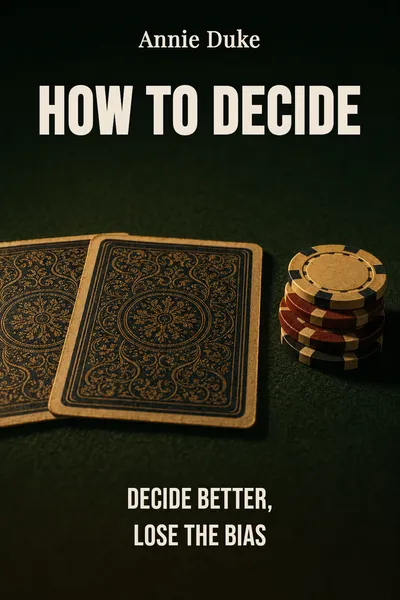
How to Decide
Decide better, lose the bias
Description
In the late 1980s, a graduate student in cognitive psychology at the University of Pennsylvania dropped out of her PhD program, sick, broke, and unsure of what came next. Her brother played poker for a living, so she borrowed the family trade. Annie Duke sat down at Montana card tables and, over roughly two decades, won more than four million dollars in tournament earnings, including a World Series of Poker bracelet in 2004. Then she quit the felt and started teaching companies, doctors, and ordinary people something she'd learned the hard way: how to decide.
Her 2020 book, How to Decide, is a workbook more than a manifesto — full of exercises, checklists, and slightly uncomfortable questions. But underneath the practical tools sits one stubborn idea that poker beat into her over years of watching skilled players go broke and reckless ones get rich. The idea is that we grade our choices on the wrong report card. We look at how things turned out and work backward, assuming the result tells us whether we chose well. Duke says that's exactly the mistake, and it's the one nearly everyone makes without noticing.
What makes the book worth sitting with is that it doesn't promise to make us right more often. It promises something stranger and more useful: a way to make good decisions that still sometimes end badly, and to know the difference. That runs against a deep instinct — the instinct that says a bad outcome must mean somebody messed up. Duke spent her career at a table where that instinct is a fast way to lose money.
The question we’re asking : If good decisions can end badly and bad ones can end well, how do we ever tell whether we're deciding well at all?What we’ll see : How a poker player's toolkit pulls apart the choice we make from the hand luck deals us — and what's left to actually work with.
Table of contents
01 Chapter 1 — The scoreboard lies
Duke opens with a word she borrowed from poker: resulting. It's the habit of judging a decision by how it turned out. Someone runs a red light, gets home safe, and calls it fine. Someone buckles up, drives carefully, and gets hit anyway — bad luck, we say, but rarely a bad decision. The trouble is we apply the logic inconsistently. When things go well, we credit our judgment. When they go badly, we blame circumstance or the other guy. And when we're grading someone else, we do the reverse.
The problem is that outcomes are noisy. Between the moment we choose and the moment we find out, luck gets a vote — often a loud one. A sound bet on a strong hand still loses if the last card betrays it. A reckless bet on a weak one still wins if the deck is kind. If we only ever look at who won the pot, we learn the wrong lessons: we start imitating the lucky fool and second-guessing the careful player who got unlucky.

02 Chapter 2 — Two knobs: luck and skill
Once we stop trusting outcomes on their own, the obvious question is what to trust instead. Duke's answer is to treat every result as a mix of two ingredients: the quality of the decision and the roll of the dice. She likes to picture two knobs. One is how much of an outcome you can influence; the other is how much is left to chance. Chess is nearly all skill; a slot machine is nearly all luck. Almost everything real — careers, health, business, love — sits somewhere in the messy middle, and we're bad at estimating where.
This is where poker earns its place in the book. A hand of cards is a laboratory for exactly this problem, because you get thousands of quick results where skill and luck are visibly tangled. Duke learned to ask, after a hand went wrong, whether she'd played it well given what she knew — not whether she'd won. Losing with the better decision was fine; it was even the goal, hand after hand, because the math eventually rewards it. Winning with a bad one was a warning, not a trophy.
03 Chapter 3 — The archaeology of a good decision
So what does a good decision look like from the inside, before any result arrives? This is where How to Decide turns into a workbook. Duke wants us to build what she calls decision fitness — a set of habits that make the process itself sturdier, regardless of how any single call lands. The tools are unglamorous on purpose, because the failures they target are the quiet ones we don't notice in the moment.
The first is honest with ourselves about knowledge. For any choice, some of the outcome sits inside a zone we understand and some sits in the dark. Duke has us name our estimate and, crucially, put a number on our confidence — not "I think this'll work" but "I'm about seventy percent sure." The number forces the vagueness out of hiding. It also gives our future self something to check against, instead of the fog of "I always knew it."
04 Chapter 4 — The friend who read the book on chance
Step back from the exercises and Duke is really making an argument about how to live in a world we don't run. Most of the advice we absorb about decisions assumes that with enough effort we can be right — that certainty is the reward for diligence. Poker teaches the opposite. You can play flawlessly and lose, play badly and win, and the only sane response is to stop demanding certainty and start managing probability. How to Decide is, underneath the worksheets, a quiet case for growing up about luck.
That's a harder sell than it sounds, because our culture rewards the confident story. We admire the founder who bet everything and won, and we rarely ask how many identical bettors went broke and vanished from the anecdote. Duke's framework asks us to hold two things at once: to act decisively while admitting we might be wrong, to commit to a choice while knowing chance could still sink it. It's the mindset of someone placing a smart bet, not someone claiming to know the future.
05 Conclusion
The graduate student who left her PhD to play cards ended up building a second career out of the one lesson the felt kept repeating: the pot you win tells you almost nothing about how you played. How to Decide takes that hard-won humility and hands it to people who will never sit at a poker table — the manager weighing a hire, the couple choosing a city, the patient facing options no doctor can rank with certainty. Its method is less about being clever than about being honest, mostly with ourselves, about what we knew and what we merely hoped.
Related books