

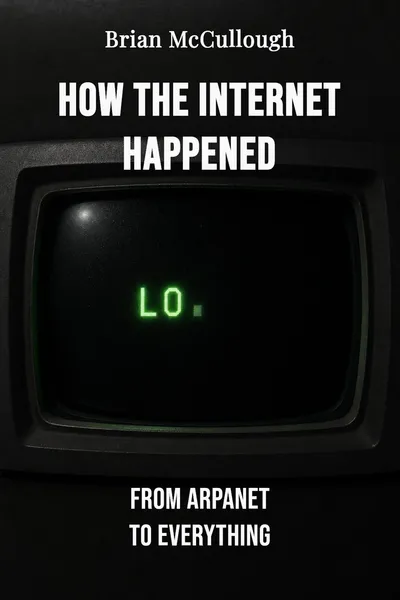
How the Internet Happened
From ARPANET to everything
Description
On a spring afternoon in 1969, a small team at UCLA tried to send a message to a computer at Stanford Research Institute, roughly four hundred miles up the California coast. The plan was to type the word LOGIN. They got as far as the L and the O before the system crashed. That halting two-letter transmission was the first message ever sent over ARPANET, the research network funded by the U.S. Defense Department that would, over the next three decades, grow into the thing we now spend most of our waking lives inside.
In How the Internet Happened, tech writer Brian McCullough tells the story of what came after that crash — not as a tale of visionaries executing a master plan, but as a messy, contingent scramble. Packet-switching, the web browser, the search box, the online store, the social feed: each arrived because someone solved a narrow problem, often stumbled into a bigger one, and rarely knew what they were building. The giants that ruled one decade — Netscape, AOL, Yahoo — were roadkill by the next.
McCullough's account runs from that first crashed login through the dot-com boom and bust and on to the smartphone era, and its through-line is quietly unsettling: the network that now organizes commerce, politics, and attention was never really designed. It accreted. Which raises the obvious question about the world it produced.
The question we’re asking : If nobody set out to build the internet we actually got, who — or what — did the deciding?What we’ll see : How a Cold War research project became the substrate of everyday life, one improvised commercial gamble at a time.
Table of contents
01Chapter 1 — The network built to survive
The origin myth most people carry is that the internet was designed to survive a nuclear attack. McCullough is careful here: the truth is close but not quite that clean. ARPANET, launched in 1969 by the Advanced Research Projects Agency, was built to let expensive university computers share resources across long distances, at a time when a single mainframe cost a fortune and sat idle for much of the day. Resilience mattered, but the immediate driver was thrift and research convenience, not doomsday.
The technical breakthrough underneath it was packet-switching, worked out in the early 1960s by researchers including Paul Baran and, independently, Donald Davies in Britain. Instead of holding open a dedicated line between two points the way a phone call did, the idea was to chop a message into small packets, send each one along whatever route was free, and reassemble them at the far end. No single path was essential. If part of the network went down, the packets simply took another way around. That design choice — distributed, no central switchboard — is the reason the thing scaled the way it did.

02Chapter 2 — The web made it usable
The turn from network to phenomenon runs through one man solving a small, practical irritation. In 1989, Tim Berners-Lee, a British software engineer at CERN, the physics laboratory near Geneva, was frustrated that researchers couldn't easily share and link documents across incompatible systems. His proposal — a system of pages written in a simple markup language, addressed by unique locators, and connected by clickable links over the existing internet — was the World Wide Web. He wrote the first browser and server himself, and in 1991 the web went public. Crucially, CERN released it royalty-free. It belonged to no one, which is a large part of why it spread.
McCullough's point is that the internet and the web are not the same thing, and conflating them hides where the real shift happened. The internet was the plumbing; the web was the interface that made the plumbing bearable for humans. A link you could click was a radically different proposition from a command you had to memorize. Suddenly information had a surface anyone could touch.
03Chapter 3 — Netscape, the browser wars, and the bubble
In 1994, Andreessen teamed up with the veteran entrepreneur Jim Clark to found what became Netscape, and its browser, Navigator, swept the early web. Then came the moment McCullough treats as the true starting gun of the internet economy: Netscape's initial public offering in August 1995. The company had almost no profits, yet its shares more than doubled on the first day, valuing a barely-two-year-old firm at over $2 billion. Wall Street had just been shown that a web company could mint fortunes on promise alone, and the message landed.
What followed was a scramble. Microsoft, which had nearly missed the web entirely, turned its full weight against Netscape, bundling its own Internet Explorer free with Windows. The browser wars that followed were brutal and, for Netscape, fatal — an antitrust case against Microsoft would drag on for years, but by the time it resolved, Navigator's market share had collapsed. Meanwhile America Online, or AOL, took a different route to dominance: it didn't try to be the best network, it tried to be the easiest. Those ubiquitous mailed CDs and the walled-garden simplicity brought tens of millions of first-time users online, and in 2000 AOL used its inflated stock to buy Time Warner in a deal worth around $165 billion — later remembered as one of the worst mergers in corporate history.
04Chapter 4 — The platform economy nobody planned
The companies that walked out of the wreckage were the ones that had quietly solved a real problem while everyone else chased hype. Amazon, launched by Jeff Bezos in 1994 as an online bookstore, had spent the boom years building logistics and enduring losses, and emerged as the default place to buy nearly anything. Google, founded in 1998 by Stanford students Larry Page and Sergey Brin, had cracked the problem the whole web now had — too much information, no good way to find it — with an algorithm that ranked pages by who linked to them. Search turned out to be where the money and the power were.
This is where McCullough's larger argument comes into focus, and it's less a verdict than an observation about how the whole thing was assembled. Nobody sat down and designed an internet organized around a few enormous platforms that would know what billions of people read, buy, and think. It emerged, decision by commercial decision, from a system explicitly built to have no center. The packet-switched network had no gatekeepers by design; the web was released free to anyone; the browser was given away. Openness at every layer was the founding condition — and yet the endpoint was concentration on a scale earlier monopolists could only dream of.
05Conclusion
Go back to that crashed login at UCLA in 1969, the L and the O and then the silence. Everything that followed — the clickable link, the browser your parents could use, the IPO that lit the fuse, the store and the search box that outlived the bubble — sits downstream of a system that was designed to be resilient and open, with no one at the switchboard. McCullough's achievement is to show that the internet's defining features were not chosen so much as arrived at, each solving a modest problem and quietly enabling the next.