How Not to Be Wrong
Math's antidote to bad thinking
Description
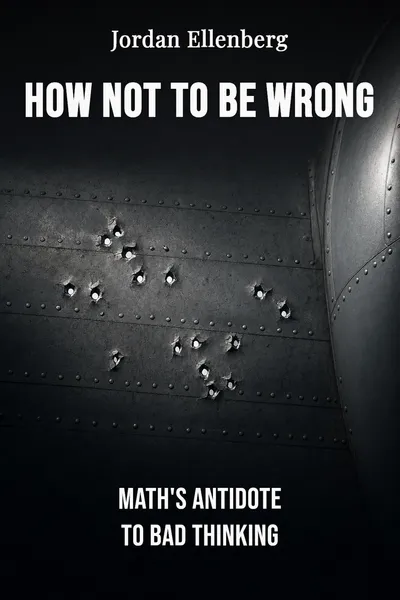
During the Second World War, a group of statisticians in a Manhattan office were handed a practical problem: American bombers were coming back from Europe riddled with bullet holes, and the military wanted to add armor. Armor is heavy, so you can only add it where it counts. The engineers mapped where the returning planes had been hit — the fuselage, the wings — and proposed reinforcing those spots. A mathematician named Abraham Wald looked at the same data and said the opposite. Put the armor where the holes aren't.
His reasoning was quietly devastating. The bullet holes on returning planes marked the places a bomber could take damage and still fly home. The planes hit in the engines weren't in the sample at all — they were at the bottom of the Channel. The data everyone was staring at had a hole of its own, an absence nobody thought to count. This little story sits near the front of Jordan Ellenberg's How Not to Be Wrong, and it does a lot of work. It shows that the useful mathematical move was not a calculation. It was a question about which numbers were even there.
That is the wager of the whole book. Ellenberg, a working mathematician at Wisconsin, wants to pull math out of the classroom, where it lives as a set of procedures to be endured, and hand it back as something closer to a way of paying attention. Not the arithmetic — the reasoning. The habit of asking what a figure is quietly assuming before we let it push us around.
The question we’re asking : What does it actually mean to think mathematically, once we stop confusing it with being good at sums?What we’ll see : How a handful of ideas — nonlinearity, improbability, expectation, inference — turn math from a school subject into a defense against confident nonsense.
Table of contents
01Chapter 1 — The bullet holes that came back
Wald's insight is the kind of thing Ellenberg keeps returning to, because it isolates what mathematics adds and what it doesn't. The engineers weren't bad at data. They collected it carefully and read it honestly. What they missed was structural: the sample selected itself. Only survivors came home to be measured, so the pattern in the survivors said as much about who survived as about where planes get shot. Statisticians now call this survivorship bias, and once you have the name, you start seeing it everywhere it doesn't belong.
The point Ellenberg presses is that Wald didn't need heavier machinery than the engineers. He needed a sharper question. Mathematical thinking, in this telling, is less about grinding through equations and more about noticing the assumption folded invisibly into a claim. Where does this number come from? Who is missing from it? What would the world look like if the opposite were true? These are not technical questions. They're the questions a careful person asks, made systematic.

02Chapter 2 — When the line stops being straight
One of Ellenberg's favorite mistakes is the assumption that lines keep going straight. We reason in straight lines almost by default: if a little of something is good, more must be better; if a trend rose this year, extend it and read off next year. The trouble is that the world is mostly made of curves, and treating a curve as a line works right up until it doesn't. He has fun with a projection, floating around a few years ago, claiming that a huge share of Americans would be overweight by some future date — a figure produced by drawing a straight line through recent data and following it off the edge. Follow it far enough and eventually more than everyone is overweight, which is a clue the line was never straight.
The deeper example is the Laffer curve, the idea behind the argument that cutting tax rates can raise tax revenue. Ellenberg's treatment is a small masterclass in fairness. The curve is real and the underlying logic is sound: a tax rate of zero raises no money, and a rate of one hundred percent raises almost none either, because nobody bothers to earn income the state will simply take. Somewhere between those extremes, revenue peaks. That much is just arithmetic about a hump-shaped curve.
03Chapter 3 — The improbable happens all the time
We are terrible judges of coincidence, and Ellenberg spends a good part of the book explaining why. Confronted with something unlikely — a strange cluster of illnesses, a hidden message spelled out in an ancient text, a run of lucky numbers — our instinct is to conclude that something meaningful is going on. The mathematical reflex is to ask a colder question first: given how many chances there were for something surprising to happen, how surprising is this particular thing, really?
The famous case here is the so-called Bible code, where researchers claimed to find prophecies encoded in the letter patterns of Hebrew scripture. Ellenberg walks through why this collapses under scrutiny: if you search a long enough text with enough flexibility about what counts as a hit, you will find patterns, because patterns are what large random datasets are made of. The clinching move was when critics ran the same method on other texts, including Moby-Dick, and found it foretelling assassinations just as tidily. The signal was in the searching, not the scripture.
04Chapter 4 — Every number is an argument in disguise
Step back from the individual tricks and a single posture runs through all of them. Ellenberg is not teaching us to compute; he's teaching us to distrust the finished number handed across the table. A statistic arrives looking neutral, like a fact of nature, but it always got made — someone chose what to measure, who to count, where to draw the line, how far to extend the trend. Mathematical thinking, in his account, is the habit of reopening that closed box and asking how the number was built before letting it decide anything.
This reframes what the book is even for. It is not a manual for winning arguments with equations, and it is emphatically not a celebration of certainty. Quite the opposite: the recurring virtue is comfort with not knowing. The mathematician's stance is to say clearly what we can conclude, what we cannot, and how confident the evidence actually licenses us to be — no more. Ellenberg draws a line between that disciplined humility and the false precision of a figure quoted to three decimal places by someone who has no idea where the last two came from.
05Conclusion
Abraham Wald sent his armor to the places where the surviving planes showed no damage, and he was right, because he had thought about the planes that never came back. The move that saved lives wasn't advanced mathematics. It was refusing to take the visible data at face value — asking what the sample was quietly leaving out. That single reflex, applied to bombers, is the reflex Ellenberg spends the whole book teaching us to apply to trends, coincidences, studies and statistics.
Related books