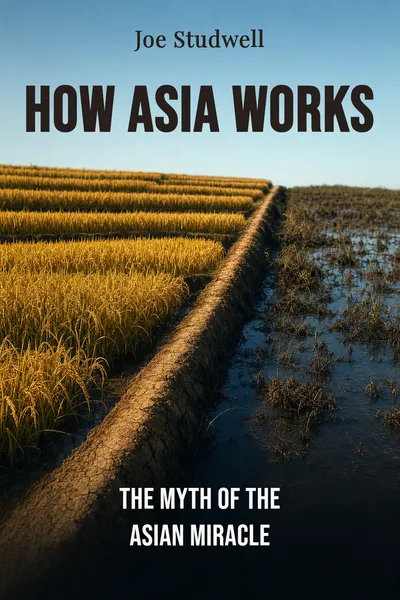
How Asia Works
The myth of the Asian miracle
Description
For a stretch of the 1980s and 1990s, the West talked itself into a story. Japan was going to buy the world; then China would inherit it. A cluster of smaller economies got branded with zoo names — tigers, mini-dragons — and the whole region got flattened into a single narrative. East Asia was rising, it was rising together, and it was rising because of something shared: Confucian discipline, a taste for saving, a knack for hard work. The economies looked interchangeable from a distance, so people assumed the causes were interchangeable too. It made for tidy magazine covers and terrible analysis.
Joe Studwell, a journalist who spent two decades reporting from the region, wrote How Asia Works in 2013 to take that story apart. His starting point is deceptively simple: some Asian economies got spectacularly rich, and some — often right next door, with similar cultures and similar resources — stayed poor or fell over. The Philippines and Korea were not so different in 1960. By 2010 one was a manufacturing power and the other was exporting nurses. If culture explained the miracle, the map should look very different than it does.
So the question isn't whether Asia worked. Parts of it worked extraordinarily well, and parts of it didn't, and the two groups did measurably different things. Studwell's argument is that development is less a mystery than a recipe — a sequence of unglamorous policy choices, done in a specific order, often against the advice the rich world was busy handing out. The countries that followed the sequence prospered. The ones that took the fashionable shortcuts stalled.
The question we’re asking : If culture and geography don't explain why some Asian economies took off and others didn't, what actually does?What we’ll see : How a handful of governments engineered prosperity through a sequence of hard, unfashionable choices — and why the neighbours who skipped it stayed poor.
Table of contents
01 Chapter 1 — Two Asias, not one
The single biggest move in Studwell's book is to stop treating Asia as a bloc. The success cases he keeps returning to are Japan, South Korea, Taiwan, and — later, partially — China. The cautionary tales are the Philippines, Thailand, Indonesia, and Malaysia. These weren't sorted by culture or climate. They were sorted by what their governments actually did with land, factories, and money.
The cultural explanation collapses on contact with the map. If a Confucian work ethic were the engine, the Philippines and Thailand should have surged too; instead they lagged. If tropical geography were the curse, Singapore and coastal China should have been doomed; instead they thrived. The variables that supposedly explained everything turn out to be shared across winners and losers alike. Something else was doing the work.

02 Chapter 2 — Land to the tiller
The first step is the one Western advisers found hardest to swallow: radical land reform. In a poor country, most people are farmers, so the fastest way to raise national output is to raise what those farmers produce. Studwell's counterintuitive claim is that the way to do that is to break big estates into tiny household plots — the opposite of the efficiency logic that says bigger farms are better.
The reason is that a family working its own small plot has every incentive to squeeze the maximum out of every square metre. They plant intensively, tend constantly, and use labour that would otherwise sit idle. Yield per hectare on these small owner-farmed plots turns out to be higher than on large mechanised estates, even if output per worker is lower. In a country with too many people and too little capital, output per hectare is exactly the number you want to maximise.
03 Chapter 3 — Making before markets
The second step is manufacturing. Once agriculture is generating a surplus, a developing state has to push that surplus into factories — specifically factories that make things and sell them abroad. Studwell insists on manufacturing rather than services or resource extraction, because making complex products is how a workforce and a set of firms actually learn. You climb the ladder by building televisions, then cars, then microchips.
The engine here is what he calls export discipline. Governments in Japan, Korea, and Taiwan protected and subsidised infant industries heavily — but they attached a brutal condition. A firm that couldn't compete in export markets lost its support. Selling abroad became the test that separated the companies worth backing from the ones milking the state. This is the difference between the tigers and, say, much of Latin America, where protection was handed out with no such test and firms grew fat and lazy behind tariff walls.
04 Chapter 4 — Finance kept on a leash
The third step is where Studwell's argument bites hardest against the orthodoxy of his own era, and it steps the whole book back into a bigger claim about how development actually works. Finance, he argues, has to be subordinated to the first two goals. In the success cases, banks were not free to lend wherever returns looked highest. The state directed credit toward farmers and toward exporting manufacturers, and it held down the temptations — consumer lending, real-estate speculation, quick money — that pull capital away from the slow work of building productive capacity.
This is the opposite of what the international consensus preached from the 1980s onward. Open your capital markets, the advice ran; let money flow freely; let interest rates and investors decide. Studwell reads the Asian financial crisis of 1997 partly as the bill for taking that advice too early. Thailand, Indonesia, and Korea had loosened controls and let in torrents of short-term foreign money; when confidence flipped, the money fled overnight and the economies buckled. Korea, having built real industrial muscle first, recovered fast. The others, with weaker productive foundations, took far longer.
05 Conclusion
The tigers were never a single organism rising on shared virtue. They were a set of governments that made a specific bet — that a poor country could engineer its way to wealth by fixing farms, forcing firms to compete abroad, and keeping money on a short leash until the other two jobs were done. The neighbours who looked culturally identical but skipped the sequence ended up somewhere else entirely, which is the cleanest evidence that the recipe, not the region, did the work.
Related books