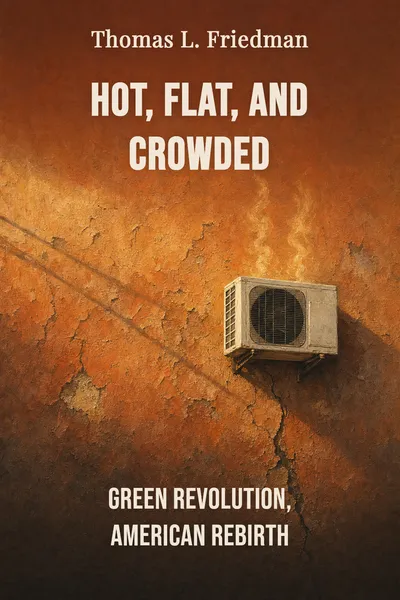
Hot, Flat, and Crowded
Green revolution, American rebirth
Description
In 2008, the world Thomas Friedman had spent a career describing as "flat" — connected, competitive, leveled by technology — suddenly looked like it was running out of room. In Hot, Flat, and Crowded, the New York Times columnist and three-time Pulitzer winner takes the argument he made famous and pushes it one step further. Being flat was only ever half the story. The other half was that this newly connected planet was also warming fast and filling up with people who all wanted the same middle-class life, with the same cars, refrigerators and air conditioners. Put those together and the twenty-first century starts to look less like a golden age of globalization and more like a stress test.
Friedman's frame is deceptively simple. Hot means a climate destabilized by carbon we keep burning. Flat means billions of people newly able to consume the way Americans have for decades. Crowded means a population racing toward nine billion. None of these on its own is new. What is new, he argues, is the collision — the moment all three arrive at full force at the same time, feeding each other, until they stop being separate problems and become one system under pressure.
And here the book turns, unexpectedly, into a book about America. Friedman doesn't write as a scold delivering an environmental verdict. He writes as someone convinced his own country has lost its edge — grown flabby, distracted, addicted to cheap oil and dependent on the regimes that sell it. The green revolution, in his telling, isn't a sacrifice America must endure. It's the one project big enough to make the country itself again.
The question we’re asking : What happens when a warming planet, a leveling economy and a swelling population arrive at exactly the same moment — and can the response be a source of renewal rather than loss?What we’ll see : How Friedman fuses climate, economics and demography into a single argument, and why he insists the answer runs through American reinvention rather than restraint.
Table of contents
01 Chapter 1 — The three trends colliding at once
Friedman builds his case around a word he coined earlier and now sharpens: the planet has gone hot, flat, and crowded, and the trouble is that all three happen together. Take them apart and each is familiar. Climate scientists have warned about warming for decades. Economists have tracked the rise of Asia for a generation. Demographers have plotted population curves since the 1960s. What the book insists on is the interaction — the way each trend amplifies the other two until they behave like one force.
Consider the flattening. The same connectivity that let a call-center worker in Bangalore compete with one in Ohio also let hundreds of millions of people glimpse the American standard of living and decide they wanted it. That aspiration is entirely reasonable. It is also, at scale, a carbon problem. When Friedman writes about a family in a fast-growing city buying its first car and its first refrigerator, he isn't judging them. He's doing arithmetic. Multiply that reasonable desire by billions and the demand for energy, meat, water and materials climbs past anything the old model can supply cleanly.

02 Chapter 2 — The energy-climate era and its price of admission
If the three trends have merged into a single condition, Friedman gives that condition a name: the Energy-Climate Era. The label is meant to do real work. Just as historians speak of an Industrial Age with its own logic and its own winners, he argues we've entered a period defined by five intertwined problems — energy supply and demand, petro-dictatorship, climate change, energy poverty, and biodiversity loss. They are not five issues on a checklist. They are five faces of one thing, and any policy that treats only one of them tends to make the others worse.
The link he presses hardest is between the gas pump and geopolitics. Friedman coins what he calls the First Law of Petropolitics: as the price of oil goes up, the pace of freedom tends to go down in states that live off it. Cheap Western consumption, in this reading, is quietly funding regimes that have every incentive to stay unaccountable. The 4x4 in an American driveway and the politics of an oil-exporting capital are wired to the same meter. Energy stops being an environmental footnote and becomes a matter of national security.
03 Chapter 3 — Why "green" stopped meaning soft
Here Friedman picks a fight with a word. For decades, he argues, "green" carried a whiff of the wholesome and the marginal — recycling bins, canvas totes, a private virtue you performed to feel better. Corporations reached for it as a marketing color. Politicians used it to sound caring without spending. That version of green, he insists, is almost useless against a problem the size of the Energy-Climate Era. Feeling good is not a strategy.
What he wants instead is green rebuilt as a hard-edged, systemic word — closer to "industrial" or "national defense" than to "lifestyle." The real lever, in his analysis, isn't consumer guilt but the price signal and the innovation it unlocks. As long as dirty fuels stay artificially cheap, because their true costs to climate and security never appear on the receipt, no amount of good intentions will move the market. Make clean energy the smart economic bet and you don't need to persuade people to be virtuous. You just need to let them be rational.
04 Chapter 4 — Code Green as national rebirth
Step back, and the argument reveals what it was really about all along. Friedman calls his program Code Green, and its ambition is national before it is environmental. He looks at the America of the late 2000s and sees a country that has stopped doing hard things — coasting on cheap oil, borrowing against the future, dependent on the very regimes it distrusts, and quietly convinced that its best days are behind it. The green revolution, in his hands, becomes the test of whether a society can still summon a great collective effort at all.
This is the deeper move of Hot, Flat, and Crowded. The climate crisis is not framed only as a threat to be survived but as an opportunity to be seized — the one challenge large enough to demand the innovation, the manufacturing, the engineering talent and the sense of shared mission that Friedman associates with America at its best. He reaches for the memory of the space race and wartime mobilization not out of nostalgia but as proof that the country has, before, turned a frightening problem into a burst of renewal. Leading the clean-energy transition, he argues, would rebuild not just the grid but the national self.
05 Conclusion
Friedman began by taking his own famous idea and admitting it was incomplete. Flat was never enough; the planet was also hot and crowded, and the three arriving together changed everything. From that collision he built a case that runs, almost against expectation, from atmospheric chemistry to national morale — arguing that the response to a warming world would decide not only the climate but the character of the societies forced to answer it.
Related books