
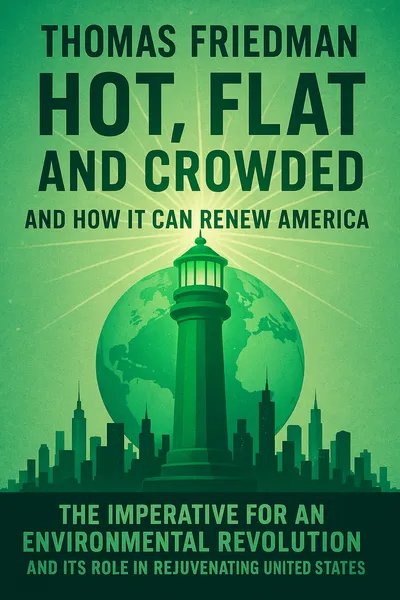
Hot flat and crowded and how it can renew america
The imperative for an environmental revolution and its role in rejuvenating the united states
Description
Global warming, globalization, and population growth are converging to shape the future of civilization. Addressing these challenges requires a revolutionary, greener approach to energy production and usage. This presents a significant opportunity for the United States to lead the way in developing green energy sources, bolstering its economy and reinforcing its position as a global business leader.
The construction of a green power infrastructure could create investment opportunities, new jobs, and solidify global leadership. Thomas Friedman suggests that America can regain its momentum by leading the world in solving these pressing issues. He proposes a project named 'Code Green', likening the urgency of the green movement to the 'red' threat of the mid-20th century.
Table of contents
01 Current position overview
The world is currently facing a self-inflicted crisis as several trends converge, creating unstable conditions. At the same time, America is dealing with its own unique challenges, having lost its sense of direction in recent times. The optimal solution for America's problem lies in leading the resolution of the world's major issues. If America can develop the necessary tools, systems, energy sources, and ethical frameworks to enable sustainable global growth, it will reequip itself to thrive in the future.
Three key global trends define the present era. Firstly, there is a widespread scientific consensus that our planet is undergoing a warming trend that surpasses natural fluctuations, largely attributed to human activities linked to large-scale manufacturing. This is the cumulative effect of burning fossil fuels for electricity, deforestation, significant changes in agriculture, and industrialization, all of which have led to unprecedented levels of greenhouse gas emissions.
Secondly, the economic landscape has somewhat leveled, enabling more individuals than ever before, from virtually anywhere in the world, to participate in the global economy. This has resulted in millions more people being classified as middle-class consumers. The catalysts for this trend have been the personal computer, digitization, the Internet, and a revolution in collaborative work practices.

02 Historical context
Global population surge and resource scarcity
The global population is expected to hit 9 billion by 2050, intensifying the race for dwindling resources. In 2004, oil prices soared, driven not by middle eastern turmoil but by rising demand from developing nations—a trend that persists despite nearly 2.4 billion people living on under $2 a day. As countries develop, energy use spikes, with many aiming for the american middle-class lifestyle, seen as a benchmark of prosperity. However, this model is increasingly viewed as unsustainable, likened to a missed bus for latecomers who must now walk.
The scale of this issue is vast, particularly in india and china, where over 200 million have escaped poverty in recent decades, adopting urban middle-class lives. Countless millions await their chance, reflecting a global pattern no government can refuse, as economic advancement is deemed a right. This progress strains resources, including food, materials, fuel, housing, and infrastructure. With americans as top energy consumers, the push for more electricity is relentless.
Jeff wacker, a futurist at electronic data systems corporation, warns that american capitalism's nature, once a prosperity driver, now threatens it. He advocates for a foundational shift, arguing that neither china's nor america's existing models can sustain further growth. A new foundation is imperative, as we've hit the limits of the old one.
Wealth shift to petrodictators
The global energy market is characterized by significant financial flows from energy-consuming nations to energy-producing ones, often governed by undemocratic leaders who may prioritize personal agendas over national development and education. Western dependence on oil has several negative consequences, including empowering a branch of islam that resists modernization and the west, funding a rollback of post-cold war democratic trends in various regions, and indirectly financing terrorism through energy purchases. Additionally, competition for oil resources leads to reluctance in addressing human rights issues in oil-rich nations.
The environmental impact of burning fossil fuels, contributing to global warming, is another concern. There is also an observed inverse relationship between oil prices and the progress of freedom in oil-rich states, with higher prices correlating with less transparency and democracy.
Peter schwartz, chairman of the global business network, criticizes the current american energy policy for increasing demand, limiting supply, and relying heavily on purchases from hostile producers. The solution is not to bankrupt oil producers, which could lead to poverty-induced instability, but to develop renewable energy sources that could reduce global oil demand. This would encourage oil-rich states to diversify their economies and innovate, aligning with thomas friedman's suggestions for a politically improved world.
Escalating human-induced climate change
The term 'global warming' can be misleading as it implies a uniform and benign process focused solely on temperature increases. In reality, climate change encompasses a wide array of effects, including alterations in precipitation, humidity, soil moisture, atmospheric patterns, storm severity, snow and ice cover, and ocean currents. The impacts on human welfare are overwhelmingly negative, overshadowing any potential benefits. Hunter lovins, co-founder of the rocky mountain institute, suggests 'global weirding' as a term that better captures the erratic and complex nature of the changes we are witnessing.
The majority of climatologists agree that human activities are significantly influencing the earth's climate, and there is mounting concern that we may be moving from a phase of manageable and reversible effects to one where the impact is uncontrollable and likely irreversible. As research into earth's climate continues, the interplay between different aspects of climate change is becoming more apparent, convincing even former skeptics of the profound transformations occurring. The debate may persist over specific causes, but it is increasingly hard to deny that climate science is far from uneventful. The current dynamic and troubling state of the climate is a call to action that cannot be ignored.
03 Dominant economic nations
Cultivate political resolve
Transitioning to code green requires establishing a governmental framework that includes policies, regulations, research funding, and tax incentives to foster innovation, production, and implementation of clean energy, energy efficiency, and resource productivity. This approach also emphasizes a conservation ethic, demanding a holistic strategy for a comprehensive response. However, embarking on such a national industrial project necessitates significant political will, transcending party lines and gaining acceptance from corporations and consumers alike. It involves confronting entrenched interests, as advancing a genuine code green agenda is not about finding simple solutions but represents an unprecedented non-war effort in human history. The question of whether a political leader can emerge to commit the united states to this endeavor remains open. As harvard philosopher michael sandel notes, when all sides claim to support a cause, it may indicate the problem hasn't been adequately defined as a real political issue. True social, economic, and political change is contentious and requires shared sacrifice and political determination. Politics involves making difficult choices, not just feel-good posturing. A serious green agenda will only emerge from real debate, indicating a readiness to tackle the energy challenge head-on.
Establish renewable energy grid
The energy internet (ei) is a revolutionary concept that aims to transform the traditional power grid into a smart, interconnected system capable of integrating renewable energy sources and facilitating energy sharing globally. Unlike the current grid, which focuses on providing reliable, omnipresent power with excess capacity for peak demands, the ei introduces intelligence into the system, enabling a more efficient and sustainable approach to energy production and consumption. This smart grid would allow for the integration of clean energy from any location, offering compensation to producers and enabling electrical devices to operate at optimal times for a balanced load, significantly reducing capital and energy costs. Consumers would be charged based on actual generation costs, which vary throughout the day and across seasons, encouraging the use of energy during off-peak times. Additionally, electronic devices could communicate with power utilities to optimize energy sharing, and consumers could sell back their own generated power. This capability to control demand and source clean power globally could lead to fewer power plants, enhanced energy efficiency, and increased use of renewables, smoothing energy demand fluctuations. Thomas friedman envisions the ei as a catalyst for growth, driving innovation, and sustainably lifting people out of poverty on an unprecedented scale by merging the revolutions of information technology and energy technology.
Reform market pricing structures
Thomas friedman emphasizes that addressing the challenges of the energy-climate era requires innovation rather than regulation. He argues that the transformative power of the u.S. Marketplace for innovation and commercialization, driven by the motive of profit, is a crucial force in this struggle. According to friedman, establishing a clean energy market in the u.S. Could mobilize thousands of inventors, leading to a mix of enhancements to existing technologies and radical new approaches. However, for such a market to emerge, government intervention is necessary to level the playing field, possibly through measures like taxing high carbon-emitting sources, subsidizing clean power innovation, setting a minimum oil price, introducing a carbon tax or cap-and-trade system, implementing a federal gasoline tax, offering "feebates" for fuel-efficient cars, or establishing a national renewable energy mandate. The choice of mechanism is less important than the need to stimulate the clean energy market. Friedman recalls a warning from the 1970s by saudi arabian oil minister sheikh ahmed zaki yamani, who cautioned against raising oil prices too quickly as it could spur innovation in renewable energy in the west, illustrating his point with the analogy that the stone age didn't end due to a lack of stones, but because alternative materials like bronze and iron were developed.
04 Dominant economic nations
As the United States considers a national clean energy initiative, it is suggested that China would follow, driven by the need to join the global clean energy market. Both countries must adopt greener energy practices to maintain economic leadership. China's rapid economic expansion, once fueled by prioritizing growth over environmental concerns, is now deemed unsustainable due to its large population and increasing emissions that could undermine global environmental efforts. Thus, transitioning to clean energy is crucial.
Related books