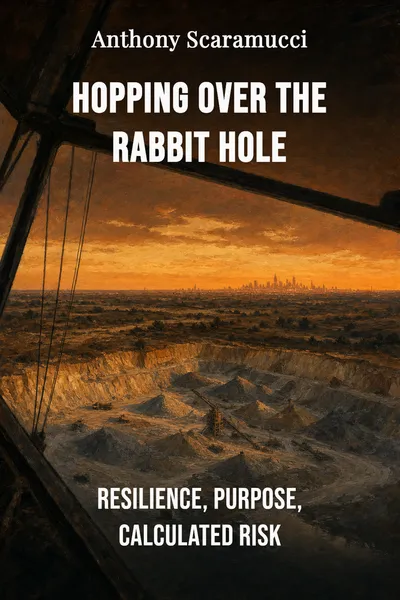
Hopping over the Rabbit Hole
Resilience, purpose, calculated risk
Description
In 1989, a working-class kid from Port Washington, Long Island, walked into Goldman Sachs with a Harvard Law degree and a chip on his shoulder. His father had operated a crane in a sand-and-gravel pit. Within two years, Anthony Scaramucci was fired from the firm he'd fought to enter. He talked his way back in a few months later, into a different division, and stayed for another five years before leaving to start his own thing. That sequence — the entrance, the fall, the return — became the template for everything he'd later write about building a business.
The thing he built, SkyBridge Capital, nearly died in its first years. He launched it in 2005, sold the original incubator business, then bought a fund-of-funds operation in 2010 just as the world was still picking itself up from the 2008 crash. He turned it into a several-billion-dollar firm and launched SALT, a Las Vegas conference that became a fixture of the hedge-fund calendar. None of it ran in a straight line. The story he tells in his book is less a victory lap than a field report from someone who kept getting knocked over and kept standing back up.
"Hopping over the Rabbit Hole" takes its title from Alice in Wonderland — the idea being that an entrepreneur has to jump into the unknown rather than fall into it, eyes open, by choice. Scaramucci wrote it as a practical handbook, drawn from his own wins and his own embarrassments, for anyone thinking about making that jump. What's striking is how little of it is about being clever, and how much is about temperament.
The question we’re asking : What does Scaramucci say it actually takes to start something and survive it — and how much of that is skill versus character?What we’ll see : The making of a entrepreneur who treated failure as tuition, the mechanics of money and people, and what he insists holds it all together when the deals dry up.
Table of contents
01 Chapter 1 — The kid from Port Washington who refused to stay down
Scaramucci is unusually candid about where he started, because the where matters to the argument. He grew up in a blue-collar Italian-American family on Long Island, the son of a man who worked in construction aggregates for decades. There was no Rolodex of finance contacts, no summer at a family hedge fund. What there was, he says, was a particular kind of hunger that comes from watching your parents work hard for modest money — and a refusal to be intimidated by rooms full of people who'd grown up with more.
That refusal got tested fast. He made it to Tufts, then Harvard Law, then Goldman Sachs, climbing rungs that weren't built for someone with his background. And then, early in his career, Goldman let him go. He describes the humiliation plainly: the walk out of the building, the call home, the sense that the whole improbable run had ended. What he did next is the part he wants the reader to sit with. He didn't accept the verdict. He lobbied to come back, landed in a different group, and rebuilt his standing from a worse starting position than the one he'd lost.

02 Chapter 2 — Getting fired, then betting on himself in the rubble
The Goldman years gave Scaramucci the trade he'd build a career on: connecting investors with funds, and understanding how money actually moves between people who have it and people who can grow it. But the firm was always going to be someone else's house. In 2005 he left to start SkyBridge Capital, and the early version of the business was a different animal from what it became — an incubator seeding new hedge-fund managers. He eventually sold that piece, a decision that looked at the time like an admission the original idea hadn't worked.
Then came the move that defines the book's appetite for risk. In 2010, with the financial crisis still fresh and fund-of-funds structures deeply out of fashion, Scaramucci bought a hedge-fund advisory business from Citigroup. Everyone's instinct was to retreat from that corner of finance; he ran toward it. The bet wasn't reckless gambling, and he's careful to make that distinction. He'd studied the assets, understood the client relationships he was acquiring, and calculated that the fear in the market had pushed the price below the value. The risk was real, but it was measured.
03 Chapter 3 — Capital, teams, and the art of the calculated bet
When Scaramucci turns to the nuts and bolts, the advice gets pleasingly unglamorous. Raising money, he says, is mostly about trust built slowly, not pitches delivered brilliantly. Investors back people before they back ideas, and they back people they've watched behave well over time — including when things went badly. The relationships that funded SkyBridge weren't conjured in a single meeting; many traced back years, to favors done and promises kept when there was nothing obvious to gain. Capital follows reputation, and reputation compounds quietly.
On building teams, he's equally direct. The instinct of an ambitious founder is to hire people who reflect them, and Scaramucci treats that as a trap. The strongest organizations, he argues, are built by people willing to surround themselves with talent that exposes their own gaps — to hire someone better at the thing you're worst at, and then actually let them do it. Leadership, in this frame, is less about being the smartest person in the room and more about assembling and retaining a room you'd want to be the dumbest person in.
04 Chapter 4 — Why purpose outlasts the next deal
Step back from the individual episodes and the book is making a larger claim about what entrepreneurship actually rewards over a lifetime. Scaramucci's view is that wins are unreliable — markets turn, luck swings, the deal that made you can be erased by the one that breaks you — so building your sense of self around outcomes is a fragile strategy. What proves durable, in his account, is something closer to purpose: a reason for doing the work that doesn't evaporate when a given quarter goes wrong.
He grounds this in authenticity, a word that risks sounding soft until he attaches it to consequences. Investors, employees, and partners are all, over a long horizon, betting on who you are rather than what you last delivered. The person who stays recognizably the same in good years and bad — who keeps their word when keeping it costs something — accumulates a kind of trust that no single success can buy. Integrity, in Scaramucci's framing, isn't a virtue you display; it's an asset you bank, and it pays out precisely when everything else is going badly.
05 Conclusion
The book ends where the man's instincts began: in the conviction that the worst moments are survivable if you treat them as part of the work rather than a refutation of it. The kid who got walked out of Goldman, the founder who sold his first idea and bet on a hated corner of finance, the executive who built a billion-dollar firm out of the wreckage of a crisis — it's all one continuous argument that getting knocked down is the cost of entry, not the end of the game.
Related books