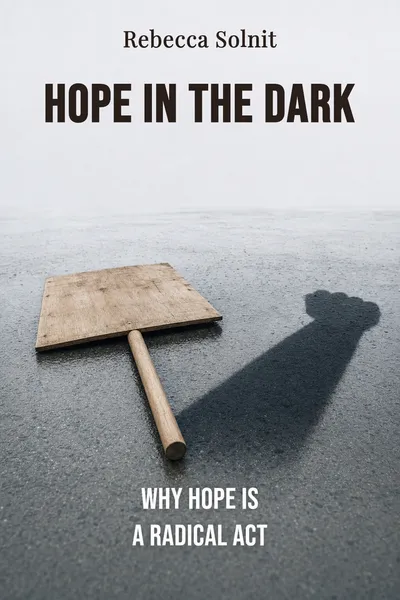
Hope in the Dark
Why hope is a radical act
Description
In 2003, as the United States marched toward war in Iraq and the largest coordinated protests in human history failed to stop it, a writer named Rebecca Solnit sat down to argue with the mood of the people around her. The mood was despair. Millions had filled the streets on a single February weekend, and the bombs fell anyway. Among her fellow activists, the lesson many drew was the obvious one: we lost, we always lose, nothing we do lands. Solnit thought that reading was not just demoralizing but wrong — factually, historically wrong. Out of that disagreement came a short, insistent book called Hope in the Dark.
The book set out to do something that sounds almost paradoxical: to defend hope not as a feeling but as a discipline, and to defend it precisely to the people least inclined to trust it. Solnit was not writing for the naive. She was writing for the burned-out, the veterans of campaigns that seemed to go nowhere, the people who had learned to protect themselves by expecting the worst. To them she offered an unusual claim — that despair is itself a kind of certainty, a confident bet that the future is already decided, and that this confidence is unearned.
Reissued in 2016 with a new introduction and afterword, the book found a second life in another season of dread. Its argument had not aged, because it was never really about any single election or war. It was about the relationship between action and outcome, and about what we owe the future when we cannot see it.
The question we’re asking : What does Solnit mean when she calls hope a radical act, rather than a mood or a temperament?What we’ll see : How a book written against despair reframes memory, uncertainty, and what it means to act without knowing the result.
Table of contents
01 Chapter 1 — The book that argued with despair
Solnit wrote Hope in the Dark quickly, in the heat of the Iraq war, and its origins matter to how it reads. This is not a treatise composed in calm; it is a rebuttal, aimed at a specific tone she kept hearing on the left. The tone said that the good fight was already lost, that power was total, that showing up changed nothing. Solnit recognized the tone because she had felt it herself. But she came to see it as a trap dressed up as realism — a way of feeling clear-eyed while actually refusing to look.
Her opening move is to separate hope from optimism, and both from their opposites. Optimism, she argues, assumes things will turn out fine, so there's no need to act. Pessimism assumes things will turn out badly, so there's no point acting. The two are mirror images, and both let us off the hook. Hope, in her definition, is something else entirely: an acknowledgment that we do not know what will happen, and that this uncertainty is the very ground on which action becomes worthwhile. If the outcome were guaranteed either way, there would be nothing to do.

02 Chapter 2 — Victories nobody remembered
The heart of Solnit's argument is a claim about memory. Activists despair, she suggests, partly because they have terrible memories of their own successes. They remember the battles they lost with painful precision and forget the ones they won, or forget that they ever fought them at all. Once a victory becomes ordinary — once women vote, once a wall falls, once a chemical is banned — it stops looking like a victory and starts looking like the way things simply are. The struggle that produced it disappears.
She fills the book with examples of changes that would have seemed impossible to the people who set them in motion. The fall of the Berlin Wall in 1989 came without the war everyone assumed would be required. Apartheid in South Africa ended through a negotiated transition that few strategists had predicted. She points to the abolition of slavery, to the extension of the vote, to the emergence of movements — feminism, environmentalism, gay liberation — that reshaped the moral common sense of entire societies within a generation. None of these were inevitable. All of them looked hopeless from inside the fight.
03 Chapter 3 — The dark is not the tomb, it's the womb
If the past supplies Solnit's evidence, the future supplies her argument's real stakes, and here she leans on the strangeness of not knowing. Despair, she insists, is a form of prophecy — and a bad one, because it claims to read a future that has not been written. The pessimist and the optimist share the same error: both believe they already know how the story ends. Solnit's wager is that they don't, that nobody does, and that this ignorance is not a defect to be overcome but the opening through which change enters.
She draws on the imagery of darkness deliberately, and reclaims it. In the culture's shorthand, darkness means threat, ignorance, the thing to be feared. Solnit flips it. The dark is where things are gestating that we cannot yet see — the seeds underground, the pregnancy before the birth. To act in the dark is not to stumble blindly; it is to work on behalf of a future that remains genuinely open because it has not yet arrived. The uncertainty that terrifies the despairing is, read another way, the only reason to bother at all.
04 Chapter 4 — What uncertainty actually asks of us
Step back from the marches and the historical examples, and what Solnit has really done is change the question hope is supposed to answer. We tend to treat hope as a forecast: will things get better? Answer yes and you're an optimist, answer no and you're a realist, and either way you've made a prediction. Solnit's move is to say the forecast is the wrong instrument entirely. Hope is not a claim about what will happen. It is a stance toward the fact that we cannot know — a way of holding the unwritten future open rather than sealing it shut with a guess.
That reframing is why the book survived its moment. Written against one war and reissued into another season of dread, it never depended on the news, because it was never really arguing about outcomes. It was arguing about the posture we take toward uncertainty itself. And uncertainty is the one condition that does not expire. Every generation faces a future it cannot read, and every generation is tempted to convert that blankness into premature despair, mistaking exhaustion for insight.
05 Conclusion
Solnit began by arguing with the people beside her in the streets, the ones who had decided in advance that they had lost. Hope in the Dark was her long answer: that they had lost some battles and forgotten others they had won, that they were reading a future nobody could actually see, and that their despair was not clear-sightedness but a failure of memory and a failure of nerve. The book does not promise that things will improve. It refuses the promise on principle, because a promise would defeat the whole point.
Related books