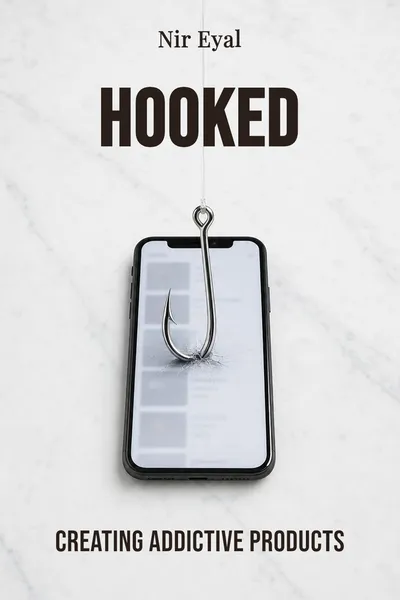
Hooked
Creating addictive products
Description
The "Hook Model" describes how to create habit-forming products. It involves four steps - a trigger that prompts the user to action, making the intended action easy to do, providing variable rewards to create intrigue, and getting users to invest in the product over time to increase engagement.
Companies that successfully get consumers hooked through this cycle can make their products indispensable and generate significant benefits to their bottom line. However, the ethics behind deliberately engineering habit-forming technology are questionable.
While it can help users in some cases, like with educational apps, it also risks manipulating consumers against their best interests just for profit. Ultimately, the Hook Model is a tool that companies should use responsibly to enhance people's lives, not harm them.
Table of contents
01 Why habit formation matters for business
Successful entrepreneurs and business leaders often attribute their achievements to the cultivation of certain habits and daily routines that drive their productivity and effectiveness. One of the most common practices among high achievers is waking up early, typically between 5-6 AM. This early start provides them with a quiet time to engage in exercise, plan their day, and begin work before the rest of the world wakes up, setting a productive tone for the day ahead.
In addition to rising early, setting daily goals is a crucial habit for maintaining focus and direction. By establishing specific and measurable objectives each day, entrepreneurs hold themselves accountable and ensure that they make consistent progress toward their larger ambitions. These goals act as a motivational force and a guide for daily activities.
Time management is another essential habit for success. Successful individuals are meticulous about how they allocate their time, often blocking out periods for high-priority tasks and scheduling uninterrupted time for deep work. They recognize the importance of avoiding procrastination and steering clear of time-wasting activities, such as excessive use of social media.
Networking is also a key component of a successful entrepreneur's routine. Regularly connecting with new and existing contacts helps to build a network of relationships that can provide opportunities, advice, and potential partnerships. These connections are often invaluable for business growth and development.

02 The four phases of habit formation
The hook model fosters user habits through triggers, simple actions, variable rewards, and user investment. By regularly prompting engagement, offering unexpected delights, and encouraging personal investment, products can create lasting habits. This model is effective in various applications, from shopping apps with sale notifications to social media platforms with easy scrolling and personalized content.
Initiating triggers: external and internal
Habit triggers prompt users to take action and are categorized into external and internal types. External triggers, such as seeing a vending machine, encourage immediate action and include paid, earned, relationship, and owned varieties. Internal triggers, on the other hand, are mental associations, like linking instagram with capturing life's moments. When developing a habit-forming product, it's crucial to identify the problem users aim to solve, tapping into their desires and emotions to find the right solution and triggers. For instance, instagram leverages the fear of missing out and the desire to stay connected. To establish a new habit, link it to an existing routine event that occurs frequently, ensuring the new habit follows this trigger consistently to strengthen the association. The goal is to create a solution that users identify with, using motivational triggers like email reminders to guide them through the habit loop and achieve their objectives.
Action steps: simple and effortless
The second step in the hook model emphasizes the importance of action following interest. For this, three elements are crucial: motivation, the ability to act, and a trigger. Companies often enhance ability by making actions easier, quicker, or cheaper, as seen with the streamlined signup processes of facebook and twitter. To boost motivation, they employ psychological tactics like highlighting scarcity to create urgency or using pricing anchors to set value perceptions. Tactics such as partially filled loyalty cards also play into this by leveraging the idea of endowed progress to encourage completion. These strategies, combined with well-placed triggers, are key in forming customer habits. As technology evolves, understanding these habit-forming techniques becomes essential for product designers aiming to create beneficial, not manipulative, products.
03 Optimizing habit formation ethically
The Hook Model, conceptualized by Nir Eyal, is a powerful framework designed to build habit-forming products by closely associating the user's problems with the solutions offered by a product through repeated exposure. This strategic approach ensures that the product becomes the go-to solution whenever the user encounters the problem again. The essence of the Hook Model lies in its ability to create a cycle of user engagement that leads to increased customer retention and loyalty.
At the heart of the Hook Model are four critical stages: Trigger, Action, Variable Reward, and Investment. The Trigger stage involves both external and internal cues that prompt the user to engage with the product. External triggers can be notifications or advertisements that directly call the user to action, while internal triggers are more subtle, often rooted in emotions or established routines that drive the user towards the product in search of a solution or relief.
Following the trigger, the Action stage is where the user is encouraged to perform the desired behavior. This stage emphasizes the importance of making the action as simple and rewarding as possible to ensure that the user finds value in the engagement. The easier and more rewarding the action, the more likely the user is to repeat it.
04 Identifying opportunities to strengthen habits
The Hook Model is a framework for creating habit-forming products, which involves understanding and designing around four key phases: trigger, action, reward, and investment. To enhance a product's habit-forming potential, one should first analyze user data to identify how the product is currently used and define what characterizes a devoted user. By understanding the behaviors of these users, one can make educated guesses about user engagement.
The next step is to codify the steps that habitual users take, often referred to as the "habit path," which leads from initial onboarding to regular engagement. This involves analyzing data to pinpoint the actions that correlate with high levels of user retention and satisfaction.
Once the habit path is understood, the product can be modified to encourage more users to follow this path. This is done by iterating on the product design based on insights from real-world usage, thereby guiding more users towards habitual behavior.
Related books