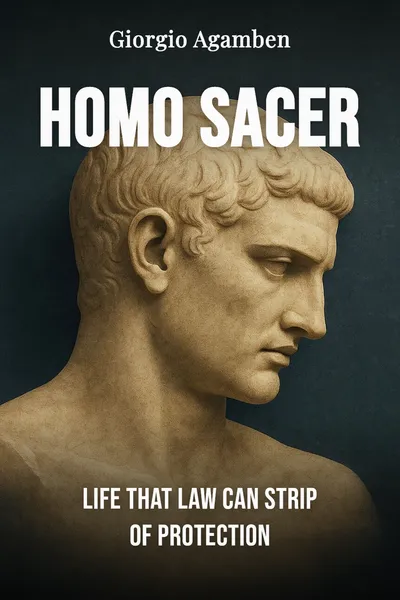
Homo Sacer
Life that law can strip of protection
Description
In archaic Roman law there was a figure so strange that jurists kept circling back to it without quite explaining it. He was called the homo sacer — the sacred man. But sacred here did not mean holy or protected. It meant the opposite. A man declared homo sacer could be killed by anyone, with no charge, no trial, no punishment for the killer. And yet he could not be sacrificed to the gods either. He was excluded from human law and from divine law at once. Killable, but not sacrificeable. A life that had fallen entirely outside every protection society offers, while remaining fully inside society's reach.
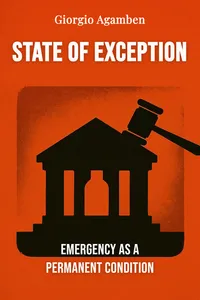
For most of two thousand years this was a footnote, a curiosity of legal antiquity. Then in 1995 the Italian philosopher Giorgio Agamben put it at the center of a book that reshaped how a generation reads power. His claim was not that the homo sacer is a relic. It is that this figure — the human being reduced to a life that law can abandon — sits quietly at the foundation of Western politics, and that modernity has only made it more visible. What looked like an obscure Roman puzzle turned out, in his hands, to be a mirror.
Agamben's argument runs against a comforting assumption: that sovereignty exists to protect life, and that the worst abuses are failures of the system. He suggests instead that the power to strip a life of protection is not a malfunction of political power but its secret core. To follow him is to look at the state, at law, at the very idea of a protected citizen, and see something colder underneath — a threshold where the human can be turned into something that can be disposed of without consequence.
The question we’re asking : What if the power to remove a life from all protection isn't a breakdown of the political order, but the thing that holds it together?What we’ll see : How a forgotten Roman figure becomes, in Agamben's reading, the key to sovereign power, to the life politics quietly produces, and to the darkest space of the twentieth century.
Table of contents
01Chapter 1 — A criminal who could not be sacrificed
Agamben begins with the paradox itself, because the paradox is the whole point. The Roman sources — Festus above all, drawing on older material — describe the homo sacer as a man judged for a crime whom the people have set outside the law. Two things follow, and they don't fit together. First, it is not a crime to kill him: whoever does so goes unpunished, unindicted, as if the death simply did not register in the legal world. Second, he cannot be put to death in the ritual forms, cannot be offered up in sacrifice. He is banned from the sphere of the gods and the sphere of men in the same gesture.
This is what makes the figure so hard to place. We tend to imagine two categories: the person law protects, and the person law condemns to a formal punishment. The homo sacer belongs to neither. He is not protected, but he is not executed by the state either. He is abandoned — left in a zone where killing him is neither murder nor sacrifice, neither crime nor ritual. Agamben calls this the double exclusion, and he insists that it is also a double capture. The homo sacer is not simply outside the law. He is held by the law precisely in the form of his exclusion from it.

02Chapter 2 — The exception that makes the rule
To explain the homo sacer, Agamben reaches for a companion idea: the state of exception, borrowed from the German jurist Carl Schmitt. Schmitt had argued, in the 1920s, that the sovereign is defined not by ordinary rule-following but by the power to decide when the normal legal order can be suspended. In an emergency, the sovereign steps outside the law in order to save the law. Whoever holds that power — the power to declare that, for now, the rules do not apply — is the true sovereign.
Agamben takes this and turns it into something more unsettling. The sovereign, he argues, occupies a paradoxical position: he is at once inside the legal order and outside it. Inside, because his authority is legal; outside, because he can suspend that same order. The sovereign decision that suspends the law is the mirror image of the ban that produces the homo sacer. In both, something is included precisely by being excluded, held by the law in the very act of being placed beyond it. The two figures — the one who can suspend all protection, and the one from whom all protection has been withdrawn — belong to the same structure. They are the two ends of a single relation.
03Chapter 3 — Bare life at the center of politics
Here Agamben introduces the term the book is best known for: bare life. He draws on a distinction the Greeks made between two words for life. Zoē named the simple fact of being alive, the biological life shared by every living thing. Bios named a qualified life, a way of living proper to an individual or a group — the life of the citizen, of the political community. For Aristotle, politics began when humans moved from mere living to living well, from zoē to bios. The bare fact of existence was supposed to stay outside the political sphere, in the household, in nature.
Agamben's claim is that this neat separation never held, and that Western politics has always secretly turned on the point where the two meet. Bare life is not simply zoē. It is natural life caught inside the political order in the mode of exclusion — life that has been stripped of its qualified, protected form and reduced to something that can be exposed, managed, or abandoned. The homo sacer is the ancient name for exactly this: a human being reduced to bare life, still gripped by power but no longer clothed in any status that would shield him.
04Chapter 4 — When the camp becomes the pattern
The book's most disturbing move comes when Agamben names the place where this logic reaches its purest form: the camp. Not as a symbol, and not only as a horror to be mourned, but as what he calls a paradigm — the hidden pattern that reveals the structure of modern politics itself. The concentration camp, he argues, is the space that opens when the state of exception becomes permanent, when the temporary suspension of the law is stabilized into a fixed territory.
His reasoning follows from everything before it. In the camp, the exception is no longer a moment; it is a place. Inside it, ordinary law is suspended, and the people held there are reduced to bare life in the most literal sense — human beings who can be subjected to anything, killed without the act registering as murder, because they have been placed outside every juridical protection while remaining wholly in the grip of power. The camp is where homo sacer and sovereign exception, ancient figure and modern jurist, finally coincide on the ground.
05Conclusion
We started with a legal curiosity: a Roman figure both cursed and sacred, killable and unsacrificeable, held by the law in the very act of being cast out of it. In Agamben's reading, that figure stops being ancient. It becomes a lens. Through it, sovereignty appears not as the guardian of life but as the power that decides which lives are protected and which are exposed. The exception is not a lapse in the order; it is the order's secret hinge. And bare life — life reduced to something that can be abandoned — is not a relic but the ground beneath the modern state.
Related books