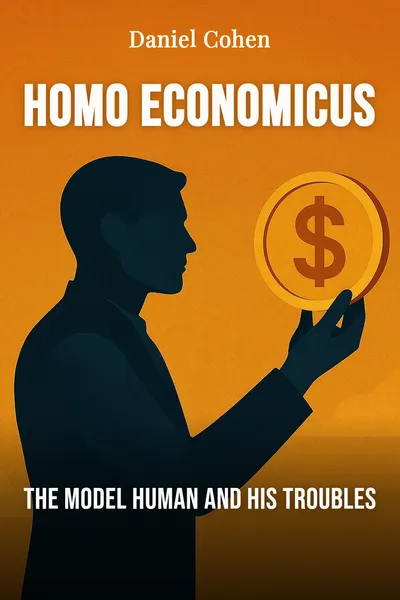
Homo Economicus
The model human and his troubles
Description
Somewhere in the pages of a nineteenth-century economics textbook, a creature was born who would go on to run the modern world. He had no name at first, then he got one: homo economicus. He was never a real person. He was a convenient fiction — a human stripped down to a single trait, the cool, tireless calculation of his own interest. He knew exactly what he wanted, he ranked every option, he never regretted a choice, and he spent his life quietly maximizing. In the French economist Daniel Cohen's account, this figure is less a discovery than an invention, a model human built so that the equations would hold.
The trouble is that the fiction worked, and worked spectacularly. For over a century, the idea that people are rational agents chasing their own advantage became the backbone of a science that claimed the prestige of physics. It explained prices, markets, trade, even marriage and crime. Governments were redesigned around it, and so were schools, hospitals, and the incentives that run our daily lives. The model human escaped the textbook and started reshaping the real ones.
Cohen's book is the story of that escape, and of the slow realization that the creature doesn't quite match the people it was meant to describe. We are not nearly as calm, as consistent, or as content as the equations assume. And where the gap opens — between the human we modeled and the human we are — Cohen finds the more interesting question: what did economics leave out when it decided we were calculators?
The question we’re asking : How did a fictional, perfectly rational human become the organizing idea of modern economics — and why does he keep letting us down?What we’ll see : We follow homo economicus from his birth in the equations to his collision with real human behavior, and with everything the model was built not to see.
Table of contents
01Chapter 1 — The man who only wanted more
The idea at the center of homo economicus is almost embarrassingly simple: a person wants more of what is good for them, and will act to get it. More goods, more money, more utility — the word economists eventually settled on for the abstract stuff of satisfaction. Faced with choices, this person compares, ranks, and picks the option that delivers the most. He does this consistently. He does it without emotion, without fatigue, and without ever changing his mind for no reason. Cohen traces how this austere little portrait moved to the heart of a whole discipline.
The appeal was that it made economics calculable. If you assume people maximize, you can write equations for their behavior, draw curves, predict outcomes. Adam Smith had already planted the seed in the eighteenth century with his butcher and baker serving us not from kindness but from self-interest. The nineteenth-century economists turned that intuition into mathematics. By assuming each person was a consistent maximizer, they could model markets as the orderly meeting of millions of these calculations, with prices emerging as if by the famous invisible hand.

02Chapter 2 — The century that believed the equations
Through the twentieth century, homo economicus stopped being a modeling convenience and became something closer to a worldview. Economics borrowed the formal elegance of physics, and with it a growing confidence that human behavior obeyed laws as reliable as gravity. Cohen describes how the rational-actor assumption spread outward from its home turf. If people maximize utility in markets, why not everywhere? The logic was extended to the whole of life, and the discipline grew bolder about what it could explain.
The expansion reached its most striking form at the University of Chicago, where economists like Gary Becker applied the maximizing model to things no one had thought of as economic. Crime became a calculation: a criminal weighs the gains of an offense against the odds and cost of punishment. Marriage became a market, where people search for the best available partner. Even having children could be modeled as an investment decision. The rational actor, once confined to the shop and the stock exchange, now governed the bedroom and the courtroom.
03Chapter 3 — The cracks in the calculator
The first serious challenge came from inside, from researchers who simply watched what people do. In the 1970s, the psychologists Daniel Kahneman and Amos Tversky ran experiment after experiment showing that human judgment is riddled with systematic errors. We don't weigh probabilities correctly. We fear losses far more than we value equivalent gains. We are swayed by how a choice is worded, choosing differently when the same options are framed as a loss rather than a gain. None of this is random noise that cancels out. It is patterned, predictable irrationality — exactly what the model said shouldn't exist.
Kahneman's distinction between fast, intuitive thinking and slow, deliberate reasoning cut to the heart of the matter. Homo economicus was supposed to be all slow, careful calculation. Real people run mostly on the fast system, full of shortcuts and gut reactions that work well enough most of the time and fail in consistent ways. Cohen shows how this behavioral turn did not just add footnotes to economics; it undermined the foundation. If people reliably violate the axioms of rational choice, the elegant equations describe a creature who doesn't exist.
04Chapter 4 — The happiness the model never priced in
Step back from the equations, and Cohen's deepest challenge to homo economicus is not that he miscalculates — it's that he was pointed at the wrong goal. The model assumes that more is better, that rising consumption means rising satisfaction. Yet the research on well-being tells a stubbornly different story. Beyond a certain point, wealthier societies do not become measurably happier. The paradox, first noticed by the economist Richard Easterlin, is that economic growth delivers far less contentment than the whole apparatus of homo economicus was built to promise.
The reason, Cohen argues, is that happiness is comparative and social, not absolute. We judge our situation against others and against our own past, so gains that lift everyone leave no one feeling richer. A raise feels good until the neighbors get one too. This is a treadmill the maximizing model cannot even see, because it treats satisfaction as a private sum of goods consumed rather than as a restless, relative, deeply human experience. The creature who only wanted more was never going to arrive anywhere.
05Conclusion
The creature born in the textbook turned out to be a poor likeness of the people he was meant to represent. He calculated when we hesitate, maximized when we compare, and wanted endlessly when we are, in truth, chasing something the equations never named. Cohen's story is not a demolition of economics — the model gave the discipline real power and real insight — but a long accounting of what gets lost when a science builds its human by subtraction. Homo economicus held up for a century because he was useful, and he showed his age because usefulness is not the same as truth.
Related books