
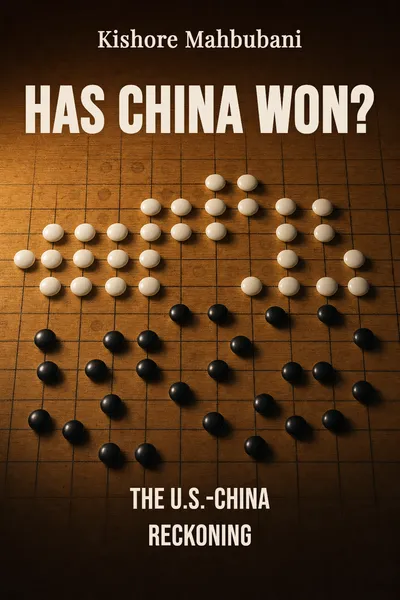
Has China Won?
The U.S.-China reckoning
Description
Somewhere around 2018, the relationship between the two most powerful countries on earth shifted from competition to something closer to a standoff, and almost no one in Washington had sat down to define what winning would even look like. Kishore Mahbubani, a Singaporean diplomat who spent decades at the United Nations and later ran a policy school in one of the few places that trades comfortably with both Beijing and Washington, watched this happen with a specific kind of unease. He had lived inside both worlds. And what struck him was not that the United States and China had become rivals — great powers do that — but that the larger of the two had launched a contest without a strategy, driven more by mood than by analysis.
His book, published in 2020 with a title phrased as a provocation, takes that gap seriously. Has China Won? is not a prediction dressed up as a question. It is an argument that the question itself is being asked badly, by people who have decided the answer in advance. Mahbubani writes as someone raised in Asia, educated in the Western canon, fluent in the assumptions of both sides — which lets him do something rare: hold up each power's blind spots to the other without flattering either.
What follows is his attempt to force clearer thinking onto a subject drowning in reflex. He weighs the economics, the history, the cultural instincts underneath the policy — and asks whether the way America has framed the rivalry is quietly guaranteeing that it loses the parts that matter most.
The question we’re asking : Is the United States running a strategy against China, or reacting to a rise it never truly understood?What we’ll see : How a diplomat who knows both capitals reads a rivalry that neither power has thought through — and where the real stakes sit.
Table of contents
01Chapter 1 — A contest neither side chose to think through
Mahbubani opens with a distinction that runs through the whole book: there is a difference between having a rival and having a plan. By the late 2010s, the United States had clearly decided China was a strategic competitor. Tariffs arrived, technology bans followed, and the tone in Washington hardened across both parties in a way that felt permanent. But when Mahbubani looks for the underlying strategy — the document, the debate, the sober assessment of ends and means — he finds mostly absence. The contest, he argues, was launched on emotion.
That absence matters because China, by contrast, has thought about the United States for a very long time. Mahbubani points to the patience baked into Chinese statecraft, a civilization that measures itself in centuries and treats the current moment as one chapter among many. He is careful not to romanticize this; Beijing makes serious errors, and he names them. But the asymmetry is real. One side plays a long game deliberately. The other reacts week to week and calls it resolve.

02Chapter 2 — The trap America walked into without a plan
The sharpest section of the book examines how the United States chose its posture. Mahbubani argues that Washington drifted into confrontation less through cold calculation than through a bipartisan consensus that China had become the enemy — a consensus that formed faster than the reasoning behind it. Once that mood set, questioning it became politically costly, and clear-eyed analysis got crowded out by the safer instinct of sounding tough.
He traces several assumptions that went unexamined. One was that engaging China economically would inevitably make it liberal and democratic; when that did not happen on the American timetable, the disappointment curdled into hostility. Another was that pressure would slow China down, when much of the evidence suggested pressure often accelerated Beijing's push toward self-sufficiency in exactly the areas Washington hoped to deny it. Mahbubani's point is not that engagement was flawless. It is that the pivot away from it was made without asking what would replace it.
03Chapter 3 — What China actually wants, and what the West keeps mishearing
Having pressed America hard, Mahbubani turns the same scrutiny on how the West reads China's intentions — and finds a habit of hearing the most alarming interpretation available. The dominant assumption is that Beijing seeks to export its system and dominate the globe. Mahbubani is skeptical. China, he argues, is far more preoccupied with its own stability, its own hundreds of millions still climbing out of poverty, and the fragility that any Chinese leadership feels when it looks at the country's turbulent modern history.
This does not make him an apologist, and he is explicit about it. He acknowledges Beijing's coercive turn, its treatment of dissent, its assertiveness in its near seas, and the genuine anxieties these produce among neighbors. But he separates two things Western analysis tends to fuse: a China that wants respect and room to rise, and a China that wants to run the world. The evidence, in his account, points far more toward the first. The Communist Party's obsession is regime survival at home, not ideological conquest abroad.
04Chapter 4 — The question that outlasts the rivalry
Step back from the duel and Mahbubani's deeper argument comes into view. The real contest, he suggests, is not over which flag flies highest but over which system can actually improve the daily lives of the people living under it. Great-power prestige is a distraction. The measurable question is whether a government delivers rising living standards, functioning institutions, and a sense that tomorrow will be better than today. On that scoreboard, both powers have work to do, and neither should assume it is winning.
This is where he holds a mirror up to the United States. Mahbubani, who admires much of what America built, argues that its greatest vulnerability is internal — stagnant wages for large parts of its population, a political system captured by money, and a growing gap between what the country says about itself and what its citizens actually experience. A nation consumed by an external rival, he warns, can neglect the erosion happening at home. The danger is not that China defeats America. It is that America, fixated on China, defeats itself through inattention.
05Conclusion
The book ends roughly where it began — with a diplomat urging both capitals to slow down and think. Mahbubani's provocation was never really about handicapping a race. It was about exposing how a contest of this magnitude had been entered on autopilot, with America reacting to a rise it had not understood and China reading its own history as vindication. He asks the two most powerful governments on earth to do the unglamorous thing: define what they actually want, and check it against what their people actually need.