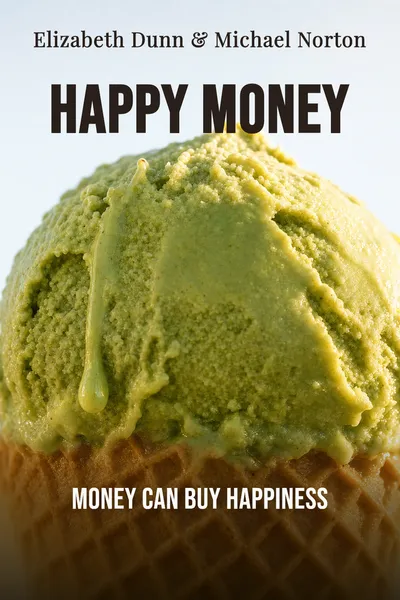
Happy Money
Money can buy happiness
Description
There's a well-worn line, repeated at dinner tables and in graduation speeches, that money can't buy happiness. It sounds wise, a little consoling, and it turns out to be mostly wrong. In 2013, two behavioral scientists — Elizabeth Dunn at the University of British Columbia and Michael Norton at Harvard Business School — published a slim book called Happy Money, arguing that the old proverb had the problem backwards. Money can absolutely buy happiness. Most of us are just terrible at spending it well.
Their claim rests on a decade of experiments, their own and others', showing that the link between income and well-being is real but weak — and that the way we spend swamps how much we earn. Give two people the same raise and one comes out noticeably happier, not because of the number in the account, but because of what each does with it. We chase bigger houses, faster upgrades, more stuff, and reliably feel the same six months later. The money, in other words, is doing something, but rarely what we hoped.
What Dunn and Norton set out to do is unusual for a book about personal finance: not tell us to save more or budget harder, but to redesign the act of spending itself. Their argument is that a few simple shifts in where the money goes turn ordinary purchases into lasting satisfaction — and that these shifts run against almost every instinct the modern economy trains into us.
The question we’re asking : If money really can buy happiness, why are we so consistently bad at making it happen?What we’ll see : How a handful of counterintuitive spending principles, drawn from behavioral research, turn the same dollars into more lasting satisfaction.
Table of contents
01Chapter 1 — The problem isn't how much, it's how
The starting point of Happy Money is a finding that behavioral economists have chewed on for years: beyond a certain threshold, more income barely moves the needle on day-to-day happiness. Dunn and Norton don't dispute that having more money helps — being poor is genuinely miserable, and the escape from financial stress matters a great deal. What they question is the assumption that once we're comfortable, the next raise, the bigger salary, the fatter bonus will keep the happiness climbing. It mostly doesn't. We adapt. The thrill of the new car fades into the background hum of ownership, and we start eyeing the next one.
This treadmill has a name in the research — hedonic adaptation — and it's the villain running quietly through the whole book. We're wired to get used to things. A pleasure that stays constant stops registering as a pleasure. The problem is that most of the ways we instinctively spend money are precisely the ways that invite adaptation: we buy durable goods that sit there, day after day, until we no longer notice them. The house we fought so hard to afford becomes the house we live in without a second thought.

02Chapter 2 — Buying time, and buying experiences
Two of the five principles cut against the deepest grain of consumer culture. The first: buy experiences rather than things. When Dunn, Norton, and their colleagues ask people to recall a purchase that made them happy, the material objects — the gadget, the watch, the shoes — tend to lose out to the trip, the concert, the meal with friends. Experiences beat objects for a few reasons. They resist adaptation better, because a memory keeps being reworked and savored while a possession just sits there. They're more tied to our sense of who we are. And they're social almost by definition, which turns out to matter more than the experience itself.
There's a subtlety the authors are careful about: not every experience wins, and not every object loses. A miserable vacation is worse than a reliable coffee machine used with pleasure every morning. What makes the difference is whether the purchase connects us to other people, gives us stories to tell, and becomes part of our identity. The best experiential spending, in their telling, is really spending on relationships and on the self we're trying to build.
03Chapter 3 — The gift of anticipation and the discipline of scarcity
The third principle turns a common frustration into a feature. Delayed gratification, Dunn and Norton argue, isn't just a virtue for saving — it's a source of pleasure in its own right. The stretch of time between deciding on something and actually having it is where anticipation lives, and anticipation is often the sweetest part of the whole transaction. Research on vacations finds that people are frequently happiest before the trip rather than during or after it. The planning, the imagining, the counting down: that's free happiness we throw away when we buy on impulse and consume immediately.
This is why the authors are quietly skeptical of the frictionless, one-click, buy-now-pay-never economy. Instant credit and same-day delivery strip out the waiting, and with it the anticipation. Worse, buying now and paying later inverts the ideal order — we should, they suggest, pay first and consume later, so the pain of payment is behind us and the pleasure lies ahead, undiluted by the arriving bill.
04Chapter 4 — When spending stops being about you
The fifth principle is the one Dunn and Norton clearly hold dearest, and the research behind it is among their own most cited: invest in others. Across studies run in wildly different settings — from Canadian students handed an envelope of cash and told to spend it on someone else, to survey data spanning rich and poor countries — spending money on other people produces more happiness than spending it on yourself. The effect shows up even with small amounts, even among people who predict, wrongly, that they'd be happier keeping the money. Handing a stranger a coffee can lift the mood more reliably than buying your own.
This isn't presented as a moral instruction so much as an empirical finding about how we're built. Prosocial spending activates the same reward circuitry as receiving money. It seems to be remarkably universal, appearing in toddlers and across cultures with very different levels of wealth. And it works best when it feels like a genuine connection rather than an obligation — when we see the impact, when it strengthens a relationship, when the giving is a choice rather than a levy.
05Conclusion
The proverb we started with survives, but only in a mangled form. Money can't buy happiness if we spend it the way instinct and advertising tell us to — on things that fade into the background, on ourselves, on immediate gratification bought with tomorrow's bill. The same money, routed differently, buys a good deal of happiness. Dunn and Norton's contribution is to make that difference concrete: five principles, each grounded in experiments, each cheap to apply, each running against a habit the consumer economy has spent decades installing in us.
Related books