Happy Accidents
When chance rewrites history
Description
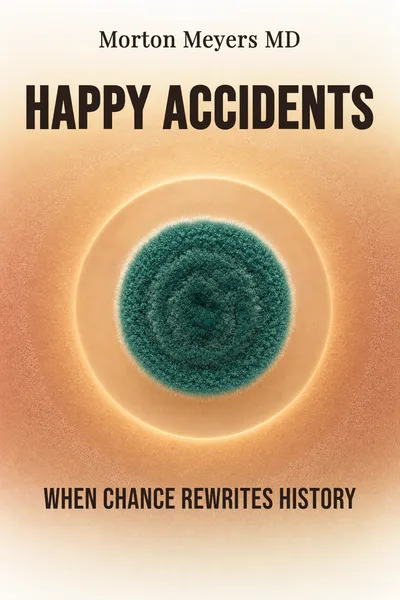
In September 1928, a Scottish bacteriologist named Alexander Fleming came back from a holiday to a lab he had left in his usual state of disorder. On a stack of petri dishes waiting to be washed, one had gone moldy — a bluish-green fungus had drifted in from somewhere and settled on a culture of staphylococcus. Most researchers would have tossed it. Fleming looked closer and noticed something odd: around the mold, the bacteria had dissolved into a clear ring. The contaminant was killing the thing he was studying. He had not set out to find an antibiotic. He had set out to grow bacteria, and failed.
That failure became penicillin, and penicillin became the drug that reshaped the twentieth century. But the story is less a triumph of method than a triumph of noticing — a lucky spore, an untidy bench, and a mind willing to be interrupted. And in Happy Accidents, the physician and medical historian Morton Meyers argues that Fleming's dirty dish is not the charming exception to how medicine advances. It is closer to the rule. X-rays, chemotherapy, Valium, the smallpox vaccine, Viagra — an unnerving share of the tools we trust our lives to arrived sideways, through error, contamination, and coincidence.
Meyers, who spent a career in radiology before writing about how discovery actually works, is not celebrating luck for its own sake. He is making a sharper claim about who gets lucky and why — and about the widening distance between the way breakthroughs really happen and the way modern science insists they must be planned, funded, and justified in advance.
The question we’re asking : How much of modern medicine did we stumble into rather than reason our way toward — and does the difference matter?What we’ll see : A tour through the accidents behind some of the century's biggest cures, and the uncomfortable question of whether we still leave room for them.
Table of contents
01Chapter 1 — The mold that killed the bacteria
Fleming's discovery is the case everyone half-remembers, and Meyers uses it precisely because the popular version smooths over what actually happened. The mold that landed on that dish, Penicillium notatum, was a rare strain that likely floated up from a laboratory one floor below, where a colleague was working with fungi. The London weather that summer produced exactly the temperature swings the mold needed to grow before the bacteria took over. Change any one of those variables and there is no clear ring, no observation, no penicillin. Fleming himself later said he did not invent penicillin so much as fail to ignore it.
And ignoring it was the easy move. Fleming published his finding in 1929, and for roughly a decade almost nothing happened. He could not stabilize the compound, could not produce it in useful quantities, and moved on. The substance sat in the literature as a curiosity. The accident, in other words, was not enough on its own — the world was not ready to do anything with it. That gap between a lucky observation and a working drug is a pattern Meyers returns to throughout the book: chance opens the door, but someone else usually has to walk through it years later.

02Chapter 2 — The dye, the ray, and the accidental cure
If penicillin were the only example, we could file it as a fluke. Meyers piles on the cases until the fluke starts to look structural. Take X-rays. In 1895, the German physicist Wilhelm Röntgen was experimenting with a cathode-ray tube, entirely wrapped in black cardboard, when he noticed that a chemically coated screen across the room had begun to glow. Something invisible was passing through the cardboard. He spent weeks alone chasing the mystery, and eventually held his own hand in the beam to see the bones of his fingers cast on the screen. He had not been looking for a way to see inside the body. He had been studying electricity in a vacuum.
Or take chemotherapy, which arrived through one of the darker accidents in the book. During the Second World War, an American ship carrying mustard gas was bombed in the harbor at Bari, Italy, in 1943, exposing hundreds of people to the agent. Doctors examining the victims noticed that the gas had savaged their white blood cells and lymph tissue. If a chemical could destroy rapidly dividing blood cells, the reasoning went, perhaps it could be aimed at cancers of exactly those cells. Nitrogen mustard became one of the first chemotherapy drugs, born from a wartime catastrophe nobody intended as research.
03Chapter 3 — The drug that failed at its job
Some of Meyers's most telling accidents are the drugs that succeeded by failing. The clearest is Viagra. In the early 1990s, the pharmaceutical company Pfizer was testing a compound, sildenafil, as a treatment for angina — it was meant to relax blood vessels and ease chest pain. In the clinical trials it did little for the heart, and the researchers were preparing to shelve it. Then they noticed that male participants were oddly reluctant to return their leftover pills, and reported an unexpected side effect. The drug that flopped as a heart medicine became one of the best-selling pharmaceuticals in history, aimed at a problem no one had set out to solve.
Valium and its cousin Librium follow a similar arc. In the 1950s the chemist Leo Sternbach was working at Hoffmann-La Roche on a class of compounds that had produced nothing useful. As the project wound down, a lab cleanup turned up a leftover substance that had never been tested — it had been synthesized almost as an afterthought. Rather than discard it, someone sent it off for screening, and it turned out to have powerful calming effects in animals. That neglected compound became Librium, then Valium, the tranquilizers that defined an era of anxiety and reshaped psychiatry's relationship to the pill bottle.
04Chapter 4 — Why science pretends it planned all this
Step back from the individual stories and Meyers's real argument comes into focus. It is not that science is lucky; it is that science lies about being lucky. The way research gets published, funded, and taught erases the accident after the fact. A paper opens with a hypothesis and marches to a conclusion, as though the discovery had been the plan all along. Fleming's dirty dish becomes a heroic investigation. The messy, sideways, contaminated reality gets rewritten into a straight line, because a straight line is what committees and textbooks reward.
That rewriting has a cost, and it is the heart of the book. Modern biomedical funding is built around the hypothesis-driven grant: a researcher must state in advance what they expect to find and how they will find it. It is a rational system, designed to spend public money responsibly. But Meyers argues it is almost perfectly designed to exclude the kind of open-ended, curiosity-driven work that produced penicillin, X-rays, and the tranquilizers. You cannot write a grant proposal to accidentally discover something. By definition, the accident is not in the plan.
05Conclusion
Fleming came back to a moldy dish he should have thrown away, and the twentieth century turned on his decision to look twice. Meyers assembles case after case to show that this was not a one-off but a way discovery has repeatedly worked — the ray no one sought, the poison that became a cancer drug, the heart pill that failed upward, the tranquilizer rescued from a lab bin. Behind every clean origin story he finds a spill, an error, or a coincidence, and a person alert enough to notice it was there.
Related books