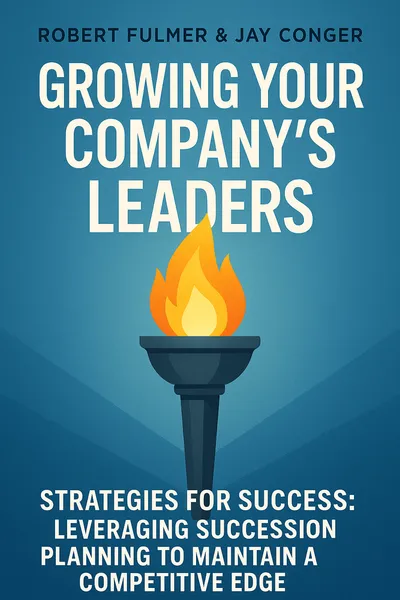
Growing your companys leaders
Strategies for success: leveraging succession planning to maintain a competitive edge
Description
As executives frequently transition between organizations, succession management has become a critical strategy for companies of all sizes. It's no longer just a human resources concern, but a potential competitive advantage. The organization that effectively manages executive talent is likely to thrive in the future.
A robust succession management system includes seven key elements, which together ensure the smooth transition of leadership and the continued success of the organization.
Table of contents
01Revitalized focus on succession management .
Succession management has become a critical focus for organizations due to several compelling reasons. Firstly, effective leadership remains a scarce commodity, making it a highly valuable asset within any company. Despite considerable efforts over the years, the rarity of truly effective leaders means that there is a constant battle for executive talent. This competition is expected to intensify with the upcoming retirement of Baby Boomer executives, which will create a significant gap in experienced leadership.
Secondly, the career paths of leaders have evolved. Today's leaders, who are essentially knowledge workers, are less likely to spend their entire careers with one organization. The modern workforce anticipates multiple career changes, driven by the dynamic nature of industries and the continuous emergence of new opportunities. Thirdly, the development of future leaders is paramount. High-performing individuals need to be challenged to grow their skills. Without appropriate challenges, these potential leaders are likely to seek opportunities elsewhere that offer the growth they desire.

02Seven crucial components of succession management
Business strategy
Succession management is a strategic process that ensures a company has the right talent to achieve its goals. It involves identifying critical roles, understanding the competencies needed for these positions, and developing a talent pool to fill future vacancies. This process requires collaboration between senior management and hr to anticipate organizational needs and develop strategies for talent attraction, retention, and development. As companies face a dynamic global economy, leaders must possess diverse skills, including technological literacy, global market understanding, cultural fluency, and entrepreneurial abilities. However, many organizations lack structured initiatives to develop such skills, leading to a shortage of executive leadership talent. To address this, companies are reinventing management systems, focusing on talent development to maximize capabilities, and redesigning hr systems to support succession planning effectively.
Stakeholders and proprietors
Succession planning is a strategic process to ensure talent continuity in key positions within an organization. It involves identifying and developing potential successors for critical roles to prevent disruption in business operations when a transition occurs. Traditionally, hr has been the advocate for succession planning, but for it to be effective, it requires the endorsement of top management, including the ceo and senior leaders. These leaders must champion the initiative, signaling that talent development is a priority. Hr should own the process, providing tools and frameworks, while business unit managers handle daily execution, identifying and nurturing emerging talent. The approach has evolved from merely replacing high-level talent to fostering development throughout the organization, ensuring a deeper talent pool and aligning with long-term organizational goals.
Talent spotting
Effective succession systems are crucial for identifying and nurturing exceptional talent within an organization. These systems assess individuals based on past performance, potential for development, and a set of valued leadership and organizational competencies. Past achievements often indicate leadership potential, as success in early career roles can signal future leadership capabilities. Leadership competencies include attributes like problem-solving, consensus building, and a high tolerance for ambiguity, which are essential for top-performing leaders. Organizational competencies encompass behaviors and values such as technical proficiency, integrity, and the ability to create value. To streamline the succession process,
it's best to focus on a limited number of competencies, making the system less complex and easier to manage. Describing behaviors in concrete terms helps minimize subjective interpretations. Using multiple raters and various evaluation techniques, such as 360-degree feedback and performance appraisals, provides a comprehensive view of each individual's potential. Organizations typically categorize candidates as "ready today," "ready in the near future," or "ready a year or two down the road," and develop talent pools for leadership roles to ensure a succession of qualified leaders. Recognizing that high performance at one level may not translate to the next, organizations are increasingly assessing individuals' potential for development rather than just past achievements. Effective succession processes also identify suitable developmental opportunities for those ready for advancement, turning the system into a powerful developmental tool.
03Succession management's future
The future of succession management is indeed promising, with the belief that talent is a key determinant of an organization's performance being more widely accepted today than ever before. Succession management is poised to become a central strategy for companies to gain and maintain a significant competitive edge in the market. Several emerging business trends will further transform succession management from a replacement tool to a tool for business development and leadership.
Enhanced integration and alignment will see succession planning becoming more integrated, transitioning from being seen as an annual event to a daily activity. This integration will be facilitated by the availability of company-wide databases, positioning succession planning as an integrated system rather than a series of disconnected activities. The transition of succession planning from the IT department to the desktop will make it feel less like an event and more like a routine task, with web-based tools providing continuous access to simple tools on personal computers rather than corporate mainframes. This will enhance the perception of succession planning and allow employees to take ownership of their own succession planning, making them responsible for keeping their resumes and other information current.
More rigorous and less subjective assessments will emerge as managers become more comfortable with assessment methodologies, leading to a shift towards more objective evaluations. Techniques like 360-degree feedback will accelerate and strengthen this trend. However, as succession planning moves more to the forefront, there are also some challenges on the horizon. Limited developmental opportunities will arise as senior roles within a company are generalized, yet many of the positions leading up to these roles are functional in nature. It will become increasingly difficult for potential managers to gain cross-functional experience as more companies organize along product lines rather than by geographical areas.
Related books