Grinding It Out
The late bloomer who built empires
Description
In 1954, a fifty-two-year-old milkshake-machine salesman from Illinois drove out to San Bernardino, California, to see for himself why a single hamburger stand had ordered eight of his Multimixers at once. Each machine could spin five shakes at a time; eight of them meant this one drive-in was somehow mixing forty milkshakes at once. Ray Kroc had spent most of his adult life selling things — paper cups, real estate in Florida, band jobs on the radio, and for the last seventeen years, mixers. He had ulcers, the early tremors of diabetes, and most of his gallbladder gone. By the standards of any biography of a great entrepreneur, his best years were behind him. He had none of them yet.
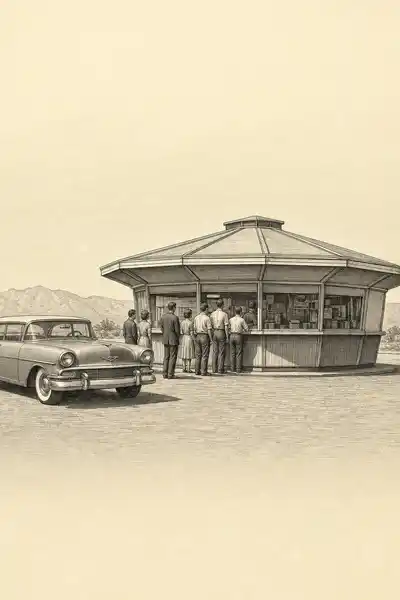
What he found in San Bernardino was a small octagonal building run by two brothers, Richard and Maurice McDonald, who had stripped the restaurant business down to almost nothing. No carhops, no plates, no cutlery, a menu of nine items, hamburgers at fifteen cents, food handed over a counter in under a minute. Kroc stood in the parking lot and watched the lunch crowd move through like an assembly line. He did not invent what he saw that day. But he saw, faster and more completely than the men who built it, what it could become if it were repeated across a continent.
Kroc told the whole story himself, late in life, in a memoir called Grinding It Out. It is not a management manual and not a confession. It is a salesman talking, still selling, still enthusiastic at seventy-something about the thing he found when most men his age were winding down. The book is worth reading less for the burgers than for the voice — restless, opinionated, funny, occasionally ruthless — of a man who insists his story is ordinary and keeps proving it isn't.
The question we’re asking : How does a man past fifty, in poor health and with a modest résumé, end up building one of the most imitated companies on earth — and what does his own telling reveal about why?What we’ll see : We follow Kroc from the parking lot in San Bernardino through the machinery of franchising he wired together, and into the harder question of what his late start actually says about ambition.
Table of contents
01 Chapter 1 — Fifty-two, and still knocking on doors
Kroc's own account of his early life reads like a catalogue of jobs that didn't quite land. He dropped out of high school, drove an ambulance in the same wartime unit as a young Walt Disney, played piano in bands, sold ribbon novelties, and spent a stretch peddling Florida real estate in the boom that collapsed under everyone standing on it. For seventeen years he sold paper cups for the Lily company, then broke off to hawk the Multimixer, a five-spindle milkshake machine he believed in with the conviction of a man who had bet his savings on it. He was good at it. He was not rich.
By the early 1950s the Multimixer business was fading. Soda fountains were closing, supermarkets were taking over the cold-drink trade, and Kroc, in his fifties, could feel the ground going soft under a career he had built on a single product. He kept working the phones and the road because that was the only mode he knew. The health was already going — he mentions the diabetes and the ulcers almost in passing, the way a man mentions weather he has decided not to complain about.

02 Chapter 2 — The brothers had the system; Kroc had the appetite
The McDonald brothers had genuinely built something remarkable, and Kroc is generous about it. They had thrown out the drive-in model entirely, timed their kitchen like a factory floor, standardized every step, and priced a burger low enough to pull in families rather than teenagers looking to loiter. They called it the Speedee Service System. They were, by their own admission, comfortable. They lived well in San Bernardino, drove new Cadillacs, and had no burning desire to run themselves ragged opening stores across the country.
That was the gap Kroc walked into. The brothers had already tried franchising in a small way and found it more trouble than it was worth. Kroc proposed to take it over nationally, sending them a slice of the revenue while he did the traveling, the selling, and the worrying. In 1955 he opened his own first store in Des Plaines, Illinois, and founded the company that would carry the name forward. He was, at that point, a franchise agent with a handshake deal and a single restaurant.
03 Chapter 3 — One store, then a thousand, run like a religion
The thing Kroc actually created was not a hamburger but a method of copying one perfectly, thousands of times, in thousands of places, by thousands of people he would never meet. This is the part of his book where the salesman turns into something closer to an obsessive. He talks about a bun as if it were a moral matter, about the exact fry oil, about the number of seconds a patty sits on the grill, about the width of a slice of onion. Consistency, in his telling, was the whole product. A customer in Denver had to get the identical meal a customer got in Pittsburgh.
To make that possible he built the machinery of modern franchising around the food. He set up a training program — he called the campus Hamburger University, half in jest and half not — where operators learned the system down to the smallest detail before they were trusted with a store. He pooled advertising money so a small operator could buy national television he could never afford alone. He was fanatical about cleanliness, known to police parking lots himself and to fire operators who let standards slip.
04 Chapter 4 — Late is not the same as unprepared
Kroc is insistent, throughout the book, that there was nothing miraculous about him. His favorite piece of self-description is a small framed motto he kept, praising persistence above talent, genius, and education — the line about the world being full of educated derelicts. He returns to it because it is the truest thing he knows about himself. He was not the cleverest man in any room. He was the one who would not stop, and who had spent decades sharpening a single skill until the right door finally opened onto it.
What his story quietly argues against is one of the more durable myths of business — that the great builders are prodigies who arrive early and burn bright. Kroc arrived at fifty-two, sick, tired, and financially unremarkable, carrying nothing but a lifetime of watching how commerce actually worked at the level of the counter and the cash drawer. The years that looked like failure were the years that taught him what to notice in San Bernardino. Someone younger, seeing the same stand, would very likely have missed it, because they wouldn't yet have known what they were looking at.
05 Conclusion
Kroc died in 1984, having lived long enough to see the company he took over become a fixture of the landscape in a way he could not have promised anyone in that San Bernardino parking lot. The memoir was his last act of salesmanship, dictated with the same energy he'd brought to selling paper cups, and it carries the odd double note of a man who genuinely believed his story was ordinary while spending three hundred pages proving it wasn't. He wanted, above all, to be understood as a worker rather than a genius — a distinction he cared about more than the money.
Related books