
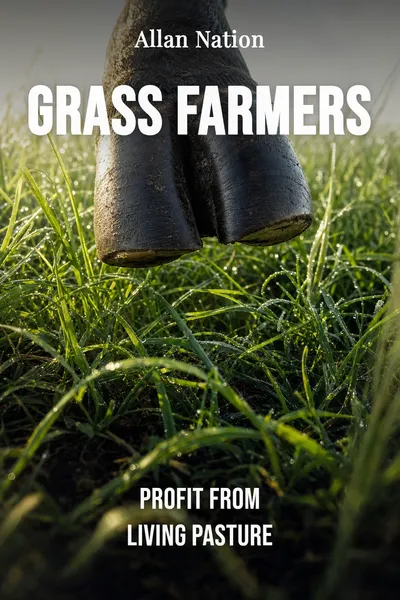
Grass Farmers
Profit from living pasture
Description
For most of the twentieth century, the American way to raise a cow was to move it off the grass as fast as possible. Wean it, ship it to a feedlot, pour corn into it until it fattened, and let the pasture behind it become an afterthought — something you drove past on the way to buy more inputs. Grass was the thing you used before the real business began. Allan Nation spent decades arguing that this had the whole equation backwards. As the founder and long-time editor of The Stockman Grass Farmer, he watched a scattered set of ranchers do something quietly radical: keep the animals on living pasture, sell the fertilizer company's number, and end up with more money in the bank.
His book "Grass Farmers" is the distilled version of that argument. It isn't a pastoral daydream about happy cows in golden fields, and it isn't an environmental sermon either — though the soil and the water do get better when you do it right. It's closer to a business manual written by someone who noticed that the most profitable operations he'd visited were often the ones spending the least. The premise is almost rude in its simplicity: the cheapest food a ruminant will ever eat is the grass it walks on, and every step you take to replace that grass with something bought and hauled is a step away from your own margin.
What makes the book stick is that Nation refuses to treat ecology and profit as opponents. He keeps insisting they are the same conversation, just told in different units — one in tons of topsoil, the other in dollars per acre. Get the biology right, he says, and the accounting tends to follow. That claim is either wishful or foundational, depending on how closely you look at how a pasture actually works.
The question we’re asking : Can raising animals on living grass really be more profitable than the industrial feedlot model that replaced it?What we’ll see : How a maligned, overlooked resource turns out to hold both the ecological case and the economic one — if you learn to manage it.
Table of contents
01Chapter 1 — The grass nobody bothered to count
Nation opens where the industry stopped looking. Grass, in the conventional model, is a passive backdrop — it either grows or it doesn't, and the farmer's attention goes to genetics, feed rations, and the price of corn. What he asks readers to do first is simply to see the pasture as a productive asset with a yield, a quality, and a season, rather than as scenery the animals happen to stand on. Once you start measuring it, the numbers get interesting fast.
The ecological case comes first because it's the easiest to observe. A pasture kept in permanent, well-managed cover holds its soil in place instead of shedding it into the nearest creek every time it rains. Roots that stay alive year-round keep building organic matter underground, which in turn holds water like a sponge and cuts the runoff that carries nitrogen and sediment downstream. Nation points to the plainly visible contrast: bare, tilled ground erodes and leaches, living sod does neither. The water leaving a well-grazed farm tends to be cleaner than the water leaving a plowed one.

02Chapter 2 — Where the money actually hides
The heart of Nation's argument is unglamorous: profit in livestock is decided far more by cost than by price. A rancher can't control what a steer sells for — the market does that — but he has enormous control over what it costs to raise. And the single biggest lever, in his telling, is the difference between harvested feed and grazed feed. Every time an animal harvests its own grass, it does for free the work a farmer would otherwise pay a tractor, a fuel bill, and a feed supplier to do. Machinery, diesel, purchased grain, and stored hay are where conventional operations quietly bleed.
So the grass farm attacks the problem from the cost side. Lower input costs mean the operation can stay profitable at prices that would ruin a feedlot-dependent neighbor, and it can do so without chasing scale for its own sake. Nation is blunt that bigger is not automatically better; a heavily capitalized operation carries heavy fixed costs, and fixed costs are exactly what sink farms in a bad year. He'd rather see a modest farm with almost nothing owed than a large one built on borrowed machinery.
03Chapter 3 — Reading the pasture like a ledger
None of this works if the grass gives out, and much of the book is spent on the craft of keeping it going. The central discipline is managed grazing: instead of turning animals loose on a whole paddock to nibble their favorite plants to death and ignore the rest, the farmer moves them in tight groups across small areas, then rests each patch long enough to regrow before they return. Graze hard, move on, let it recover. Done well, this simple rhythm can grow more forage from the same acres than continuous grazing ever did.
The variables Nation drills into are stocking rate, timing, and forage choice. Overstock and the pasture is grazed to bare ground and never recovers; understock and you leave feed — and money — standing in the field. The right rate shifts with the season, the rainfall, and the mix of plants, so the skill is less a fixed formula than a habit of constant observation. He wants farmers watching the grass the way a good manager watches inventory: what's growing, how fast, how much is left, when it needs rest.
04Chapter 4 — Farming a process, not a product
Step back from the paddocks and stocking charts, and what Nation is really teaching is a change in what a farmer thinks the job is. The conventional livestock operator manages an inventory: so many head, so many tons of feed, so many dollars of equipment, all of it counted, owned, and controlled. The grass farmer manages a process he never fully controls — sunlight becoming forage becoming animal becoming soil, a cycle driven by weather and biology that no spreadsheet can command. The animals stop being the product and become one moving part in a system whose real output is a functioning piece of land.
That reframing reorganizes a farmer's whole relationship with risk. The industrial model reduces uncertainty by buying it away — purchased feed, controlled environments, engineered inputs — which works until input prices spike or debt comes due, at which point the fixed costs that promised security become the thing that breaks you. Nation's approach accepts a different bargain: less control over any single season, but far less exposure when things go wrong, because there's little to owe and little to buy. Resilience comes not from mastering nature but from leaning on it.
05Conclusion
Nation began by asking readers to look again at the grass they'd been driving past — to count the thing the industry had decided didn't need counting. By the end, that overlooked resource has done a lot of work: holding soil, filtering water, feeding an ecosystem, and, not incidentally, feeding animals for close to nothing. The grass farmers he championed weren't romantics who happened to make a living. They were operators who noticed that the cheapest feed and the healthiest land were the same feed and the same land, and who built their businesses on that overlap instead of against it.