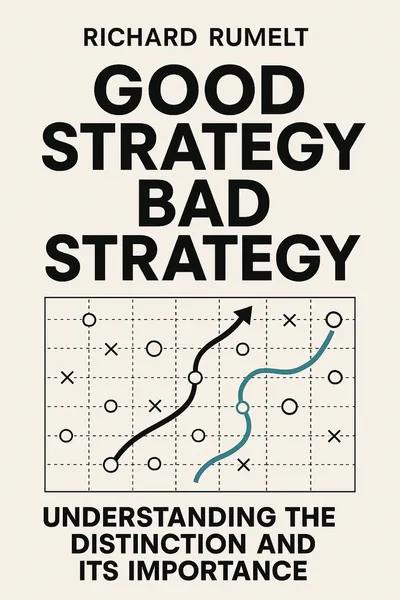
Good strategy bad strategy
Understanding the distinction and its importance
Description
Strategy is not about lofty mission statements or aggressive sales targets. It's not about effort, financial forecasts, or hopeful visions. Strategy is your plan for overcoming significant challenges. It's a thoughtful, coherent approach to facing those challenges and advancing.
A good strategy has three key components: it's not just high-level decision-making, it's a cohesive response to a critical issue. It involves a set of coherent actions that are the essence of the strategy, not mere implementation details. Strategy is about planning how to progress the organization's interests, not just setting goals and delegating tasks.
Table of contents
01 Distinguishing strategy quality
Inferior strategy is not simply the absence of a superior one; it often appears as vague clichés, unattainable objectives, and appealing yet empty catchphrases. In contrast, a superior strategy clearly outlines how an organization will allocate its resources to address a problem and make progress. It includes three components and draws from two significant and inherently crucial sources of strength. Unfortunately, effective business strategies are rare and often surprising. Many organizations lack a coherent business strategy, leading to disconnected objectives, conflicting interests, and a wish list of preferred outcomes rather than a solid plan. Effective strategy requires leaders who are prepared to reject a broad range of actions and interests, focusing as much on what an organization does not do as on what it does.
The implementation of a sound strategy increases the likelihood of gaining insights into new strengths and weaknesses. For example, Wal-Mart challenged the prevailing belief that a full-line discount store needed a population base of at least 100,000 to be profitable by opening smaller stores in towns and managing a network of stores served by a centralized distribution center. This approach allowed Wal-Mart to serve much smaller populations than its competitors efficiently.

02 Power sources in strategy .
A successful strategy leverages nine core power sources for impact, blending policy, action, and resources for short-term goals, while long-term strategies build future capabilities. Understanding these sources enhances strategy cohesiveness, propelling organizations forward by utilizing multiple tools.
Strategic Leverage
Leverage in business strategy amplifies performance by focusing collective efforts on a critical goal at the right time. It combines anticipation, like predicting market demands; understanding pivot points, where small changes have big impacts; and concentration, focusing on a few key goals.
For example, Bill Gates leveraged foresight and focus when he retained rights to the MS-DOS software while providing it to IBM, allowing him to license it to others and setting the stage for Microsoft's dominance in the software industry. This strategic use of leverage can yield significant competitive advantages.
Achievable Goals
President Kennedy's 1961 mandate to land a man on the moon within the decade exemplifies the power of setting specific, ambitious goals. This approach focuses resources and efforts, as seen when NASA engineers, guided by a detailed moon surface description, overcame design challenges in the Surveyor program.
Similarly, in business, effective strategists set clear, measurable targets to direct collective action and foster collaboration. High-level goals in large organizations lead to subordinate objectives, creating a problem-solving cascade that tackles detailed challenges, a strategy highlighted by Richard Rumelt.
System Interdependencies
In chain-link systems, performance hinges on the weakest component. Identifying and improving this "link" is crucial for enhancement. For instance, General Motors' struggles from 1980 to 2008 exemplify the futility of improving aspects like transmission quality without addressing other fundamental issues such as design appeal and manufacturing efficiency.
A strategic approach, focusing on quality, sales, and cost-cutting over three years, could have potentially saved GM from bankruptcy. Similarly, IKEA demonstrates how to gain a strategic advantage by creating a series of interconnected, high-quality activities, from design to logistics, forming a robust chain-link system that excels in delivering value to customers.
Strategic Design
Strategy is the art of planning, predicting, and unifying action to gain a competitive edge. Forethought prepares for challenges, foresight anticipates competitor moves, and unified action aligns a team's efforts. Richard Rumelt emphasizes that in intense competition, resource integration is key. Superior resources can ease this need.
03 Strategic thinking insights
For the development of superior strategies, it's crucial to meticulously scrutinize your approach towards strategizing. Reflect on your thought process, the way you conceptualize and devise strategies. This introspection can lead to a deeper understanding of your strategic thinking, enabling you to identify potential areas of improvement. By doing so, you can refine your approach, leading to the creation of more effective strategies. Remember, the key to better strategizing lies in the way you perceive and approach strategy formulation. So, take a step back, reflect, and refine your strategic thinking for better outcomes.
Hypothesize and validate
Effective strategy relies on unique organizational knowledge and viewing strategy as a testable hypothesis. Howard schultz's transformation of starbucks illustrates this approach. Initially inspired by milan's coffee culture, schultz adapted the concept for the u.S. Market by making strategic changes, such as introducing paper cups and a more casual atmosphere. This iterative process of testing and refining ideas, akin to scientific induction, was crucial for starbucks' growth from a single espresso bar to a global phenomenon. The key to developing a robust business strategy is to engage with the market, test predictions, and learn from the outcomes to gain a competitive edge.
Related books