

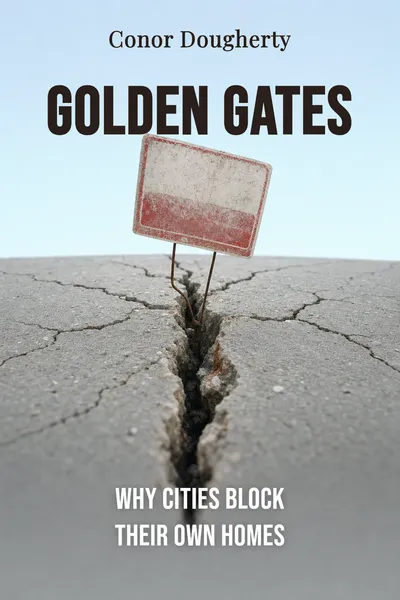
Golden Gates
Why cities block their own homes
Description
In 2015, a woman named Sonja Trauss started showing up at San Francisco planning meetings to say something almost nobody in the room wanted to hear: build more, build anything, build it here. She had no housing background. She'd been a math teacher, then baked and sold pretzels. What she noticed was that every proposed apartment building drew a crowd of neighbors explaining, politely and at length, why this particular one was wrong. Too tall. Too dense. Wrong shadow, wrong traffic, wrong feel. And the buildings kept not getting built, while the rents kept climbing, and her friends kept leaving town.
The San Francisco Bay Area, home to some of the richest companies in human history, had by the late 2010s become one of the hardest places on earth for an ordinary family to afford a roof. A median home crossed a million dollars. Teachers, nurses and firefighters commuted two hours each way or gave up and moved to Nevada. This is the terrain of Conor Dougherty's book Golden Gates, a reporter's account of how a region that prints wealth managed to choke its own housing supply — and of the people fighting, block by block, to unchoke it.
The strange part is that no villain planned this. The shortage was assembled out of reasonable-sounding local decisions, each defensible on its own, each made by people protecting something they cared about. Dougherty's book follows that machinery up close, through the activists and homeowners and developers caught inside it, and asks how a place this prosperous convinced itself that fewer homes was the responsible choice.
The question we’re asking : How does a region rich enough to house everyone end up blocking the very homes it needs?What we’ll see : A reporter's ground-level tour of the Bay Area housing crunch — the numbers, the neighbors, the activists, and what the fight reveals about who really decides who gets to live where.
Table of contents
01Chapter 1 — The math nobody wants to run
Dougherty starts where the crisis actually starts: with a supply that never kept up with the people. For decades the Bay Area added jobs — and, especially after the tech boom, extraordinarily well-paid ones — far faster than it added places to live. When a lot of money chases too few homes, the outcome isn't mysterious. Prices go up, and they keep going up until enough people give up and leave. The region built a world-class economy on top of a housing stock sized for a much smaller, sleepier place, and then acted surprised when the two stopped fitting together.
The book is good at making the abstraction concrete. A software engineer on a comfortable salary bids against a dozen others for a modest bungalow and loses. A family that rented the same apartment for years gets a notice, and the new rent is simply beyond them. The people at the bottom of this squeeze aren't the poorest — they were often pushed out long ago — but the ordinary middle, the workers a city needs to function, who discover that a good job no longer buys a normal life within reach of it.

02Chapter 2 — How a good neighbor learned to say no
The word that hangs over the book is NIMBY — Not In My Back Yard — and Dougherty treats it with more care than the label usually gets. The homeowners fighting a new apartment complex are rarely cartoon villains. They're people who saved for years to buy into a neighborhood, who love the light and the quiet and the view, and who reasonably fear that a five-story building across the street will change all of it. Asking them to welcome density is asking them to accept a cost that's concentrated and visible, in exchange for a benefit that's spread thin across strangers they'll never meet.
The tools they use are mostly boring and mostly legal. Zoning rules dictate that huge swaths of the region can hold only single-family houses, which quietly forbids the very apartments that would house more people on the same land. Environmental review laws, written to protect against pollution, get repurposed to delay projects for years. Public comment periods hand a megaphone to whoever shows up, and the people who show up are overwhelmingly older, whiter, and already housed. The renters who'd move into the new building can't attend a meeting for a home that doesn't exist yet.
03Chapter 3 — The renter who read the zoning code
Against that machinery, Golden Gates gives us Sonja Trauss and the movement that coalesced around her, the group that came to be known as the YIMBYs — Yes In My Back Yard. Their argument was almost aggressively simple: the Bay Area doesn't have enough homes, so it should build more of them, including the tall and dense kind that neighbors hate. Where earlier housing advocates had focused on protecting existing tenants and demanding subsidized units, Trauss insisted the underlying problem was raw supply, and that blocking market-rate buildings hurt the poor too, by pushing wealthier renters down into cheaper neighborhoods.
It was a genuinely new posture. For decades, the reflexive left position on a shiny new apartment tower had been suspicion — developers were the enemy, and growth meant gentrification. Trauss and her allies scrambled that map. They started turning up at hearings not to oppose development but to demand it, sometimes standing alone against a room of angry homeowners. They were young, often renters, often priced out themselves, and they had discovered that the fight over housing was decided in exactly the tedious municipal venues most people never enter.
04Chapter 4 — When building becomes a moral fight
Step back from the Bay Area and the book is really about a flaw in how communities govern growth. Housing decisions are made at the most local level possible, by the people who already live somewhere, and those people have every incentive to keep things as they are. The newcomers who would benefit from more homes don't yet live there, can't vote there, and have no seat at the table. Dougherty shows a democracy that is perfectly responsive — to the wrong constituency. It listens beautifully to the housed and cannot hear the unhoused.
That's why the region's crisis reads less like an accident than a policy, even though no one signed it. When every incremental decision is handed to incumbents, the sum of those decisions is a wall. And the costs don't stay contained. They spill into traffic, into homelessness on tech-boom sidewalks, into a workforce that can't afford to live near its work, into a widening gap between those who bought in early and those who arrived too late. Scarcity, once built, becomes an asset for the people who own it — every blocked building makes the existing homes worth more, which quietly aligns self-interest against supply.
05Conclusion
We come back, in the end, to Sonja Trauss at a podium, telling a hostile room that their city needed the building they'd gathered to stop. She didn't win most of those nights. But the argument she forced into the open — that a place refusing to house people is making a choice, not obeying a law of nature — outlasted the individual fights. Golden Gates follows that argument from a pretzel-seller's frustration all the way to the edges of state law, and it treats the people on every side, homeowners included, as understandable rather than wicked.