Gödel, Escher, Bach
Mind from matter, code from thought
Description
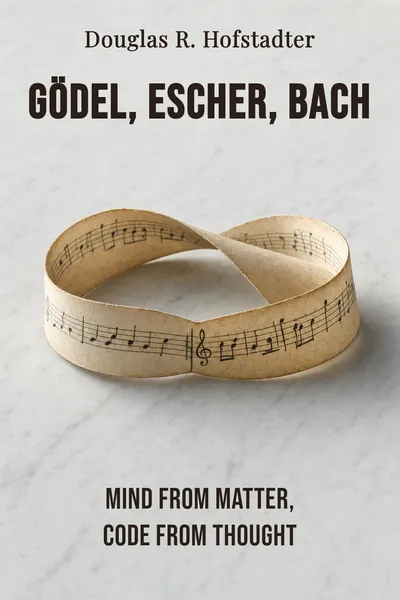
In 1979, a young cognitive scientist named Douglas Hofstadter published a 700-page book with an almost defiantly strange title: Gödel, Escher, Bach: An Eternal Golden Braid. It braided together a logician who proved the limits of mathematics, a Dutch artist who drew hands drawing themselves, and a German composer who buried his own name inside his fugues. The book won the Pulitzer Prize the following year. Almost nobody, including its publisher, had expected anyone to read it cover to cover.
The reason it endured is that the three figures were never the real subject. Hofstadter used them as a way into one question that had been gnawing at him for years: how does a mind come out of stuff that has no mind? A brain is, after all, a few pounds of cells passing chemical signals to one another. None of those cells understands anything. None of them means anything. And yet, somehow, out of all that mechanical traffic, there is a you — something that thinks, doubts, and reads this sentence. Where does the 'you' come from?
Hofstadter's answer runs through formal systems — the kind of rule-bound games mathematicians build, where symbols get shuffled by fixed instructions. His claim is that something can climb out of such a system and look back down at it. A pattern can refer to itself. And once a system can talk about itself, Hofstadter argues, the door opens to meaning, to life, and eventually to thinking machines.
The question we’re asking : How does something as rich as a thinking, self-aware mind emerge from a substrate of mindless mechanical parts?What we’ll see : How three very different geniuses point at one idea — that systems which fold back on themselves are where meaning, life and intelligence begin.
Table of contents
01 Chapter 1 — A medal, a drawing, and a fugue walk into a book
Start with the three names on the cover, because Hofstadter chose them with care. Kurt Gödel was an Austrian logician who, in 1931, proved something that shook the foundations of mathematics: in any formal system rich enough to do arithmetic, there are true statements the system can never prove. The dream of a complete, self-contained mathematics was finished. M.C. Escher was the Dutch printmaker who drew staircases that climb forever and return to where they started, hands sketching the hands that sketch them, fish that dissolve into birds. Johann Sebastian Bach wrote canons and fugues that rise through the keys and somehow arrive back at the beginning, having climbed without ever leaving the ground.
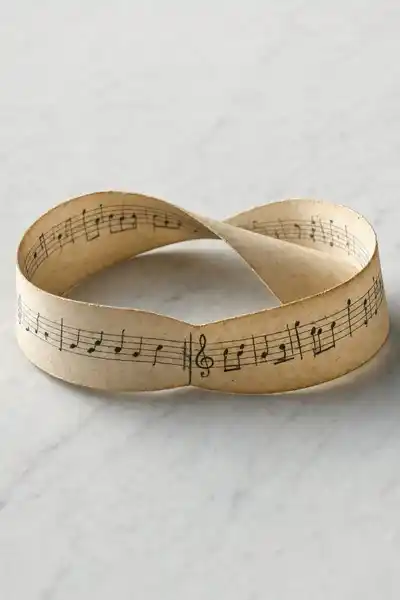
What ties them, for Hofstadter, is a single shape he calls the strange loop. You move through a system in one consistent direction — up the staircase, up the scale, up the levels of a proof — and you find yourself, impossibly, back where you began. The hierarchy eats its own tail. Gödel found it in logic, Escher drew it in ink, Bach played it in sound. Hofstadter's hunch was that the same shape sits at the bottom of the most familiar mystery of all: the feeling of being a self.

02 Chapter 2 — The sentence that ate its own tail
To see why Gödel matters here, picture a formal system as a game. There are symbols, there are starting strings, and there are rules for turning strings into new strings. That is all. The system has no idea what its symbols mean; it just shuffles them. Mathematicians in the early twentieth century hoped that with the right game, every truth of arithmetic could eventually be churned out by the rules, and every falsehood kept out. A perfect, closed machine for truth.
Gödel broke the dream with a trick of breathtaking nerve. He found a way to make the symbols of arithmetic stand for statements about arithmetic itself — assigning each formula a unique number, so that statements about numbers could secretly be statements about statements. Inside the cold machinery, he built a sentence that, decoded, says: 'This statement cannot be proved within this system.' Now look at what that sentence does. If the system could prove it, the system would be proving a falsehood. So it cannot prove it — which means the sentence is true. There sits a true statement the system can never reach.
03 Chapter 3 — Strange loops, all the way up
With Gödel's lesson in hand, Hofstadter turns to the brain and asks the same question he asked of arithmetic. The brain is a formal system in its way: neurons fire or do not fire according to the signals they receive, obeying physics and chemistry with no freedom and no understanding. At that level there is nothing but switching. No neuron knows that you exist. So where, exactly, is the thought?
His answer leans on the idea of levels that do not reduce neatly to one another. Just as a true statement could live on a level above arithmetic's symbols, a thought lives on a level far above its firing neurons. We do not experience neurotransmitters; we experience concepts — 'dog', 'justice', 'tomorrow'. Hofstadter calls these high-level patterns symbols, deliberately echoing the formal systems, and he argues the mind is the dance of these symbols, riding on top of the neural traffic the way software rides on a chip without being any particular transistor.
04 Chapter 4 — The self that isn't anywhere
Step back from the loops and the fugues, and Hofstadter is making one large wager, repeated at every level of the book. Life grows out of chemistry that is not itself alive — a cell is molecules following the same blind laws as a rock, and yet it reproduces, repairs, adapts. Consciousness grows out of neurons that are not themselves conscious. In both cases something rich and unified rises out of a formal substrate that contains no hint of it, and the higher thing is real even though you cannot find it in any single part. The whole is doing something the pieces cannot.
If that is how mind works, the consequence is direct and, in 1979, provocative: there is nothing sacred about the substrate. What matters is the pattern, the organisation, the loop — not the meat it happens to run on. If a self is a particular kind of self-referential structure, then any system complex enough to build a model of itself and to let that model fold back on the machinery below could, in principle, host a self. Carbon is not the point. The loop is the point.
05 Conclusion
The book ends where it began, with Gödel, Escher and Bach standing in for a single shape glimpsed three times. A logician finds a sentence that names itself, an artist draws a hand that draws itself, a composer writes a theme that climbs back into its own opening — and a brain assembles a model of itself and calls it 'I'. The strange loop is the thread, and Hofstadter has spent 700 pages convincing us it is not decoration but the thing itself, the way a system becomes a self.
Related books