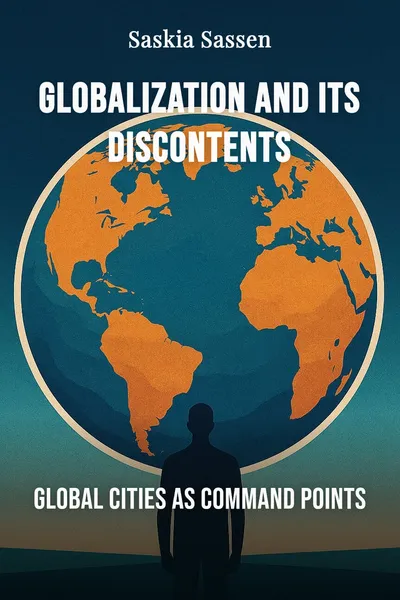
Globalization and Its Discontents
Global cities as command points
Description
In the late 1990s, a Dutch-American sociologist named Saskia Sassen kept noticing the same thing in the numbers. The world economy was supposedly dispersing — factories moving to wherever labor was cheapest, capital flowing across borders at the speed of a keystroke, work becoming something you could do from anywhere. And yet the coordination of all that dispersal was piling up in a handful of places. New York, London, Tokyo. A few dozen others behind them. The more spread out production became, the more tightly concentrated the management of it grew. That paradox is the engine of the book she gathered under the title Globalization and Its Discontents, drawing on the research she had built through the 1990s on what she called the global city.
The intuition most of us carry is that globalization dissolves place. If money moves at light speed and a design can be emailed to a factory eight time zones away, geography should stop mattering. Sassen's finding cut the other way. Certain cities were becoming more important, not less — and not as the biggest ports or the largest populations, but as command points. Places where the specialized work of running a global economy actually happens: the legal, financial, accounting and advisory labor that turns scattered operations into something manageable. The dispersal was real. But dispersal needs a center, and the centers were multiplying in value even as the periphery spread.
What made Sassen's account uncomfortable was that it refused to stop at the glass towers. A command point is a place, and places have to be cleaned, fed, guarded and repaired by people who live nowhere near the boardroom. The same city that concentrates the highest-paid work also concentrates the lowest-paid, and the two are not separate stories. They are the same story, told from two floors of the same building.
The question we’re asking : If globalization was supposed to make place irrelevant, why did economic power concentrate in a handful of cities instead of dissolving across the map?What we’ll see : How a few cities became the control rooms of a dispersed economy, what gets done inside them, and who keeps them running.
Table of contents
01Chapter 1 — The map nobody drew on purpose
The starting point of Sassen's argument is a contradiction that the standard story of globalization could not hold. Through the 1980s and 1990s, the productive economy scattered. A single product might be designed in one country, financed in a second, assembled from parts made in a third and a fourth, and sold in a fifth. Multinational firms ran operations across dozens of jurisdictions. The whole system was supposed to be placeless — capital and information flowing freely, indifferent to where anything sat on a map.
But dispersal at that scale creates a problem, and the problem is coordination. Someone has to manage the risk of operating across forty legal systems and a dozen currencies. Someone has to structure the financing, audit the accounts, write the contracts, and interpret the regulations. That work is not routine and it cannot be automated away. It requires specialists working close to one another, close to clients, close to the markets they read all day. So the more the economy spread out, the more this specialized coordinating work concentrated — and it concentrated in cities.

02Chapter 2 — What actually gets managed in the tower
To see why these cities gained rather than lost importance, it helps to look at what the specialized work inside them actually does. Running a global operation is not the same as owning factories. It is the ongoing job of holding a dispersed system together: pricing risk, moving capital, structuring deals across borders, and making sure that operations spread over many countries can be steered as one. Sassen's insight was that this coordinating capacity had itself become a product — something firms bought from clusters of specialists rather than built alone in-house.
Finance was the clearest case. The financial industry did not merely fund the global economy; it produced the instruments that let capital move and risk be traded across every border. Doing that required constant, face-to-face collaboration among people who dealt in extremely specialized knowledge — the kind that changes by the hour and travels badly through a memo. That knowledge lived in the trading floors, the deal rooms, and the after-hours conversations of a few cities. The concentration was not sentimentality about place. It was where the work got done fastest and best.
03Chapter 3 — The invisible workforce that keeps the lights on
The part of Sassen's account that gives the book its edge is what she saw when she looked past the command function to the city that houses it. A place stuffed with highly paid specialists does not run on specialists alone. It runs on an army of low-wage workers who service both the firms and the lifestyles of the people inside them. The office towers have to be cleaned overnight. The high earners need their food delivered, their apartments renovated, their children minded, their laundry done. The command function generates, right alongside itself, a dense demand for exactly the kind of low-paid manual and service labor that the placeless economy was supposed to have made obsolete.
Sassen's point was that these two labor markets are not accidents that happen to share a city. They are structurally linked. The concentration of high-income professionals creates a market for luxury goods and personal services that is itself labor-intensive at the bottom. A gourmet restaurant needs many more low-wage hands than a supermarket serving the same number of people; a refurbished loft needs more custom manual work than a mass-produced house. The very intensity of wealth at the top manufactures the demand for cheap labor beneath it. The glamorous economy and the sweated one are produced together.
04Chapter 4 — Sovereignty leaks out of the nation-state
Step back from the two labor markets and a larger shift comes into view — one that reaches past economics into the question of who is actually in charge. When Sassen traced how command concentrates in global cities, she was also tracing how a slice of authority migrates out of the nation-state. The specialized apparatus that runs global finance and cross-border business operates by its own rules, its own private legal regimes, its own transnational logic. It sits inside a national territory but answers increasingly to a global one. The global city, in her reading, becomes a kind of frontier zone where the national and the global overlap and where the state's grip loosens.
This is why the concentration matters beyond the balance sheet. A country's economic center of gravity can end up governed less by national policy than by the imperatives of a global market that has planted its coordinating functions in a few of that country's cities. The state does not disappear; it is often the very thing that clears the ground for these flows, writing the deregulation and the guarantees that let global capital feel at home. But in doing so it hands a portion of its own steering to actors it no longer fully controls. Power is not lost so much as displaced, upward and outward.
05Conclusion
Sassen began with a number that did not fit: an economy dispersing across the planet, yet concentrating its control in a handful of cities. The resolution she offered is that dispersal and concentration are two sides of one process. The wider production spreads, the more coordination it needs, and coordination clusters where the specialists, the capital, and the information already sit. The global city is the address where a placeless economy turns out to need a place after all.
Related books