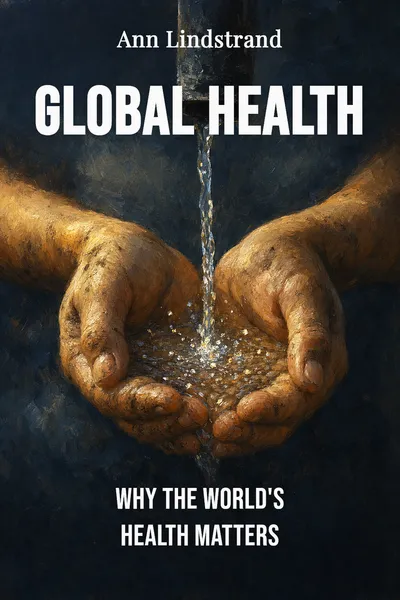
Global Health
Why the world's health matters
Description
Sometime around 1900, a child born almost anywhere on Earth could expect to live roughly thirty to forty years. A little over a century later, global life expectancy has more than doubled, sitting somewhere above seventy. That is one of the largest changes in the human condition ever recorded, and it happened fast enough that people alive today have grandparents who were born into the older world. Ann Lindstrand's Global Health takes that transformation as its starting point, not to celebrate it, but to ask a harder question: if the world got so much healthier, why is the gap between the healthiest and the sickest places wider than it has ever been?
The book is written from a public health perspective, which means it is less interested in individual illness than in the health of whole populations — why some groups live decades longer than others born the same year, a few hundred miles away. And its central move is to refuse the comfortable idea that health is mostly about doctors and medicine. A newborn's chances, Lindstrand argues, are set long before any clinic gets involved: by income, by clean water, by schooling, by the air outside and the politics above.
That reframing is what makes global health a distinct field rather than a bigger version of medicine. It treats a fever in one country and a food shortage in another as parts of the same conversation, and it insists that the numbers — who dies, of what, at what age — are the only honest way to see a population's life. To read it is to watch health stop being a private matter and become a map of how the world distributes its resources.
The question we’re asking : If the world has never been healthier on average, why has the distance between the healthiest and the sickest places never been wider?What we’ll see : How a public health lens reads a population's life through its history, its living conditions, its numbers and the systems built to care for it.
Table of contents
01 Chapter 1 — A century of gains that didn't reach everyone
The long view is genuinely startling. For most of human history, the great killers were infectious: diarrhoeal disease, respiratory infections, the illnesses that carried off children before they reached five. A population's health was hostage to microbes and famine, and progress, where it happened at all, was slow and reversible. Then, over roughly the last hundred and fifty years, much of the world went through what demographers call the epidemiological transition — a shift away from dying young of infections toward dying old of chronic conditions like heart disease, cancer and diabetes.
Lindstrand is careful about what drove it. The instinct is to credit medicine, but the timeline doesn't cooperate. Much of the early decline in mortality came before antibiotics and most vaccines, driven instead by cleaner water, better sanitation, more reliable food and rising incomes. Medicine mattered — vaccination in particular saved enormous numbers of lives — but it arrived as one force among several, often after the curve had already begun to bend. The lesson the book draws is that health is built as much by engineers, farmers and legislators as by physicians.

02 Chapter 2 — What actually decides whether people stay well
If medicine isn't the main engine of a population's health, what is? Lindstrand's answer runs through what public health calls the determinants of health, and the striking thing is how few of them happen inside a hospital. Income sits near the top: poverty shapes what people eat, where they live, whether they can afford to stop working when sick, and how much stress their bodies absorb over a lifetime. Wealth doesn't just buy treatment; it buys the conditions in which illness is less likely in the first place.
Education comes close behind, and its effect on the health of mothers and children is one of the most consistent findings in the field. A girl who stays in school tends to marry later, have fewer and healthier children, understand how disease spreads, and know when and where to seek care. Educating women, the book notes almost drily, turns out to be one of the most powerful health interventions available, and it has nothing to do with a clinic. The same logic applies to clean water, sanitation, safe housing and nutrition — the unglamorous infrastructure of ordinary life.
03 Chapter 3 — Counting the dead to see the living
A discipline that thinks in populations lives or dies by its ability to measure them, and a good part of Lindstrand's book is devoted to the unglamorous work of counting. Public health needs to know how many people are being born, how many are dying, at what ages and from what causes — and in much of the world, that information is patchy or missing entirely. Many countries lack complete civil registration, so a large share of the world's deaths are never formally recorded. You cannot manage a problem you cannot see, and a great deal of global health effort goes simply into making populations visible.
The book walks through the core indicators, and they repay attention because each one tells a different story. Life expectancy summarizes a whole population's fate in a single number. Infant and under-five mortality are treated almost as a society's honesty test, because a country that lets its youngest die is failing at the most basic level. Maternal mortality reveals how women are valued and cared for. These are not neutral statistics; they are moral thermometers.
04 Chapter 4 — The care systems the world improvised
Step back from the numbers and a broader picture emerges: global health is really the study of how the world organizes itself, seen through the body. Nowhere is that clearer than in the health systems Lindstrand surveys, because there is no single model. Some countries pool money through taxes and treat care as a public right; others run insurance markets; many low-income countries rely on a fragile mix of government clinics, private providers and out-of-pocket payments that push families into poverty precisely when they fall ill. How a society funds care turns out to be a statement about what kind of society it wants to be.
This is where the book's public health lens does its widest work. A health system is not a neutral machine for delivering treatment; it is a political settlement about who deserves protection and who pays. The World Health Organization's long-standing goal of health for all, and the more recent push for universal health coverage, are attempts to write that settlement fairly across the whole world. But they run straight into the fact that money and power are unevenly held, both between nations and within them.
05 Conclusion
The book opens on that doubled lifespan and never quite lets the reader relax into it. The gain was real, one of the great achievements of the modern age, but Lindstrand keeps pulling the eye toward the distribution: who received the extra decades and who is still waiting for the first ones. A population's health, in the end, is not a medical fact but a social one, written in water pipes, school enrolment, tax systems and the air people breathe.
Related books