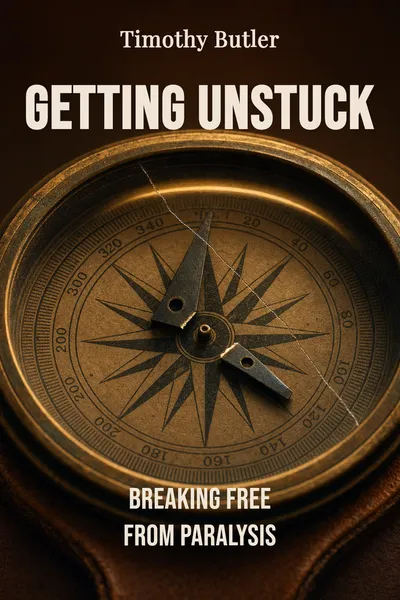
Getting Unstuck
Breaking free from paralysis
Description
There is a particular kind of stuck that has nothing to do with laziness. You are competent, you show up, the work gets done — and yet something underneath has gone quiet, or gone loud, and you can no longer pretend not to hear it. The job that fit for a decade suddenly chafes. The relationship, the city, the whole shape of the days feels off in a way you can't quite name. Timothy Butler, a psychologist who spent years at Harvard Business School counseling people at exactly these moments, has a word for it: impasse. Not a bad patch. A genuine standstill, where the old map no longer leads anywhere.
What makes impasse so disorienting is that it arrives without a villain. Nothing is technically wrong. The salary is fine, the résumé is enviable, the checklist is complete — and still the feeling of being trapped is total, almost physical. Butler's clients were often high-achievers, the last people who expected to freeze. Their instinct, and ours, is to treat the paralysis as a problem to be solved fast: change jobs, make a list, push harder, wait it out. Most of those moves, he found, quietly make things worse.
Butler's book "Getting Unstuck" argues that this experience is not an accident to be eliminated but a passage nearly everyone crosses several times in a life. The stakes are real — a career, a marriage, the health of a whole team can hang on whether we move through it or dig in. But the way out, he insists, runs somewhere counterintuitive: not around the impasse, but straight into what it is trying to tell us.
The question we’re asking : What is really happening when we feel stuck, and why does trying to fix it fast so often backfire?What we’ll see : How Butler reframes psychological impasse — from a breakdown to be escaped into a passage that, handled well, moves a life forward.
Table of contents
01 Chapter 1 — The feeling that something has to change
Butler begins with the sensation itself, because it is so easy to misread. Impasse announces itself as a low, persistent dissonance — a sense that the life we are living and the person we have become no longer line up. We wake up already tired. Decisions that used to be automatic now feel impossibly heavy. We rehearse the same complaint to friends and get bored of our own voice. Nothing has collapsed, which is exactly why it's confusing: from the outside, everything looks intact.
He is careful to distinguish this from ordinary dissatisfaction or a rough month. Impasse has a stuck quality that doesn't lift when the weekend comes or the vacation ends. It's the difference between being tired and being at the end of a road. The person feels certain that something has to change — the job, the field, the partner, the whole trajectory — without any clarity about what the change actually is. That gap between the urgency and the blankness is the signature of a true impasse.

02 Chapter 2 — Why the usual fixes make it worse
Faced with paralysis, most of us reach for the tools that have always worked, and Butler's point is that these are precisely the tools that fail here. The first reflex is speed. We want the discomfort gone, so we make a fast, dramatic move: quit the job, take the other offer, end the relationship, relocate. It feels like decisiveness. Often it is flight. Butler watched people leap from one situation into a nearly identical one, because they had changed the scenery without understanding what the impasse was about — and the same stuckness reassembled itself within a year or two.
The second reflex is analysis. Trained, capable people trust the pro-and-con list, the spreadsheet, the rational weighing of options. But an impasse is not fundamentally a logistics problem, and logic tends to run in circles around it. You can list every reason to stay and every reason to go and still feel exactly as paralyzed, because the deciding information isn't on the list. It lives lower down, in what actually pulls at us, and the analytical mind is not built to hear it.
03 Chapter 3 — Listening to what the impasse is telling you
If the fast fixes fail, what does Butler propose instead? Not a technique so much as a shift in posture: staying with the impasse long enough to let it speak. He calls the crucial capacity the ability to tolerate the discomfort of not knowing — to sit in the ambiguity without lunging for premature resolution. This runs against every instinct of an achiever, and it is exactly why achievers get stuck longest.
The material he trusts is not the résumé but the inner life: the images, memories, daydreams, and stray longings that keep surfacing when the analytical mind quiets down. Butler leans heavily on what he learned from depth psychology — the idea that we are drawn toward certain activities and away from others for reasons deeper than we consciously track. Interests, in his reading, are not hobbies; they are clues to a shape of life that would actually fit. The work is to notice them without judging them as impractical.
04 Chapter 4 — When getting stuck is how we grow
Step back, and the deeper claim in Butler's work comes into focus: impasse is not a breakdown in an otherwise smooth life. It is one of the main ways a life moves forward at all. We tend to imagine development as steady, incremental — a little wiser, a little further along each year. Butler describes something more discontinuous. We grow into a self, live inside it until it stops fitting, and then hit a wall precisely because we have outgrown the arrangement that used to serve us. The wall is the growth trying to happen.
This reframes the paralysis entirely. The stuckness that feels like regression is actually the necessary friction of transition. Something has ended before the next thing has begun, and the discomfort is the interval between them — the passage every meaningful change requires. Seen this way, the person in impasse is not failing at life; they are at the leading edge of it, closer to real movement than the person who feels comfortably settled.
05 Conclusion
The person who walks into Butler's office convinced they need a new job, a new city, a new life is usually right that something must change — and usually wrong about what. The change they can name is a substitution; the change the impasse is pushing toward is a transformation. Getting unstuck, in his account, begins not with a decision but with a willingness to stop deciding for a while, to tolerate the blankness long enough for a real direction to surface from underneath the noise.
Related books