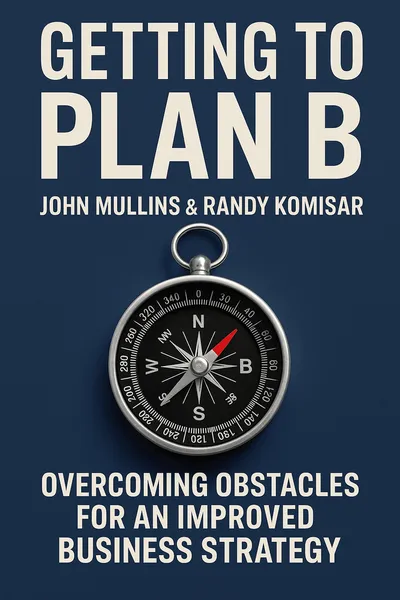
Getting to plan b
Overcoming obstacles for an improved business strategy
Description
Many businesses begin with an initial plan but find success in a different direction, so it's crucial to develop a backup strategy early on. Before drafting your business plan, rigorously evaluate the core aspects of your business model. This approach helps you create a more viable Plan B from the start, rather than a promising but unrealistic Plan A.
Most business plans fail to achieve their goals, rarely securing funding or even being read. We aim for your venture to be exceptional, demonstrating real economic and social impact through solid evidence and performance. Let's proceed on this entrepreneurial journey together. – John Mullins and Randy Komisar
Table of contents
01Constructing a profitable business framework
Max levchin moved to silicon valley in 1998, initially failing with security software for handheld devices. Pivoting to a cash transfer system for palmpilots, he inadvertently founded paypal, which ebay acquired for $1.5 billion, showcasing the importance of adaptability in business.
"earnings generation strategy"
Sales revenue is crucial for any business, as it depends on a steady flow of paying customers to remain viable. A business plan often needs adjustments if there aren't enough customers willing to pay promptly and sufficiently. Your revenue model should answer six vital questions: who your target market is, what they will buy, why they will buy it, when and how often they will make purchases, at what price point, and the costs and efforts required to sell to them. A business's survival hinges on proving that customers value and are willing to pay for its offerings. Without customer-generated cash flow, investor interest is unlikely. Google exemplifies a company that initially lacked a clear revenue model but later capitalized on pay-per-click advertising, significantly boosting its revenue and profits. At the heart of every revenue model is the aim to solve a customer's problem or provide delight, a principle highlighted by venture capital investor john doerr who noted that great business opportunities come from solving significant, painful problems.
"profit margin strategy"
Generating revenue is crucial for any business, but analyzing it alongside profitability is equally important. A gross margin model helps ensure a company maintains enough margin to support growth, compensate investors, and cover fixed costs. This model comprises the spread, which is the difference between selling price and cost of goods sold; the product mix, accounting for varying gross margins across products; and the strategy, deciding which products to focus on for the highest spread. Gross margin is based on the cost of goods sold to customers, excluding fixed costs, which are considered in operating costs. In some industries, like film, the cost of goods sold can be very low compared to fixed production costs. A business's viability depends on a gross margin that covers all fixed costs, with the goal of continuously finding ways to increase this margin by reducing costs or adding value to justify higher pricing. Maximizing this margin sustainably is key to a business's longevity.

02Deconstructing your business model
The adage "it takes money to make money" holds particular relevance when contemplating the investment strategy for launching a new business venture. This strategy is crucial for ascertaining both the initial and ongoing financial commitments required to establish a company's infrastructure, attract customers, and ultimately secure a sustainable and profitable enterprise. The aim is to devise an investment strategy that curtails the initial capital outlay, thereby diminishing the necessity to relinquish equity and mitigating overall risk. A streamlined investment approach also affords greater adaptability to pivot to alternative strategies if the need arises.
To minimize capital requirements both before and after commencement, entrepreneurs should employ various tactics. Postponing non-critical activities and concentrating on essential needs can conserve resources. Outsourcing business functions can prove cost-efficient, particularly prior to the generation of a consistent cash flow. Opting to lease assets instead of purchasing them outright can also curtail upfront expenditures, with the added possibility of acquiring them at a later stage. Selecting more affordable professional services rather than those from high-profile firms can lead to substantial savings, and exploring methods to decrease customer acquisition costs, such as leveraging online sales channels, can be advantageous. Moreover, founders can contribute their own labor and expertise to minimize the necessity for additional hires and compensation.
03Evaluating your risky assumptions
The business model matrix is a strategic tool designed to guide entrepreneurs through the process of establishing and refining a viable business model. This involves identifying and testing various leaps of faith, which are essentially assumptions about what will make the business model successful. Entrepreneurs are encouraged to formulate hypotheses for each leap of faith, such as the belief that consumers would be willing to pay a certain price for a product or service, and then determine appropriate metrics to validate these hypotheses. For example, in the case of downloadable music, the metric could be the number of tracks purchased by users from a specific platform.
The launch of Apple's iTunes website in April 2003, which saw over a million downloads on its first day and 7.5 million tracks sold by the end of July, serves as a prime example of how real-world data can validate a hypothesis. This success not only provided a new revenue stream for music companies but also bolstered sales of Apple's iPod devices. Such outcomes highlight the importance of collecting and analyzing data to refine the business model, ensuring that time and resources are not wasted on unviable ideas.
Related books