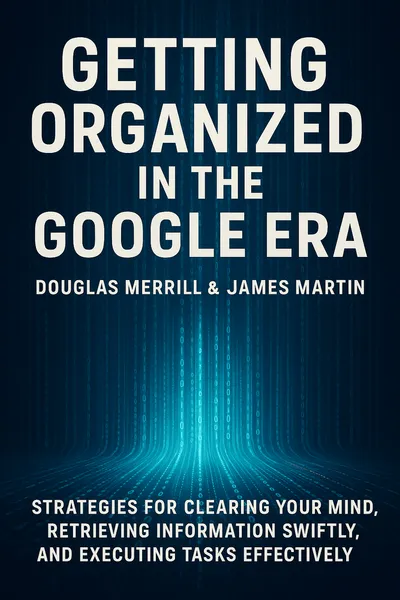
Getting organized in the google era
Strategies for clearing your mind, retrieving information swiftly, and executing tasks effectively
Description
In today's fast-paced world, staying organized amidst a deluge of information is crucial. Traditional paper-based systems are outdated, necessitating a personalized organizational system that leverages technology effectively.
Such a system should align with natural brain functions, utilize technology smartly for organization, and be realistic and scalable to manage daily information overload. By adopting these principles, you can create an organizational system that reduces stress, enhances success, and allows for a focus on what truly matters each day.
Table of contents
01Thought processes
Creating a personal organization system that resonates with your cognitive processes is essential. If you neglect to do this, you may inadvertently undermine your own efforts to progress. There are eleven foundational principles that can guide you in harmonizing your organizational methods with your thought patterns.
Our lives are inundated with a plethora of items, all vying for our attention. Whether we are conscious of it or not, our focus is perpetually shifting from one thing to another, and yet another. We are constantly bombarded with information, so it is futile to attempt to register every detail that comes our way. Instead, it is advisable to structure your life in a manner that reduces cognitive overload. Douglas Merrill emphasizes that the challenge of organizing is intricately linked to the way our brains function. He asserts that he is not in the business of imposing rules, which are restrictive by nature, but rather in offering principles that serve as suggestions for new ideas, options, and tools. These principles are designed to assist you in crafting organizational systems that are tailored to your individual needs.
One of the primary sources of mental exhaustion is the dilemma of deciding what to remember and what to discard. The human brain excels at noticing details but is notoriously poor at retention. Our alertness to our surroundings is a primal survival mechanism, and we are constantly vigilant, often without realizing it. When we take note of something, it is temporarily stored in our short-term memory. Without further action, these memories will be supplanted by new ones. Our short-term memory has the capacity to hold between five to nine items at any given moment. A crucial aspect of any organizational system is to devise strategies to efficiently transfer information from short-term to long-term storage, ensuring it is preserved in a secure and retrievable manner. By consistently implementing systems that facilitate this process, you will likely experience reduced stress, diminished mental strain, and an increase in productivity.
The essence of any organizational system should be the swift relocation of information from short-term memory to a searchable database. This practice has been recognized by astute individuals for generations. Douglas Merrill recounts an anecdote about Albert Einstein, who, when asked for his phone number by a reporter, referred to a phone book rather than relying on memory. Although the veracity of the story is questionable, it humorously underscores the importance of externalizing information to concentrate on matters of significance. In contemporary society, there is a pervasive attempt to multitask, despite the fact that the human brain is not equipped for such endeavors. Multitasking hinders the brain's ability to process information into short-term memory, rendering it counterproductive. Cognitive scientists refer to the process of transferring information from short-term to long-term memory as "encoding," and the common method of repetition for this purpose is known as "rehearsal." However, to enhance organization, a more effective method is required, as rehearsal is slow and susceptible to various potential disruptions.

02Advice methods and plans
In the bygone days of yore, when one was fortunate enough to receive a memorandum deemed of significant importance, the customary practice entailed the creation of three replicas of the document. These copies were then diligently organized into at least two manila folders, which found their home within the confines of a filing cabinet. An additional copy was securely placed in a ring binder, serving as a prudent safeguard. As we journey to the present era, this scenario has witnessed a profound metamorphosis. Memorandums are now predominantly disseminated via electronic mail, markedly simplifying the process of storage. The recipient of such an email is merely required to assign the correspondence to a designated folder, thereafter allowing it to fade into the background of their digital archive. Should the occasion arise necessitating the retrieval of the email, a straightforward electronic search employing pertinent keywords will effortlessly suffice, regardless of the specific location where the email was stored.
The realm of computer technology has been significantly enriched by the emergence of cloud computing as a central theme. This cutting-edge paradigm facilitates the delivery of services and software tools directly through the interface of a web browser. This innovation transcends the limitations of confining information to a singular personal computer, enabling the data to be stored in the ethereal expanse of the cloud. Consequently, this allows for the accessibility of information at any moment, from any device equipped with internet connectivity.
The dawn of search technology has ushered in a revolutionary transformation in the methodologies employed for organizational purposes. Generations past dedicated immense effort towards the development of information storage systems that were optimized for the retrieval of relevant data as needed. Nonetheless, these systems have largely been rendered obsolete. Through the leveraging of technological advancements, the emphasis has transitioned towards structuring life around the axiom that it is invariably possible to search for information stored electronically.
03Structuring for modern challenges
In the pursuit of organization, it is essential to master the art of minimizing distractions. Striving for an ideal work-life balance is a futile endeavor; instead, one should aim to weave together the threads of work and life, creating a tapestry that allows for the full utilization of one's energy and cognitive capacity. There are three fundamental principles to bear in mind in this regard:
When your focus on a particular subject is interrupted by a thought that is unrelated, you are experiencing what is known as a context shift. Each time this occurs, your brain undertakes the laborious task of transferring information from short-term to long-term memory to accommodate new data. This process is mentally taxing, and after several context shifts, you may find yourself feeling mentally drained. To mitigate this, it is advisable to integrate comprehensive notes into your calendar. By doing so, as you transition between contexts, these notes can serve as a springboard, propelling you into the task at hand with speed and efficiency, as opposed to wasting precious time trying to recall the agenda of your discussions.
Furthermore, it is beneficial to eliminate distractions to the greatest extent possible. When deep concentration is required, consider turning off your phone. Rather than allowing the constant influx of emails to interrupt your workflow, designate specific times to check your inbox. Identify distractions that frequently arise and endeavor to eradicate them completely from your work environment.
Another tactic to consider is the consolidation of tasks that share a common context, addressing them collectively. As you plan your day, attempt to arrange meetings with similar themes in succession, as opposed to scattering them throughout the day, which forces your mind to repeatedly adjust to different contexts. While this may not always be practical, when the opportunity presents itself, it is advantageous to schedule meetings with related topics back-to-back. Additionally, consider saving meetings that require less mental exertion for later in the day when you are more likely to be fatigued.
Related books