General Relativity for Mathematicians
Relativity for the mathematician
Description
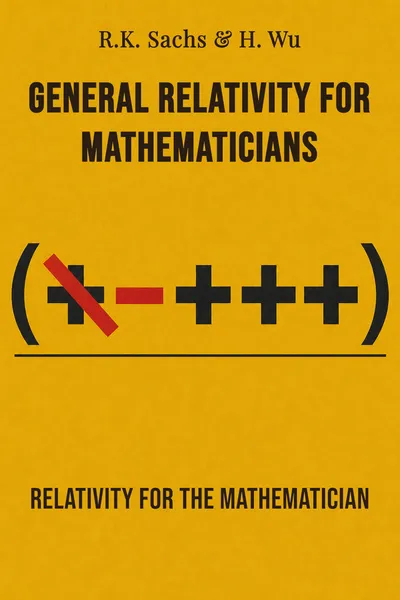
In 1977, two mathematicians — Rainer Sachs and Hung-Hsi Wu — published a book with a title that sounds almost like a provocation: General Relativity for Mathematicians. The provocation is that relativity is physics, one of the most physical subjects there is, all about clocks and light and falling bodies. And yet the book was written for people who spend their days with fiber bundles and connections, not with telescopes. The premise was that a mathematician with a good grasp of global differential geometry could learn what Einstein's theory actually asserts — not a watered-down analogy, the real thing — provided someone was willing to write it in a language that mathematician already speaks.
That someone had to make an unusual bargain. Most physics books motivate their mathematics with physics: here is a phenomenon, here is the equation that fits it, trust the equation. Most mathematics books do the reverse. Sachs and Wu asked their reader to accept the physical motivations in place of mathematical ones — to let a heuristic argument about light rays stand in for a proof — while refusing to let the mathematics itself go loose. Rigor where rigor belongs, physical intuition where proof isn't available, and a clear line between the two. That balance is the whole design of the book.
What makes the book worth revisiting is less any single result than the stance it takes toward learning a subject from the outside. It names, with unusual bluntness, exactly whom it will disappoint and why. And it insists on something easy to forget: that a strong background in one field does not exempt you from the boring, difficult details of another.
The question we’re asking : Can a mathematician learn real physics without either dumbing it down or pretending it's just more geometry?What we’ll see : How Sachs and Wu built a bridge between differential geometry and Einstein's theory, and what crossing it honestly demands.
Table of contents
01Chapter 1 — A physics book that speaks the reader's language
The reader Sachs and Wu had in mind is drawn with almost comic precision. A mathematics graduate student, comfortable with global differential geometry — manifolds, tensor fields, connections. Someone who took freshman physics once and enjoys reading popular accounts of cosmology on a slow evening. Someone who values mathematical clarity but is prepared to accept a physical argument where a mathematical one isn't on offer. And, crucially, someone willing to grind through technical detail rather than skim it. That last trait is the price of admission, and the authors say so up front.
The reason for this specificity is that the two disciplines have incompatible manners. A physicist writing about relativity leans on coordinates, on approximations, on the confidence that nature will sort out the convergence questions. A geometer wants the coordinate-free statement, the domain of definition, the theorem that says the object exists. Neither habit is wrong, but they don't translate cleanly. A mathematician handed a standard physics text tends to trip on exactly the things the physicist waves through, and to be bored by the very things the physicist finds thrilling.

02Chapter 2 — Where the Riemannian instinct betrays you
A mathematician coming to relativity carries one dangerous piece of luggage: familiarity with Riemannian geometry. Curved surfaces, geodesics, the metric that measures length — all of it feels ready to transfer. And much of the formal machinery does transfer. But Sachs and Wu single out, as one of the readers they will disappoint, the mathematician who assumes Lorentzian manifolds are basically Riemannian ones with a sign flipped. They are not.
The difference lives in the metric. A Riemannian metric is positive-definite: every nonzero vector has positive length, and the geometry behaves, locally, like ordinary space. A Lorentzian metric — the kind spacetime carries — has a signature that treats one direction differently from the rest. Some vectors have positive squared length, some negative, and some, the null ones, have zero length despite pointing somewhere real. Those three classes are not a technicality. They are the mathematical face of past, future, and the paths of light, and they impose a causal structure that Riemannian geometry simply has no analogue for.
03Chapter 3 — Spacetime as a manifold, gravity as its shape
Once the machinery is in place, the physical picture becomes strikingly clean. Spacetime is a four-dimensional manifold carrying a Lorentzian metric. Free-falling bodies — a planet, a thrown ball, a beam of light — travel along geodesics of that metric. There is no force of gravity pulling them off a straight line; the lines they follow are already the straightest available, and the manifold is curved. Gravity, in this account, is not a force acting within space. It is the shape of spacetime itself.
The link between shape and matter is Einstein's field equation, which relates the curvature of the manifold to the distribution of matter and energy sitting in it. Matter tells spacetime how to curve; the curvature tells matter how to move. For a mathematician this reads as a relation between a geometric object built from the metric and a tensor describing the physical content — a statement that can be written precisely, whose terms are all defined objects. The equation is where geometry and physics meet, and the book treats it as the centerpiece it is.
04Chapter 4 — The discipline of accepting physical motivation
Step back from the manifolds and geodesics, and the book is making an argument about how one enters a foreign field. The natural temptation, for someone strong in mathematics, is to convert the new subject entirely into the old one — to reduce physics to geometry and treat the empirical parts as noise to be cleaned up later. Sachs and Wu refuse that. They keep the physics genuinely physical: they let a physical motivation stand in for a mathematical one, and they mark clearly when they are doing it. The reader is asked to hold two modes of reasoning at once without collapsing them into each other.
This is harder than it sounds, and it is the book's deepest lesson. A mathematician trained to accept nothing without proof has to learn to accept the field equation on empirical grounds, while still demanding full rigor from the differential geometry underneath it. Knowing which questions deserve a proof and which deserve an experiment is not a lowering of standards — it is a more demanding standard, because it requires judgment about where each kind of certainty applies.
05Conclusion
General Relativity for Mathematicians never pretended to be for everyone, and that was its strength. By fixing its reader so exactly — the geometry graduate student with a taste for cosmology and a tolerance for detail — it could do something the broad encyclopedic treatments could not: speak in one voice, to one kind of mind, about a physics that had usually been written in a dialect that mind found foreign. Spacetime became a Lorentzian manifold, gravity became curvature, and the field equation became a precise relation whose truth still came from the sky rather than from a proof.
Related books