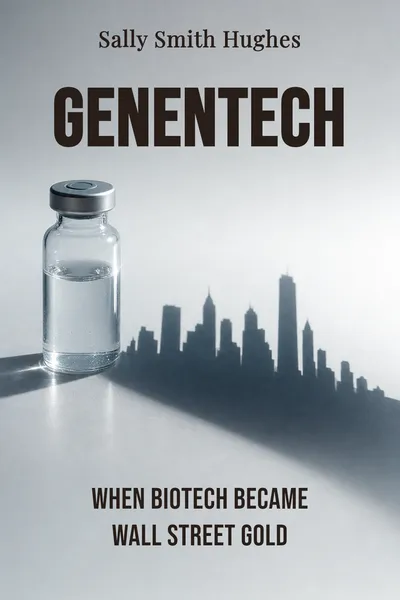
Genentech
When biotech became Wall Street gold
Description
On October 14, 1980, a four-year-old California company with no product on any pharmacy shelf offered its shares to the public for the first time. Genentech, Inc. priced its stock at $35. Within the first few minutes of trading, the price ran to $89. It was, at that moment, the fastest run-up in the history of the American stock market, and it happened to a firm most investors could not have described the day before. The company did not sell drugs. It sold the idea that it soon would — that a technique for splicing genes, barely seven years old, could be turned into medicine, and medicine into money.
The timing was almost theatrical. The United States in 1980 was in recession, rattled by inflation and by a widening sense that its factories and its inventiveness were slipping behind Japan and Germany. Then a group of young Californians in lab coats produced a headline that read like relief: here was a homegrown science, invented in American universities, that might cure disease and rebuild the economy at once. Bankers who could not explain recombinant DNA lined up to own a piece of it. The word biotechnology entered the business pages more or less overnight.
Sally Smith Hughes, drawing on years of interviews with the people who were actually in the room, tells the story of how this happened — not as inevitable triumph but as an improbable venture that spent its early years one experiment away from collapse. The firm at the center began as a conversation between a scientist and a financier, and it ended by teaching Wall Street a new way to count.
The question we’re asking : How did a company with no marketed product and no profit become, for a few minutes in 1980, the most valuable bet on the market?What we’ll see : The unlikely partnership behind Genentech, the borrowed labs where its science actually happened, the human-insulin race that proved the idea, and what that day on the exchange rewired for good.
Table of contents
01 Chapter 1 — A chemist and a venture capitalist walk into a bar
The company began, in the retelling Hughes assembles, with a phone call and a beer. Herbert Boyer was a biochemist at the University of California, San Francisco, one of two scientists — the other was Stanford's Stanley Cohen — who had shown in 1973 that genes could be cut from one organism and stitched into the DNA of another. Recombinant DNA, the technique was called, and it meant, in principle, that a bacterium could be instructed to manufacture a foreign protein. Robert Swanson was twenty-eight, a venture capitalist recently let go from the firm Kleiner & Perkins, restless and reading everything he could find on genetic engineering.
Swanson worked his way through a list of the scientists doing the work, cold-calling to ask whether any of this could become a business. Most told him it was years off, academic, not ready. Boyer agreed to give him ten minutes on a Friday afternoon in early 1976. The ten minutes stretched into hours over drinks in a San Francisco bar. Swanson had the conviction of someone who did not know enough to be cautious; Boyer had the science and, it turned out, the willingness to gamble. Each put in $500. They incorporated in April 1976.

02 Chapter 2 — The company that outsourced its own laboratory
A striking fact of Genentech's earliest years is that, for a while, it had almost no laboratory of its own. It had a concept and very little money, and money for benches and freezers and skilled hands was exactly what it lacked. So the company did something unusual: it contracted the science out, paying university and institute laboratories to run its experiments while it held the commercial rights to whatever they produced. The work that would make Genentech's name happened, at first, in facilities the company did not own.
The first target was chosen for its symbolic clarity as much as its ambition. In 1977 the team set out to make a bacterium produce somatostatin, a human brain hormone — not because there was a market for it, but because succeeding would prove that the trick worked at all, that a microbe could be made to build a human protein to order. The work was carried out largely at City of Hope, a research hospital near Los Angeles, in collaboration with chemists there. When the bacteria yielded the hormone, it was the first demonstration that recombinant DNA could manufacture a human substance.
03 Chapter 3 — Insulin, and the race that made the science real
Insulin was the obvious prize. Diabetics depended on it, and the world's supply came from the pancreases of slaughtered cattle and pigs — a system that was workable but limited, occasionally allergenic, and clearly finite against rising demand. A human insulin made by bacteria would be purer, effectively unlimited, and a genuine product. It also carried a scientific weight the company understood well: whoever synthesized human insulin first would have proven that this technique belonged in medicine, not just in journals.
Genentech was not alone. A group at Harvard, and another at UCSF, were pursuing the same goal, and the competition was intense enough that Hughes tells this stretch as a race, with the anxieties and secrecy that races produce. Genentech again leaned on the City of Hope chemists to assemble the genes and on its bacterial expertise to express them. In the late summer of 1978 the team succeeded in getting bacteria to produce the two chains of human insulin, which could then be joined into the functioning hormone.
04 Chapter 4 — What a stock price learned to price
The 1980 offering is remembered for its numbers, but the more lasting thing it did was change what a number could mean. Genentech's shares were not priced against earnings, because there were none. They were priced against a promise — against insulin licensed but not yet sold, against proteins proven in principle, against the plausible future of an entire technique. The run from $35 to $89 was the market discovering that it was willing to buy a scientific expectation as if it were a balance sheet. That willingness did not disappear when the trading stopped; it became a template.
What Genentech established, more than any single molecule, was a way of financing science. A company could go public on the strength of its research pipeline and its patents rather than its profits, and investors would fund years of expensive experiment in exchange for a stake in what might come. The biotechnology industry that followed — hundreds of firms, most of them unprofitable for a decade or more — ran on exactly this arrangement. The IPO of a company without products became a recognized, respectable event because Genentech had made it one first.
05 Conclusion
Genentech had begun in 1976 as two men and a thousand dollars, betting that a technique confined to research journals could be pointed at something people would pay for. Four years later, on a single October morning, the market agreed in the most extravagant terms it had, running the stock from $35 to $89 before lunch. The company still had no drug of its own on any shelf and had not turned a profit. What it had was somatostatin, human insulin licensed to Lilly, and a reputation for doing what others called premature.
Related books