Gathering Moss
The quiet life of mosses
Description
There is a moment, near the start of Gathering Moss, where Robin Wall Kimmerer describes lying flat on the forest floor, her nose a few inches from a log, looking at something most of us walk past a thousand times without registering. Mosses. The green fuzz on the north side of a tree, the velvet in the sidewalk crack, the soft carpet on a rotting stump. Kimmerer is a bryologist — a scientist who studies mosses — and a member of the Citizen Potawatomi Nation, and the book she published in 2003 is her attempt to bring us down to that level, close enough to see what is actually there.
What is there turns out to be an entire civilization operating on a scale our eyes were never built for. Mosses are among the oldest land plants, roughly 350 million years in the making, and there are some 22,000 species of them. They have no roots, no flowers, no plumbing to speak of. By every measure that modern botany learned to prize — height, speed, competitive dominance — they are failures. And yet they are everywhere, on every continent, thriving in conditions that would kill a more ambitious plant. That contradiction is the door Kimmerer walks us through.
The book is not a field guide, though you will learn how a moss actually works. It is closer to a set of essays, each one built around a particular species and a particular way of paying attention — science braided with Potawatomi teaching and a life spent looking very closely at very small things. What emerges is less a lecture about plants than an argument about perception, patience, and what we forfeit when we only notice what is large and loud.
The question we’re asking : What can a plant too small to notice teach us about how to notice anything at all?What we’ll see : How mosses actually live, why staying small is a strategy rather than a defeat, and what happens when we finally kneel down to look.
Table of contents
01 Chapter 1 — A world you have to kneel to see
Kimmerer's first lesson is about the eyes, not the plants. Seeing mosses, she argues, is a skill you have to acquire, and the acquiring is mostly a matter of slowing down and getting close. She compares it to the way an experienced birder suddenly hears a dozen songs where a beginner heard only noise. The mosses were always there. The capacity to register them is what has to be trained. Most of us move through the world at a scale calibrated to our own bodies, and mosses live an order of magnitude below it, in a stratum we have simply never learned to inhabit.
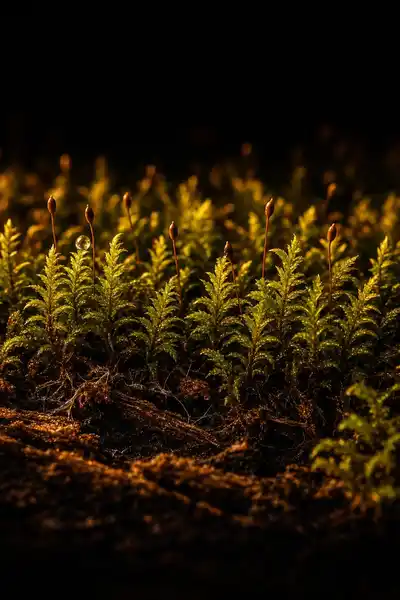
To help us in, she reaches for the tools of her own training. A hand lens — a small magnifier a botanist carries on a cord — turns a smudge of green into a forest of translucent leaves, each often a single cell thick. Under it, a moss is suddenly architecture: spiral rosettes, tiny cupped leaves, whole landscapes of texture. The point is not the equipment. The point is that reality has layers keyed to the scale at which we choose to look, and the mosses have been keeping a rich, detailed existence in a layer we walk over without a glance.

02 Chapter 2 — Small on purpose
Once we can see them, the obvious question is why mosses are so small. The answer Kimmerer gives reframes the whole thing: smallness is not a limitation mosses have failed to overcome. It is the strategy that makes their lives possible. Because they lack the internal plumbing — the vascular tissue — that carries water up a tall plant, mosses cannot grow high. But that same absence lets them do something taller plants cannot. They absorb water directly across their surfaces, over their whole bodies at once, and being small keeps every cell close to the film of moisture they depend on.
This puts mosses on the far side of a bargain most plants never get to make. A tree invests enormous resources in wood, roots, and vessels so it can stand tall and outcompete its neighbors for light. A moss opts out entirely. It stays low, hugs the surface, and colonizes the places a tree could never use — the bare face of a boulder, the thin skin of soil on a rock ledge, the vertical bark of a trunk. Kimmerer describes this as living in the boundary layer, the still, thin cushion of air that clings to any surface, where the microclimate is calmer and moister than the turbulent world just above.
03 Chapter 3 — Living at the edge of water
If there is a single fact that organizes a moss's life, it is water. Mosses are, in Kimmerer's telling, plants that have made peace with drying out. A more complex plant that lost most of its water would die. A moss simply stops. When the film of moisture it lives in evaporates, the moss shrivels, goes dormant, and waits — sometimes for weeks, sometimes for years — until the next rain brings it back. Within minutes of a raindrop, a crisp brown mat can swell and green up and resume living as if no time had passed. This trick, called desiccation tolerance, is the quiet superpower at the center of the book.
It shapes everything about how they reproduce, too. Mosses do not flower. They release spores, and much of the reproductive cycle depends on a swimming sperm that literally needs a film of water to travel across. So the whole enterprise is timed to moisture: the plants live and reproduce in the brief windows when the world is wet, and endure the rest. Kimmerer walks us through the specific choreography of particular species — how one exploits the splash of a raindrop to fling its spores, how another depends on tiny invertebrates crawling through the wet mat. The intimacy of her attention is the point; each species has solved the water problem its own way.
04 Chapter 4 — What the moss gatherers took
The book's title turns dark in one of its later essays, where Kimmerer describes the commercial harvesting of moss — great quantities of it stripped from forest floors and sold, largely to the horticultural and floral trades, to line hanging baskets and decorate gardens. She recounts being consulted about whether such harvesting could be done sustainably, and following the question honestly to an uncomfortable answer. Mosses grow so slowly, and rebuild their communities so gradually, that a cleared patch may take decades to return, if it returns at all. What is scooped up in an afternoon represents a settlement built over a human lifetime.
This is where the quiet life of mosses becomes a mirror for something larger about how we take from the living world. The commercial gatherer sees an undifferentiated green commodity, interchangeable and endlessly replaceable, priced by the bag. Kimmerer sees a specific community of specific species, each occupying its niche, bound to its neighbors and its place. The gulf between those two ways of seeing is exactly the gulf the whole book has been trying to close. Extraction depends on not knowing the thing you take; it needs the moss to stay anonymous.
05 Conclusion
We end more or less where we began, with a woman lying on the ground with a hand lens, looking at something almost everyone else steps over. The mosses have not changed across the course of the book; our capacity to see them has. What started as green fuzz on a log has become an ancient, intricate, water-timed civilization living in the thin boundary layer just below our notice — small not by failure but by design, patient not by resignation but by strategy.
Related books