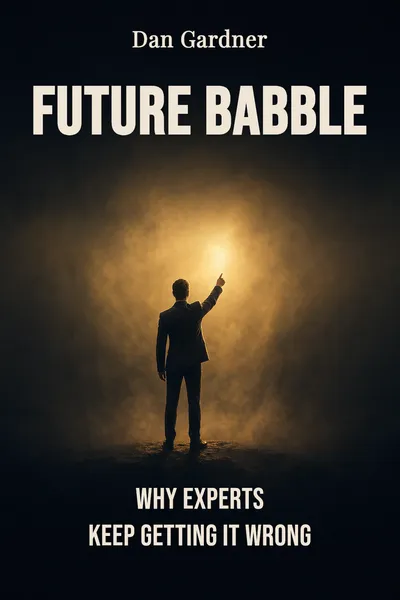
Future Babble
Why experts keep getting it wrong
Description
In the spring and summer of 2008, the price of a barrel of oil climbed past $140, and the people paid to know things stepped forward to say what came next. Goldman Sachs analysts floated the possibility of $200 oil. Serious commentators talked about a new permanent era of scarcity, about $7 gasoline, about a world reorganizing itself around the end of cheap energy. The forecasts were specific, they were confident, and they were everywhere. By the end of the year, oil was trading around $30 a barrel. The era of permanent scarcity had lasted a few months.
This is the puzzle the journalist Dan Gardner sets out to examine in Future Babble, published in 2010. The oil story is not an outlier — it is the rule. In 1967, a panel of distinguished thinkers projected that by the year 2000 the Soviet Union would have one of the fastest-growing economies on earth. In 2000, there was no Soviet Union. In 1911, a widely read book argued that economic interdependence had made a major European war essentially impossible. Three years later the continent went up in flames. The forecasts fail, and they fail spectacularly, and then we forget about them and ask the same kind of people what happens next.
Gardner builds his case on the work of the psychologist Philip Tetlock, who spent two decades tracking the predictions of hundreds of experts and discovered something uncomfortable about how little their expertise was worth. But the more interesting question is not why experts are wrong. It is why we keep coming back, notebook open, ready to write down the next number.
The question we’re asking : If expert predictions about the future are so reliably wrong, why do we keep demanding them — and believing them?What we’ll see : How a celebrated study weighed the experts, what separated the few who did better, and the hunger inside us that no failed forecast seems to cure.
Table of contents
01 Chapter 1 — The forecasts that aged badly
Gardner opens by assembling a kind of museum of confident wrongness, and the exhibits are hard to argue with. In 1968, the biologist Paul Ehrlich published The Population Bomb, which opened by declaring that the battle to feed humanity was over and that hundreds of millions would starve in the 1970s. The famines did not come on anything like that scale; the green revolution arrived instead, and global food production outran population growth for decades. Ehrlich did not lose his standing. He kept predicting catastrophe, and audiences kept listening.
The pattern repeats across every field where people are paid to see ahead. Economists at the most respected institutions did not see the 2008 financial crisis coming, even months before it broke. Sovietologists who had spent their careers studying the USSR were caught flat-footed by its collapse in 1991 — many were still debating the durability of the Soviet system as it dissolved around them. The intelligence agencies that should have been best placed to forecast such things had no warning to give. The future kept arriving in a shape nobody had drawn.

02 Chapter 2 — The hedgehog and the fox
The intellectual spine of Future Babble is the long-running study run by Philip Tetlock, then at the University of California, Berkeley. Starting in the 1980s, Tetlock recruited nearly three hundred experts — political scientists, economists, government advisers, journalists — and asked them to make specific, checkable predictions about the future: would a regime fall, would a currency hold, would a conflict break out. Over roughly twenty years he gathered tens of thousands of forecasts and then did the thing nobody usually does. He went back and scored them against what actually happened.
The headline result is the one that gives Gardner his most-quoted line. On average, the experts performed about as well as random guessing — Tetlock's famous comparison was to a dart-throwing chimpanzee. Worse, the more famous an expert was, the more in demand by television and newspapers, the less accurate the forecasts tended to be. The very confidence that made someone a good guest made them a bad predictor.
03 Chapter 3 — Why a confident wrong voice beats a cautious right one
This is where Gardner turns from the experts to us, because the failure is not only theirs. We select for confidence. Studies of how people respond to advisers show that we trust the source who sounds certain over the one who attaches probabilities and caveats, even when the cautious one is better calibrated. A forecaster who says a recession is ninety percent likely and is wrong pays almost no reputational price; a forecaster who says it is sixty percent likely sounds wishy-washy and gets booked less often. The market rewards the wrong trait.
Underneath this lies a set of mental habits Gardner walks through with the help of the cognitive research, much of it tracing back to Daniel Kahneman and Amos Tversky. We crave coherent stories, so a forecaster who weaves the facts into a clean narrative feels more trustworthy than one who admits the facts point in several directions. We fall for hindsight bias: once an event has happened, it feels as though it was always obvious, which lets failed predictors say they nearly had it and lets us believe the next event will be foreseeable too.
04 Chapter 4 — The seduction of certainty
Step back from the parade of failed forecasts and a deeper appetite comes into view, which is really Gardner's central subject. The reason we keep buying predictions is not that we are gullible about any particular pundit. It is that uncertainty about the future is genuinely hard for human beings to tolerate. The brain treats not-knowing as a kind of threat, and a confident forecast — even a wrong one — relieves the discomfort. We are not buying accuracy. We are buying the feeling that tomorrow is knowable.
This is why no amount of debunking quite breaks the spell. You can lay out Tetlock's scoreboard, you can show that the famous experts did worse than chance, and the same audience will still tune in next week to hear what the famous experts think. The hunger is older than any single prediction industry. People once read entrails and consulted oracles for the same reason they now read market outlooks and election models: the future is the one thing we cannot see, and not seeing it is unbearable, so we pay people to pretend.
05 Conclusion
The oil traders of 2008 were not stupid, and neither were the panelists who promised a thriving Soviet Union in 2000 or the author who pronounced European war impossible in 1911. They were doing what we asked of them: turning an unknowable future into a number we could write down. The forecasts collapsed because the world is the kind of place where a single accident can scatter the most careful model, and because the people best at sounding certain are rarely the people most worth believing.
Related books