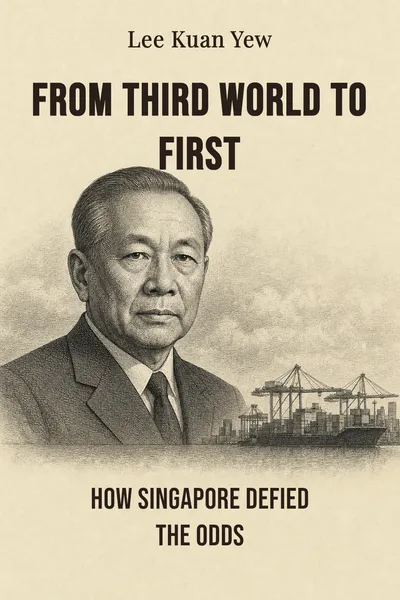
From Third World to First
How Singapore defied the odds
Description
On August 9, 1965, Lee Kuan Yew went on television and cried. Singapore had just been expelled from the Federation of Malaysia after two years of union, and the man who had spent his political life arguing for merger now had to announce that his island was on its own. It was a city of roughly two million people on a dot of land with no natural resources, no hinterland, no army worth the name, and not even its own reliable water supply — most of it piped in from Malaysia. The neighbors were larger, wealthier in land, and not especially friendly. The received wisdom of the day was that a country this small and this exposed could not make it.
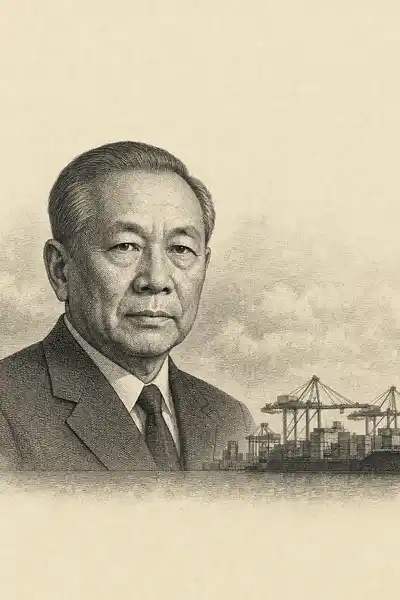
Three decades later the arithmetic had inverted. The former British trading post ran what was routinely rated the world's best airport and one of its best airlines, the busiest container port on the planet, and a per-capita income that had climbed into the ranks of the richest nations on earth. A place that started poorer than much of the developing world ended up richer than the colonial power that once governed it. Lee told this story himself in the second volume of his memoirs, whose title borrowed the trajectory outright: from third world to first.
It is a memoir, which means it is also an argument — the founder explaining, in his own terms and on his own terms, why the improbable thing happened. The account is unsentimental to the point of coldness, full of hard choices defended without apology, and it makes claims about governance, discipline and human nature that many readers find bracing and others find chilling. Reading it is less like hearing a triumphant fable than sitting across from a man who insists the results speak for the methods.
The question we’re asking : How did a resource-poor island widely written off in 1965 become one of the wealthiest, best-run places on earth — and what did that transformation cost?What we’ll see : Lee Kuan Yew's own account of building Singapore, from the first survival decisions to the machinery of a state governed like an enterprise, and what such a state finally is.
Table of contents
01Chapter 1 — A country nobody expected to survive
Lee begins with the fear, not the triumph. Independence in 1965 was not a prize Singapore sought but a divorce it was handed. The island had no army to speak of, and its two infantry battalions were partly officered by Malaysians. Its water came across the causeway from Johor, which meant a hostile neighbor could turn off the tap. Unemployment ran high, the port depended on regional trade that could be diverted, and the population was a mix of Chinese, Malay and Indian communities that had already produced deadly race riots in 1964. On paper, the ingredients for a failed state were all present.
The survival strategy Lee describes had two immediate legs. The first was security: he moved quickly to build a defense force from almost nothing, quietly bringing in Israeli advisers because they had experience turning a small population into a credible military, while telling the public they were Mexican instructors to avoid provoking Muslim neighbors. The second was recognition — getting Singapore into the United Nations and the wider world fast, so that the island's independence became a fact others had to respect rather than a temporary accident.

02Chapter 2 — The order before the growth
Before the investment could come, Lee argues, the island had to become the kind of place investors and citizens could trust — and that meant order, cleanliness and honesty enforced with unusual intensity. He is unembarrassed about this. A great deal of the memoir is devoted to matters that sound almost trivial until you see the logic: keeping streets clean, planting trees along every road, ensuring taps produced drinkable water and toilets flushed. Singapore's famous greening campaign was not decoration. It was a signal, aimed at every visiting executive, that this was a competent, first-world environment on a patch of the developing world.
Corruption received the same treatment. Lee describes it as the single force most capable of rotting a small state, and the campaign against it was deliberately harsh and, crucially, applied upward as well as downward. Ministers and senior officials were investigated; one cabinet colleague, confronted with graft charges, took his own life. The anti-corruption bureau was given wide powers and a direct line to the prime minister. The message was that the rules bound everyone, and that a clean government was not a luxury but the island's chief competitive advantage.
03Chapter 3 — Governing a nation like a company
Once security and order were established, the memoir turns to the machinery of growth, and here Lee's guiding metaphor is unmistakable: he governed Singapore as one might run a demanding, high-performance enterprise. The Economic Development Board functioned like a corporate sales force, chasing individual multinationals, smoothing their path, and treating each factory won as an account closed. Companies like Texas Instruments and Hewlett-Packard were courted personally, and the pitch was always the same — political stability, honest officials, a trainable workforce, and a currency and legal system that would not spring surprises.
Human capital was the raw material Lee obsessed over, since the island had no other. Education was funded heavily and steered toward the skills industry needed; English was retained and pushed as the language of commerce and technology, alongside the mother tongues, precisely because it opened the world market. Housing was another deliberate instrument. Through the Housing Development Board, the government moved most of the population into public flats they were encouraged to own, reasoning that citizens with a stake in their homes and their country would defend both.
04Chapter 4 — What a founder-built state actually is
Step back from the individual policies and a single question runs underneath the whole memoir: can a country really be built this way, from the top, by a small group of people who believe they know best? Lee's answer is unabashedly yes, and the book is in large part a defense of that premise. He is openly skeptical of the idea that Western-style liberal democracy is the universal precondition for prosperity, and he argues instead that a poor, fragile society needs competent, honest, disciplined authority first — that freedom without order produces neither.
What makes Singapore's case so difficult to file away is that the results genuinely arrived. The usual assumption is that concentrated power breeds corruption, stagnation and decay; here it coincided with clean government, rising wealth and world-class institutions. Lee presents this not as an accident but as proof that the decisive variable was the quality and integrity of the people at the top — that a small elite, selected for merit and held to a rigorous standard, could outperform the messy bargaining of ordinary politics.
05Conclusion
The man who wept on television in 1965 lived to see the improbable case closed in his favor. The island that could not water itself became a country the rest of the world studied and, in many capitals, envied — its airport, its port, its clean government and its per-capita wealth cited as evidence that geography and history are not destiny. Lee Kuan Yew tells that story as the direct outcome of choices: to sell order, to court the world's capital, to treat a nation as a problem demanding relentless, unsentimental management.
Related books