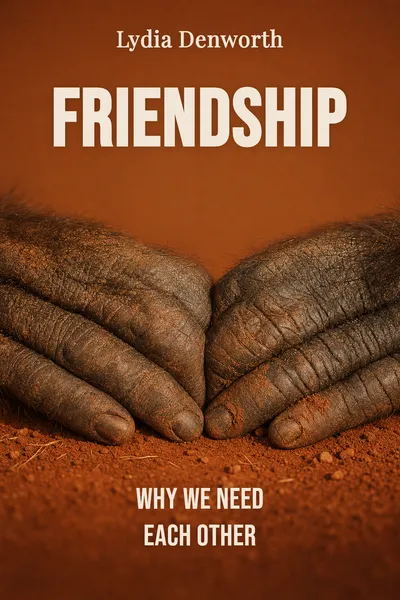
Friendship
Why we need each other
Description
When the science writer Lydia Denworth set out to understand friendship, she started with an odd problem: nobody could quite say what it was. Love had libraries written about it. Family had its own field. But friendship — the voluntary, unromantic bond between people who owe each other nothing — sat in a strange gap, treated as pleasant but peripheral, the thing you fit in around the serious business of work and family. Denworth, whose earlier work had traced the biology of hearing, suspected this was a mistake. Her 2020 book, Friendship, is the case she builds for why.
Her method was to follow the researchers who had stopped treating friendship as a topic for greeting cards and started treating it as a measurable biological phenomenon. She sat with primatologists on the plains of Kenya, with neuroscientists watching dopamine light up in monkey brains, with epidemiologists tracking who lives longer and why. What emerged was not a self-help thesis about being a better friend. It was something closer to a natural history — an account of a bond that shows up in baboons and dolphins and macaques, that leaves fingerprints on the immune system, and that evolution seems to have built into social animals for reasons that have nothing to do with sentiment.
The through-line is that friendship is not the soft edge of a serious life. It is closer to a vital sign. And the reason we so rarely see it that way, Denworth argues, has less to do with the evidence than with a habit of mind — a lingering sense that anything this enjoyable can't also be essential.
The question we’re asking : Why does something as informal as friendship turn out to be wired into our biology, and what happens to us when we have it or lose it?What we’ll see : How a bond long dismissed as trivial became a subject of hard science, and what animals, bodies, and evolution reveal about why we need each other.
Table of contents
01 Chapter 1 — A hunch a science had to catch up to
Denworth begins with an admission that shapes the whole book: for most of the twentieth century, friendship was scientifically homeless. Psychology had attachment theory, but that grew from the study of infants and mothers. Sociology counted networks without much curiosity about the feeling inside them. Friendship, being unowed and unofficial, kept slipping through the cracks — too casual to seem urgent, too universal to seem interesting. Researchers who took it up early on often felt they had to justify why a grown scientist would spend a career on something so apparently lightweight.
Part of the trouble was definitional. What actually counts as a friend? Denworth lands on a working definition drawn from the researchers she trails, and it is refreshingly unsentimental. A friendship, in this account, has three markers: it is stable over time, it is positive — the interactions leave you feeling good rather than depleted — and it is cooperative, a two-way street where both parties look out for each other. Strip away the romance and the poetry, and you are left with something that can be observed, coded, and compared across species.

02 Chapter 2 — What the baboons of Amboseli revealed
To show friendship at work below the human line, Denworth travels to Kenya's Amboseli basin, where one of the longest-running studies of wild primates has followed baboons for decades. Baboons are not obvious romantics. They live in large, competitive troops full of aggression and rank. Yet the researchers there — building on work by Jeanne Altmann, Susan Alberts, Joan Silk and others — noticed that some females spent far more time grooming and sitting with particular companions than troop life required. These were not fleeting alliances. They looked, in every measurable way, like friendships.
The finding that made the field sit up was what those bonds predicted. Female baboons with stronger, more stable social ties lived longer and raised more surviving offspring than the loners of the same rank. Being socially connected was not a pleasant extra on top of survival; it was tangled up with survival itself. Denworth is careful with the word cause here — the studies show robust association — but the pattern held across years and across measures, which is exactly what a real biological effect looks like.
03 Chapter 3 — The body keeps the tally
From the plains, Denworth moves indoors, to the laboratories and long-term human studies that measure what social connection does to the body. The headline number is one she treats with care, because it is easy to inflate. A landmark analysis by the researcher Julianne Holt-Lunstad, pooling data from many studies, found that people with stronger social relationships had markedly better odds of surviving over a given follow-up period — an effect she placed in the same league as quitting smoking, and larger than the risk from obesity or inactivity. Denworth reports it as association, sturdy but not a promise, and that restraint is part of why the finding lands.
The next question is how. Loneliness, it turns out, is not just a mood; it registers physiologically. Chronic isolation is linked to elevated stress hormones, higher inflammation, worse sleep, and altered immune function — a low-grade wear on the system that accumulates over years. The neuroscientist John Cacioppo, whose work Denworth draws on heavily, argued that loneliness evolved as a kind of hunger signal, an unpleasant prod pushing a social animal back toward the group, the way thirst pushes it toward water. The pain of being friendless is not a malfunction. It is a warning light doing its job.
04 Chapter 4 — Not a luxury, an evolved need
Step back from the baboons and the biomarkers and Denworth's real target comes into focus: not a gap in the science, but a mistake in how we categorize friendship in the first place. We file it under leisure — the thing that competes with the gym, the deadline, the family calendar, and usually loses. It is what we mean to get to once the important things are handled. The accumulated evidence she gathers quietly dismantles that filing system. Friendship is not the reward for a well-managed life; it is one of the conditions of a healthy one.
The reframe matters because our categories drive our choices. A society that treats connection as optional will build lives, cities, and work schedules that make it easy to skip — and then be puzzled by rising loneliness, as if it were a personal failing rather than a predictable result. Denworth's synthesis suggests we should think about social connection the way we learned, over the last century, to think about diet and exercise: as a domain with real biological stakes, worth deliberate attention rather than left to whatever time is left over.
05 Conclusion
Denworth's investigation closes where it started, with a bond that hides in plain sight. Having followed it from a Kenyan basin to the inside of the immune system, she has turned the thing we treat as trivial into something with the weight of a vital sign. The baboons on the plains, the survival curves in the epidemiology, the oxytocin in the blood — they converge on a single unfashionable claim: friendship is not what we do instead of living well. It is part of the mechanism of living well at all.
Related books