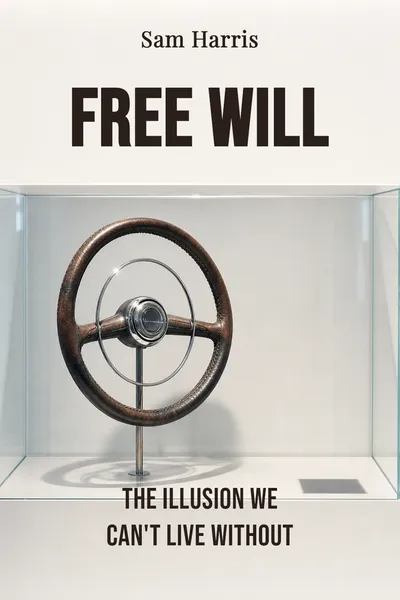
Free Will
The illusion we can't live without
Description
In his 2012 book Free Will — a slim thing, barely a hundred pages — the neuroscientist Sam Harris opens with a crime he'd rather not describe and then describes anyway. Two men break into a Connecticut home in 2007, terrorize a family through the night, and leave a mother and two daughters dead. Harris admits that if he could feel what those men felt, inhabit their exact brains with their exact histories, he might have done exactly what they did. Not because he excuses it. Because he can't locate the place where a person becomes the free, uncaused author of what they do.
That's the wager of the book. Harris thinks free will isn't just unproven — it's incoherent, a story that dissolves the moment we look closely at where our own thoughts come from. And he thinks almost nothing we care about was built to survive that news. Our courts, our sense of virtue, our pride in what we've made of ourselves, the grudges we hold and the credit we claim — all of it leans on the quiet assumption that we could have done otherwise.
What makes the argument land isn't the neuroscience alone. It's that Harris keeps insisting the illusion isn't only false but, in a strange way, removable — and that removing it feels less like losing something than setting it down. Whether that's true, and what's left standing once it's gone, is where the book actually lives.
The question we’re asking : If free will turns out to be an illusion, does everything we build on it — blame, pride, punishment, love — collapse with it, or survive in a changed form?What we’ll see : A short, unsettling case that the self we think authors our choices was never in the room, and what follows once we notice.
Table of contents
01 Chapter 1 — The thought that arrives on its own
Harris asks us to try something before he argues anything. Pick a city. Any city. Whatever name surfaced — Paris, Denver, Tokyo — notice that you didn't author it. It appeared. You could not have chosen the cities that never crossed your mind, because you didn't know they were candidates. And you didn't decide which of the available options would rise to the surface, because deciding would require a prior thought, which would itself have to arrive from somewhere. Follow that chain back and it never bottoms out in a free chooser. It bottoms out in causes you didn't set in motion.
This is the intuition the book keeps returning to: thoughts and intentions simply emerge in consciousness. We don't watch them being manufactured. We meet them already formed, then experience the feeling of having produced them. Harris calls this feeling exactly that — a feeling — and argues it's the whole substance of what people mean by free will. Not a power, but a sensation of authorship layered over processes we neither see nor steer.

02 Chapter 2 — What the brain does before we decide
The introspective argument would be easy to shrug off if the lab didn't back it. Harris leans on a line of experiments running back to the physiologist Benjamin Libet in the 1980s. Libet had volunteers flick a wrist whenever they liked, and watched their brain activity while asking them to note the instant they consciously decided to move. The build-up of neural activity — the readiness potential — began measurably before the reported moment of choosing. The decision seemed to be underway before the person felt they'd made it.
Libet's work was contested for decades, and Harris knows it. But he points to more recent studies that sharpen the picture. Using fMRI, researchers found patterns of brain activity that predicted a simple choice — which of two buttons a subject would press — several seconds before the subject was aware of having decided. Not milliseconds. Seconds. Long enough that an observer with a scanner could, in principle, know your choice before you did.
03 Chapter 3 — The trouble with taking credit and assigning blame
This is where the book stops being a curiosity and starts to bite. If no one is the ultimate author of their character, what happens to blame? Harris presses on the intuition through the criminal cases he opened with. We recoil from a killer — rightly, he thinks — but he asks us to notice how our judgment shifts with the causes. Learn that the man had a tumor pressing on his brain, and the sense of pure evil softens into something closer to misfortune. Learn it was a childhood of abuse, or a genetic load he was born under, and the recoil bends the same way.
Harris's move is to point out that a bad childhood, a set of genes, and a tumor are all, at bottom, the same kind of thing — prior causes the person didn't pick. We treat the tumor as exculpatory because we can see it. The rest is just harder to image. Push the logic through and the deep, retributive kind of blame — the belief that a person truly deserves to suffer for being the free source of a wicked choice — loses its footing. There's no free source to punish.
04 Chapter 4 — Living without the author in the driver's seat
Step back and the wager Harris is making comes into view: dropping free will isn't a descent into nihilism, it's a recalibration of feelings we thought were bedrock. He argues the belief touches nearly everything humans value — law and politics, religion and public policy, the intimacies of love and the sting of remorse — precisely because all of it quietly assumes each person is the true origin of their thoughts and acts. Pull that assumption and the structures don't vanish; they get rebuilt on sturdier ground.
In justice, this looks like a shift from vengeance to public health. A legal system that stopped believing in ultimate desert would still restrain the dangerous and still ask people to answer for harm, but it would treat crime more like a problem to be reduced than a debt to be paid in suffering. Harris thinks this is not softer but clearer — the same firmness, minus the cruelty we permit ourselves when we're sure the guilty deserve it.
05 Conclusion
The book ends near where it began, back at the unbearable image of a family destroyed by two men Harris cannot bring himself to fully hate — not because he softens the horror, but because he can't find the free agent behind it to hate. That's the strange country the argument leads to: a place where the most monstrous act and the most generous one are both the last links in chains that stretch back before anyone was born. Harris walks us there in fewer than a hundred pages and refuses to let us treat it as an abstraction.
Related books