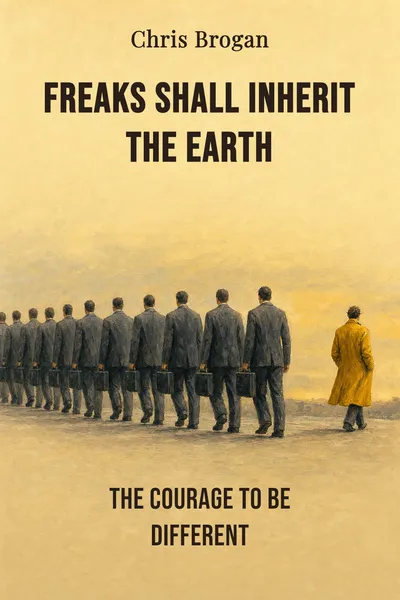
Freaks Shall Inherit the Earth
The courage to be different
Description
Chris Brogan spent years feeling like the kid picked last. Not literally last, maybe, but close enough that the feeling stuck. He was the one who didn't quite read the room right, who said the awkward thing, who never found the comfortable spot inside a normal job description. For a long time he treated that as a defect — something to file down, hide, apologize for. Then, somewhere along the way, he started building a working life out of marketing, writing and speaking, and noticed the people he admired most weren't the ones who'd blended in. They were the ones who'd leaned hard into whatever made them odd. In 2014 he put that observation into a book with a deliberately uncomfortable title: Freaks Shall Inherit the Earth.
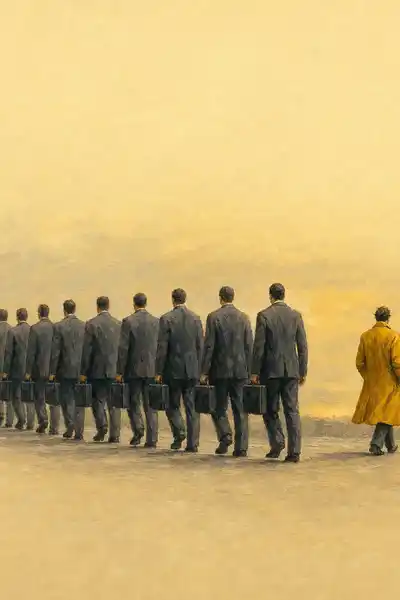
The word "freak" is doing real work there. Brogan isn't using it as an insult to reclaim, and he isn't being cute. He means anyone who doesn't fit the slot the world keeps trying to slide them into — the entrepreneur, the artist, the side-hustler, the person who lies awake convinced they were built for something other than the cubicle and the steady paycheck. His pitch is blunt: that feeling of not fitting isn't a flaw to manage. It might be the most commercially and personally valuable thing about you, if you stop running from it.
What makes the book more than a pep talk is that Brogan keeps yanking it back to the practical. The fear is real, he admits — the anxiety, the late-night maybe-I-should-just-play-it-safe. But he keeps asking what "safe" even means now that the factory job and the corner office have stopped guaranteeing anything. Once you sit with that question, the whole risk calculation flips, and the cautious choice starts looking a lot less cautious than it used to.
The question we’re asking : If not fitting in is supposed to be a weakness, why do the people who own their oddness so often end up winning — and what is actually stopping the rest of us from joining them?What we’ll see : How a self-described misfit turned the courage to be different into a working philosophy, and why the safe option may be the riskiest one left.
Table of contents
01 Chapter 1 — The misfit who built a business out of being one
Brogan tells his own story without much polish, which is part of the point. He grew up feeling out of step, carried that into a string of jobs, and watched himself underperform in roles that demanded he be a smoother, more conventional version of himself. The standard advice — round off the edges, fit the culture, wait your turn — never took. What changed wasn't that he fixed himself. It was that he stopped trying to, and started looking for work where the edges were the asset.
By the time he wrote the book, Brogan had built a reputation in the messy early world of social media and digital marketing, a field that barely existed a decade earlier and rewarded exactly the people who'd never thrived in a tidy org chart. He'd co-written a bestseller, run his own company, and spent enough time around founders and creators to notice a pattern. The ones who succeeded weren't the most polished or the best credentialed. They were the ones who'd identified the specific weird thing they did better than anyone, and built around it instead of apologizing for it.

02 Chapter 2 — Owning the thing that doesn't fit
The hinge of the whole book is ownership. It's one thing to admit you're different; it's another to build your livelihood on it, on purpose, in public. Brogan spends a lot of energy on the gap between those two states, because that gap is where most people get stuck. They sense the thing that makes them unusual, then immediately bury it under a more marketable, more normal-sounding version of themselves — and wonder why the more normal version never quite lands.
His argument is that the market doesn't reward the average. It rewards the specific. A generalist who does ten things competently is forgettable; the person known for the one strange thing they do better than anyone has something nobody can copy. Brogan pushes readers to find what he frames as their particular advantage — the obsession, the odd skill, the unfashionable interest — and to treat it not as a hobby but as the foundation. The discomfort of standing out, in his telling, is the price of being chosen at all.
03 Chapter 3 — The map nobody hands you
Having made the case for owning your difference, Brogan turns to the obvious problem: there's no instruction sheet. Misfits, almost by definition, don't get to follow the well-marked path, because the well-marked path is what they're misfitting against. So a good chunk of the book is him trying to hand over a rough map — not a guarantee, just a set of bearings for people walking off the marked trail.
Much of it comes down to relationships and trust. Brogan, who'd spent years in marketing, keeps insisting that the freak's real currency isn't reach or follower counts but the depth of connection with a relatively small group of people who genuinely want what they offer. He calls these the people who'll show up — the ones who buy, who refer, who stick around. The instinct to chase everyone is, in his view, the enemy of building anything solid. Better to matter enormously to a few than vaguely to a crowd.
04 Chapter 4 — When everyone gets to be a little weird
Step back from Brogan's pep and a larger shift comes into view — the one his book is really riding on. When he wrote in 2014, the ground under the word "career" had been moving for years. The implicit deal of the twentieth century, where you handed an employer your loyalty and your individuality and got stability in return, had quietly stopped paying out. Pensions thinned, tenure shortened, whole job categories disappeared. The cubicle wasn't a fortress anymore; it was just a slower kind of exposure. Brogan's freak gospel lands so well partly because it's describing a world that had already changed, even if most people hadn't updated their fears to match.
What the book captures, without quite naming it, is the collapse of the safe-versus-risky binary that an earlier generation took for granted. Their parents could reasonably trade conformity for security. For the readers Brogan is talking to, that trade had become a bad one — you give up the difference and you still don't get the security. Once that's true, the entire moral weight of "playing it safe" evaporates. Being a freak isn't a romantic rebellion against a stable system; it's an adaptation to an unstable one.
05 Conclusion
Brogan ends roughly where he started: with the kid who got picked last, now running a business built on exactly the traits that once got him picked last. The arc isn't a fairy tale of vindication, and he resists making it one. The fear never fully left, the doubts never fully resolved. What changed was the decision to stop treating the misfit as a defect and start treating it as the raw material. Everything in the book flows from that single reframing — that the thing you've been hiding might be the thing worth charging for.
Related books